
By Emmanuel Edukugho
What is the price of Nigerians’ love for automobiles, even apart from multitude of buses used for commercial public transportation and taxi cabs in all the 36 states, FCT Abuja and 774 local government areas which make up this federation?
It could add up to several billions of naira yearly if petrol prices are included in wasted time and fuel. Most drivers would add an emotional cost in frayed nerves due to frequent traffic jams and hold-ups that may take four hours and above for a journey of 30 minutes.
Most people affected have no choice as towns sprawl into cities and then into suburbs. According to investigation, most goods and travelling people are transported across the country by road.
As of today, about 10 million vehicles are moving on Nigerian roads. Less than 40,000 kilometres of federal roads constructed over a period spanning three decades, for vehicular transportation, there had been no significant, modern autoways to meet demands of national development and transformation as the new millennium beckoned.

Paucity of funds had been the bane of road development and modernisation in the country even as acknowledged by Architect Mike Onolemenmen, Minister of Works who had often reiterated that government alone can not provide the needed fund. Hence the public private sector partnership was being considered ideal investment strategy after which completed road projects can be concessioned and tolls collected from motorists until the funds are recovered. It was estimated that the country has a total road network of 200,000 kilometres shared by federal, state and local governments while a major chunk of this road network purportedly belong to the federal government saddled with the responsibility for its development.
Presently, there is confusion over who owns what as some state governments often passed the cost of reconstruction and rehabilitation of several of these roads to the federal government for settlement, claiming they are “federal roads”.
However, it was reported recently by Vanguard Newspaper, that contractors awarded major highways and bridges jobs in the country are being owed N500 billion as at 2013 by the federal government which claimed amount owed the contractors was only N30 billion.
In the current year, Governor Babatunde Fashola of Lagos State claimed that 70 new roads had been approved and awarded for construction and rehabilitation, bringing to 230, the number of awarded road contracts since his re-election for second term in 2011.
His target in the second term is to complete about 450 roads, pointing out that roads that carry the most traffic will be handled first.
There is the ongoing reconstruction of Lagos-Badagry Express Carriageway to have 10 lanes and Rail Mass Transit system awarded to CCECC, a Chinese Construction and Engineering Corporation. This is a multi-billion naira contract believed to be financed by the Lagos State Government with World Bank assistance which is of great socio-economic importance not only to Nigeria but to the West African sub-region at large. When completed in few years time, the road and rail complex would be a major artery that connects Lagos with the Economic Community of West African States, ECOWAS, particularly Benin Republic, Togo, Ghana, Sierra Leone, The Gambia, Liberia, Guinea, Ivory Coast, etc.
To make way for this project, several houses, buildings, parks, petrol stations shops, business premises have been demolished even including schools.
The existing dual carriageway built several years ago by the military regime has become grossly inadequate, and been pulled down for reconstruction.
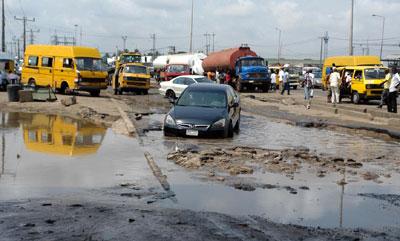
The massive traffic jam and chaos created can better be imagined than experienced as most sufferers have no choice but to remain in hold-ups for several hours trapped between Mile 2 and Okokomaiko. The slow pace of work, poor equipment, impoverished Chinese technical personnel and unfavourable weather conditions with rains falling seemed to be worsening the situation.
No alternative route for vehicular movement of goods and passengers travelling from Mile 2 to Agbara and then to Badagry throguh several towns and villages along including Otto-Awori, Ijanikin, Mowo, Oko-Afo, Ajara to Seme, the border town between Nigeria and Republic of Benin. Work has not progressed beyond the Mile 2 axis with two magnificent terminals with the rail line from Ijora/Orile already reaching there.
Mr. Eddie Ayobami is a computer technologist who lives in Ijanikin and works in Apapa talked with Saturday Vanguard on his harrowing experience daily on the road.
“I leave my house 4.30 am trying to beat traffic but most times to no avail. The road is horrible with several pot holes and deep gullies. Almost all the asphalt on the road has become bare. It could take 3 hours to reach Volks and Barracks before getting to Trade Fair Complex where traffic may be free. It’s like animal jungle.
“On bad days, I will reach Apapa at 11a.m or even 12 mid-day. The same also while returning. I may get to Ijanikin 11 pm. In some cases passengers will be compelled to come down from their buses and trek down to Iyana-Iba enroute home,” he lamented. Car owners often abandon their vehicles and trek to their destination.
An education officer, in one of the ministries, recalled that part of the Command school building was demolished by the Lagos State Government for construction of the road. But at the end, the road did not affect the school, although part of it had been pulled down. The government promised to rebuild it but work is yet to be completed as the government and Army are trading blames.
Commuters have become frustrated, disillusioned and disappointed by the pain, anguish and trauma experienced on the Lagos-Badagry highway caused by the reconstruction work, extensive, hampered by the difficult terrain – swampy and disjointed.
At the last inspection of the project by Governor Fashola, he said his administration is determined to complete the rail aspect, saying progress had made in the tracking.
Disclaimer
Comments expressed here do not reflect the opinions of Vanguard newspapers or any employee thereof.