
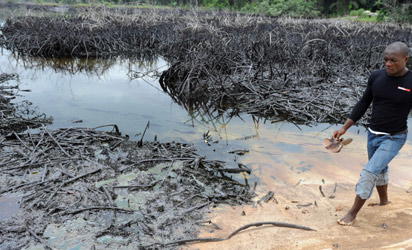
OIl spill
By Felix Ayanruoh
Part one of this article reviewed issues of environmental degradation of the Niger Delta region of Nigeria, and attempts by the PIB to correct some of these problems.
The quest for whether the proposed law will effectively address the issues of abandonment, decommissioning and disposal, is by analyzing the current legal regime vis-à-vis the PIB. Currently the legal regime for offshore decommissioning and abandonment is covered by motley assortment of inadequate and almost labyrinthine body of legislations, dating back to the Petroleum Act of 1969.
The Petroleum (Drilling and Production) Regulations, 1969 (PDPR); Harmful Waste (Special Criminal Provisions, etc.) Act (HWSCP) 1988; up to and including environmental regulations and enforcement laws such as the National Environmental Standards and Regulations Enforcement Agency (Establishment) Act (NESREA) 2007 and the National Oil Spill Detection and Response Agency (Establishment) Act, (NOSDRA) 2006.
These laws include both primary petroleum and non-petroleum legislations, with little or no provisions on the removal or dumping of disused offshore installations. For example, the PDPR provides some general provisions on abandonment which states conditions precedent to the grant of permit for exploration and production.
They include the following:
(i) no borehole or well can be plugged or abandoned without the written consent of the Director of Petroleum Resources (DPR);
(ii) (ii) any borehole or well that the licensee or lessee intends to abandon must be securely plugged to prevent ingress and egress of water in accordance with an abandonment program approved by the DPR. This law did not go far enough to meet international standard on abandonment and particularly disposal.
The PIB in an attempt to address the myriad of problems associated with abandonment, decommissioning and disposal of oil and gas infrastructures provides for a robust regulation. Section 204 of the bill, unlike previous laws provide for effective disposal rules of both on and offshore structures, including wells, installations, structures, utilities and pipelines, pursuant to international standards.
The bill states that offshore structures are to be removed under International Maritime Guidelines (IMG) and that decommissioning or abandonment cannot take place without the permission of the Inspectorate – the agency mandated by the PIB to oversee this issue as stated above. Under this provision the operator must produce a comprehensive plan for all decommissioning and abandonment proposed so as to establish its compliance with good oil field practice. However, the Inspectorate must acknowledge that the stated plan must include the following:
(a) Cost estimate
(b) Minutiae of the measures proposed
(c) Comprehensive descriptions of the methods to be used
(d) Procedures taken to ensure that the process is safe, healthy and environmentally acceptable.
The PIB also mandates the Inspectorate to ensure that a list of all petroleum installations, structures and pipelines, both on and off shore be available or accessible to the public, with an account of their current status. The Inspectorate shall also ensure that a lessee sets up and manages an abandonment fund and make it available to the Inspectorate in case the lessee fails to carry out its obligations. This section is reinforced by Section 205, which mandates the Minister on the advice of the Inspectorate to issue regulations on abandonment and decommissioning to which the oil industry is to be bound.
On the issue of pipeline transportation, which has become a big problem in the industry, Sections 231 & 232 provides a clear framework dealing with the duties of a transport pipeline owner in the course of its business. The bill requires that an owner conduct operations with utmost regard to the environment and must comply with requirements for environmental protection, management and restoration under the PIB and any applicable law. The PIB went on to state that pipeline owners must shut down as soon as they realize that a spill has occurred.
To be concluded.
Disclaimer
Comments expressed here do not reflect the opinions of Vanguard newspapers or any employee thereof.