
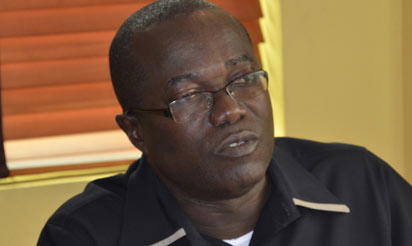
*Mr. Nick Oparandudu
By Mike Ebonugwo
Mr Nick Oparandudu, the Commissioner for Works and Transport in the recently dissolved cabinet of Imo State, comes across as a highly cerebral and articulate individual who is not afraid to speak his mind on any subject of personal interest or concern, especially that bordering on developments in his state under the watch of Governor Rochas Okorocha. The former banker- turned-politician was in his element in this regard during an encounter in Lagos.
Oparandudu did not hide the fact that he was disturbed by what he perceives as lack of appreciation in some quarters of the on-going revolution to bring development to all parts of Imo State. The situation, he said, has largely been sustained by the fact that the press, especially the print media, has under-reported the many development strides in the state, arguing that the state government had done quite a lot to deserve more than passing commendation in the media.
Strongly enamoured of this conviction, he had boldly challenged all doubting Thomases to visit Imo and see things for themselves, adding that unlike what obtained in the immediate past, a visit to the state today will clearly reveal concrete development in every sector.
Speaking then as the Commissioner in charge of Works and Transportation, he proudly declared that infrastructural transformation is the new development slogan in Imo, saying that the commendable achievements recorded so far is attributable to the various interventionist initiatives conceived and faithfully implemented for that purpose. He explained why this became a major focus of the Okorocha administration from inception.

*Mr. Nick Oparandudu
According to him: “When this government came into office , we met a state that was significantly, as far as infrastructure is concerned, in a state of disrepair. A lot of the roads were left unattended to. For those of you who are conversant with the capital city, Owerri, you will find out that most of the city roads were in different stages of dilapidation”. He did not stop there.
He continued: “Also, several parts of the state, since it was created in 1976, never really had the opportunity to have modern infrastructure, particularly roads. And, as a result, we found ourselves in a situation where some parts of Owerri metropolitan areas were gradually turning into slums. I can mention some of the areas. There is the Akwakuma-Amakohia axis. This part of the town, especially the stretch of the road leading to Orlu, had never been tarred since the state was created in 1976. What you had were tracks here and there. There is also an area called Prefab bordering the Aladinma Housing Estate, most of the roads there had never been done over the past 30 years or so. Even the real Owerri capital area, most the roads there were also not done. This was even against the backdrop of the fact that Owerri has a masterplan that provided for all these areas and all these routes. Yet, nothing was done by successive governments over the past decades,” he said.
Rescue mission
Oparandudu informed that disturbed by this prevailing situation, government was prompted into embarking on a rescue mission. “What the government did was essentially to begin a process that will lead to the provision of basic motorable roads and other infrastructure in the Owerri capital area,” he said, adding that in areas like Akwakuma-Amakohia government has since provided about eight to ten kilometres of roads such that a lot of these areas have been opened up. Same applies to the Prefab area as a lot of the roads there are currently under construction.
“As a matter of fact, this government has awarded a total of 180 road contracts for various streets in Owerri. If you are also conversant with the geography of Owerri, you will find there is what I will call this imaginary divide between the New Owerri and the Old Owerri. The Old Owerri has streets like Wethdral Road, Douglas Road, Royce Road and so on. The New Owerri is where you have the Concord Hotel and other hotels that have sprang up there in recent years.
If you want to go to the New Owerri from the Old Owerri, you have to go to where we call the Port Harcourt Road or the Assumpta Cathedral…. and then head towards Owerri, whereas the distance between the New Owerri and the Old Owerri is less than 200 metres. But this part of town is divided by a River called Nworie. You find that over the years this Nworie River criss-crosses most of Owerri and divides the New Owerri from the Old Owerri… Yet nobody had thought of making any connection between them. It’s to the credit of this present government that that connection has been made. As we speak, two bridges have been constructed across Nworie such that the journey you have to do in what I consider as circuitous manner before ….you can now do across Nworie and that will not be more than 300 metres,” he informed with pride.
Source of bottleneck
“If you’re also conversant with Owerri, you find that if you coming into Owerri from Aba, you have to get into Emmanuel College. It’s from here that you now head to Douglas Road, Wethdral Road so on and so forth. And that has always been a source of bottleneck if you’re coming in from Aba. What this government did, and this was accomplished within its first 12 months in office, was to construct a bye-pass so that if you’re coming from Aba, you can cut off the Emmanuel College axis of the town and get into Wethdral Road ….This has significantly alleviated the traffic crisis in the area.
“We’re also in the process of providing the basic ring roads around Owerri. This was something that was started by the previous government, but we’re improving on this and doing so fast. That ring road will start from Onitsha road, to Orlu Road and then to Okigwe road. That road is estimated at about five kilometres and it will be completed before December”.
Floods
One of the greatest challenges we have in Owerri is the issue of floods. The erosion challenge in Owerri is as bad as what you have in Anambra and some other South East states but this has not been really brought to the attention of the public. If you go to area of Owerri called Works Layout, virtually every street that area over the years have been ravaged by erosion. The Hardel and Enic Estate owned by Chief Emmanuel Iwuanyanwu, which has well over 40 buildings, have literally been abandoned by the occupants because of flood. But as we speak today, around the Works Layout area, we have adopted a programme called Operation Rescue Works Layout. We’re constructing a seven-kilometre road with drains. And hopefully this road will be ready in the next four to six weeks.
The road infrastructure revolution is not limited to Owerri, he said. Okigwe and Orlu are also scenes of massive road construction or reconstruction. “If you go to Orlu, it has witnessed massive infrastructural transformation. Most of the streets in Orlu are today dual carriage ways. And even as we speak, the government of Owelle Rochas Okorocha is dualising the road from Orlu town to Akokwa moving toward Anambra State,” he stated.
Another of concern to government, according to Mr Oparandudu, is education. In fact, he waxed most passionately eloquent while speaking on this.
“Government is building 305 model secondary schools, out of which as we speak, we have completed 120 of them. The plan is that before the middle of next year, the final 305 schools would have been constructed. So, we are providing one of these schools in each of the 305 wards in Imo State,” he said.
Disclaimer
Comments expressed here do not reflect the opinions of Vanguard newspapers or any employee thereof.