
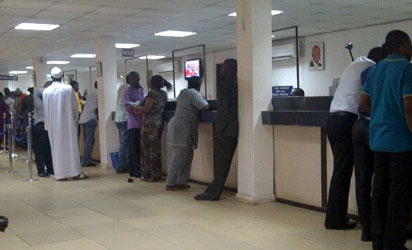
Banking hall
By Dele Sobowale
“Those who do not remember the past are condemned to repeat it”, George Santayana, 1863-1952. (VANGUARD BOOK OF QUOTATIONS p 93).
“When an old man dies, you lose a library,” according to an old adage. Having survived all odds to reach the age of 69, in a country where life expectancy is still under 52 years, it might not be too presumptuous to call myself “an old man.” Not just an old man, but one who actively attempts to document historical landmarks in the management of our national economy.
The reason is obvious and simple, I am an economist and one of the founding fathers of Economics, Alfred Marshall, 1842-1924, has enjoined us that “The economist, like anyone else, must concern himself with the ultimate aims of man.” I am primarily concerned with the ultimate aims of Nigerians within the context of economic development and aggregate social welfare.
I believe we can organise our economy better than we do at the moment and we have done for almost 30 years; and the worst area of our macro-economic policies had always been the banking sector – the sector that really should be creating wealth for most of the people but it is not. Instead, banks are once again on the verge of deepening our woes.
Nigerians with deposits in banks and their bankers are again poised to experience one of the worst traumas to which the financial sector was subjected about 24 years ago. That was when the Central Bank of Nigeria first embarked on a massive withdrawal of public funds from banks. The impact was devastating; in the end, over 20 banks went under in the first major banking crisis in Nigeria since the early 1960s – when banks like AGBONMAGBE Bank collapsed in the first ever banking disaster.
In the late 1980s to the early 1990s, when the second set of banks went down, the build up to catastrophe had been the same. Banks had left over 70 per cent of the money in circulation outside the banking sector and had allowed themselves to be seduced into chasing, securing and operating on public funds – when the public sector had more money than sense. Federal and state government officials deposit money at no interest in banks and borrow their own funds back at high interest rates.
It was scandalous when “money was no problem” for governments, that is, when revenue outstripped budget by a wide margin. It became policy insanity when revenue fell short of budget. Even a good primary school pupil can understand that when you deposit your cash without interest and borrow from the same bank at 14 per cent, you have, in effect, given away 14 per cent of your deposit. Why this simple fact became difficult for Finance Ministers, including Dr Ngozi Okonjo-Iweala, to understand remains one of the most baffling puzzles of the century in Nigeria. Why she did not put a stop to it sooner boggles the mind that wants to contemplate it.
As usual, a time comes when the interest rates payable to banks are gobbling up an increasing percentage of the funds on deposit. Then, government officials start to “do what they have left undone” because the truth was sent on holiday all along. Unfortunately, encouraging banks to avoid the difficult task of funds mobilization, for a long time, carries with it dire consequences for the banks, for the economy and for Nigerians.
Like somebody who had never had to lift a finger or rise from bed to get fed, asking him to suddenly go to the farm to harvest raw food, return home and cook it, can result in heart failure. Yet, this is what the Federal and state governments do to our banks every ten years or so. We feed them free government money; then, we force them to compete when they are least prepared and the casualties follow predictably. The graveyards of banks are waiting for the corpses of 2013-14 – as they swallowed OCEANIC etc.
The withdrawal of public funds from banks by the Central Bank in 2013 will inevitably produce the same result. Naturally, it will affect banks differently; some will withstand the pressure better than others. A few will resort to the tried-and-failed approach of issuing falsified Annual Reports and Accounts or Interim Reports in order to mislead depositors and some will even approach the capital market to raise additional capital. The ones to avoid now are those attempting to raid the market for funds. The banking sector is once again likely to experience a downturn rather than an upward surge in the short and medium terms. People should ask for advice before investing – because investors stand a good chance of losing their funds.
Perhaps, the most important question on the minds of depositors remains: “Is my bank safe”? Before attempting to answer that question let me again remind us of the lessons of our banking history. Some people might be able to answer their own questions.
Before the “sudden bank failure” during the Abacha administration, it was standard operating practice for banks to announce eye-popping profits over the last year. Among the leading banks was Alpha Merchant Bank whose Managing Director, Jimi Lawal, was the toast of the Nigerian Stock Exchange, NSE.
Those of us who pointed out that the bank was not lending to secure private sector enterprises but to shady businesses were ignored. Because Alpha was allowed by the banking authorities to get away with crimes, other banks were forced to join. Soon, banks’ Annual Reports and Accounts read more like financial fairy tales. But, the investors on the Stock Exchange still fell for the scams. Stocks appreciated in price with each announcement. But, like all parties, this too came to an end – a disastrous end for thousands of depositors. That should have taught Nigerians a lesson they would never forget. But, they failed to learn.
When, in 2004, Professor Chukwumah Soludo introduced Banking Consolidation, as monetary policy, he opened the flood-gates to another round of scams by banks. All the warnings to investors, depositors, the banks themselves and Soludo fell on deaf ears. Once again, manipulation of Annual or Semi-Annual Reports was the weapon applied by banks to fleece Nigerians of their hard-earned money.
Who can forget the mouth-watering reports issued by OCEANIC, INTERCONTINENTAL and others – before Malam Sanusi Lamido woke all of us up with a resounding slap to the face to the swindles. Banks which had declared unbelievable profits turned out to have once again falsified their reports. By the end of 2008, another banking party was over; Nigerians were staggering around with the hang-over from that banking misadventure.
Have Nigerians learnt their lessons? Certainly not; if current reports from banks serve as conclusive proof of our collective amnesia. Recently, perhaps in anticipation of the CBN funds withdrawal, banks have again started to announce jumbo profits. Nigerian banks operate with the same principle as the US circus master, P.T. Barnum, who believed that, “A sucker [fool] is born every minute” in the USA. If America needs sixty seconds to produce a dupe, Nigeria must be turning them out at a faster rate. Now, in 2013, banks are again leading investors and depositors to the slaughter house with suspect Annual Report and Accounts.
I had predicted, correctly, all the previous banking crises; there is little doubt that this will turn out to be another true forecast. Those whose fortunes are hanging on the well-being of banks are warned to seek advice before proceeding. Neither the banks nor the stockbrokers will tell people the truth because it is not in their interest to do so. People will have to think outside the box to get answers. At least one bank’s results, recently released, are too bogus to represent reality.
Disclaimer
Comments expressed here do not reflect the opinions of Vanguard newspapers or any employee thereof.