
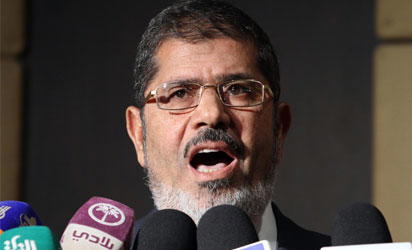
Mohamed Morsi
By Hugo Odiogor, Foreign Affairs Editor
The state of affairs in Egypt is worrisome given the fact that it is Arab’s political center and a key player in Africa’s affair. Egypt holds the balance of power in the Middle East and whatever happens in that country must go beyond its shores. In this interview, Professor Anya O. Anya provides insight into the transition process in the heartbeat of Arab politics.
Is Egypt, the power house of Arab and Middle East politics, descending into anarchy?
Yes and no. Yes in the sense that, what we have seen in the streets of Cairo and Alexandria are unexpected and unheard of given the past of Egypt. However, what we are seeing are the convergence of several forces: democratic, religious and tradition. None can wait hence the ferocity of the engagement. But it will stabilize at a new point of equilibrium which may change the long term outlook of Egypt. The supporters of deposed President Mohammed Morsi will not go in a hurry or willingly and the army may be drawn into old patterns of behaviour despite the fear of American response to the apparent defeat of democratic forces.
Do you think Morsi deserves to be ousted just after one year in office?
The run up to the elections showed deep divisions within the Egyptian society. The advantage of Muslim Brotherhood has always been its better organisation and embedding in the lower strata of Egyptian society. But it was not and is still not a majority party despite its exemplary patience and long history. Morsi did not understand the coalition of forces that brought him to power.
He could not therefore convert the electoral coalition that brought him to power into a ruling coalition. Given this fundamental lack of understanding, his ouster was inevitable and prolonging the period before his ouster could have done greater damage to Egypt’s long term prospects. Egypt is not yet a democratic society, but a society in transition. The presumption of applicable democratic norms as the Americans are wont to do is unrealistic given where the Egyptian society is coming from-the Pharaohnic past, the military pre-eminence and deep divisions occasioned by high level of poverty and unemployment amongst the youth and the
rural majority.
Do you think the way Morsi handled the military after he took office, the Sharia and Coptic Christian crisis and referendum on the constitution paved the way for the way he was ousted?
He showed neither understanding of where these forces are coming from nor did he show sufficient flexibility and inclusiveness in the handling of the affairs of state. He did not make enough effort at recruiting new allies. His vision of the future of Egyptian society did not enjoy the kind or pervasive support they presumed in his posturing.
Can democracy thrive in Arab world given the experiences in Turkey, Egypt, Iran, Iraq, etc?
The question really is: what kind of democracy. Democracy as a form of government has several variants even in western societies; so a narrow definition of democracy will regard the national experiences of these countries as precluding democracy. However, as recent events in Turkey are illustrating democratic ideals must adjust to the national environment, history and experience. These nations will overtime adjust to the reconciliation of the purist Islamist interpretation of governance and secular pressure for development and inclusiveness. But it will be a rough road given the tendency to recruit violence into the political space by extreme Islamist forces.
With hindsight of the Algerian crisis in the 1990s, do you envisage a back lash from the Muslim Brotherhood?
Yes, there will be a backlash but how long it will endure will depend on how fast the military can return the country to civilian governance and control. The military needs to build quickly a coalition of alternative forces incorporating women and the youth.
Political developments in the Maghreb and the Middle East have exerted their influence on Nigeria since 1973, is there a possible domino effect for Nigeria and sub Sahara Africa?
No, the national experiences are different. The parallelism is superficial. The real danger to Nigeria and by extension Sub-Saharan Africa is that our politicians have not learnt from our past national experiences nor are they sufficiently knowledgeable about the global forces that are impacting on our societies and are therefore, negatively reshaping the society. But this will change but time is not on our side.
Given the role of social media and youth discontent with governments in the Arab world, can our political class ignore the lessons from Egypt?
We cannot afford to ignore the lessons of events in other societies given the unrelenting economic and political forces unleashed by globalization.
How would you respond to the reaction of US and major powers to the political situation in Egypt?
There is a tendency towards simplistic responses to complex situations in the American approach to the Middle East and indeed to much of the developing world including us. The strait-jacket approach to economic and political developments not only by the US but also by the western powers is often unhelpful and usually produces unintended consequences.
The history of western societies is a variant of other histories that are part of world history as events in China continues to underline. We live in a world of dynamic forces. Hence the tendency towards linear projections of multiple forces often evident in western reading of recent history can lead to situations widely off the mark. In the modern age, history is often shaped by the minor forces rather than the major or dominant forces. a multi-factor approach to analysis and understanding of the new forces including technology reshaping the world environment is unavoidable.
Disclaimer
Comments expressed here do not reflect the opinions of Vanguard newspapers or any employee thereof.