
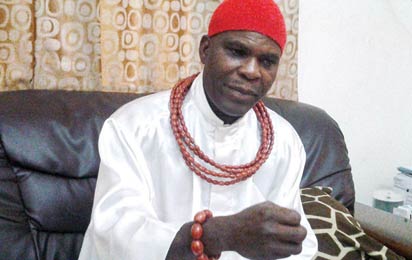
Ararile
BY GABRIEL ENOGHOLASE, BENIN
AIR VICE MARSHALL LUCKY ARARILE (rtd) is the Owie of Abraka Kingdom in Ethiope East Local Government Area of Delta State. In this interview, the former Nigeria Air Force (NAF) pilot speaks on his life as a traditional ruler, his involvement in internal and external operations including ECOWAS Monitoring Group in Sierra Leone and Liberia, among others. He also speaks on the Amnesty Programme to Niger Delta militants which he coordinated at inception. Excerpts:
How have you been coping with life after disengagement from the military?
It has been quite an experience and challenging. It demands different approaches and competencies in dealing with human beings.
Let’s look at the regimental life. How was it?
I served for over 35 years, from the age of 20 years. So a very substantial part of my life was spent in the military. I went to the Nigeria Defence Academy (NDA) for the basic military training and thereafter went to flying training schools including those of the Royal Air Force as well as the United States Air Force. Subsequently, I participated in military operations within and outside the country. I participated in the OAU peace keeping operations in Chad in 1980, ECOMOG operations in Liberia and Sierra Leone from 1990 to 2000 among others. Internally, I was involved in the Joint Task Force, Operation Restore Hope in the Niger Delta and then the amnesty programme… So it was a very busy engagement while it lasted.
Can you recall some of those memorable moments while serving in the Nigerian Air Force?
Easily the most memorable experience for me was the operation to insert Nigerian troops in Lungi airport to counter the coup by Major Johny Koroma in Sierra Leone. It fell on me to take the Air Force C130 airplane, with a crew of nine, to airlift some troops from Liberia to Lungi. At the time of the coup, only the Air Force had about 30 men on ground. We had moved our war planes to Guinea immediately the coup was announced. We used to operate from Sierra Leone to Liberia. The situation on ground was dire. The Air Force personnel was low on ammunition, food and other supplies.
The Sierra Leonean Army occupied the southern end of the airport including part of the runway while the Nigerian Air Force personnel occupied the northern end. As a result, we had to use half of the runway that was occupied by our troops; landing and taking off in opposite directions in order not to overfly Sierra Leonean positions. We deceived the Sierra Leonean Army into believing we had authority from Major Koroma to land at the Lungi airport.
By the time they realised what we were up to, we had inserted a company of troops led by then Lt. Col. Kwaskebe, with two MOWAG armoured fighting vehicles, four jeeps and enough ammunition and food to sustain operations for two weeks. The same night we completed the mission, the Sierra Leonean Army attacked our troops. Their barracks by the airport was overrun by our soldiers and the airport was secured for subsequent operations by Brigadier General Kobe. Without that airlift by the Air Force, it would have been impossible to overthrow Major Johny Koroma. I was happy to have participated in that operation.

Ararile
If you look at your role at that point you were a game changer, will you say that you are happy today?
Yes I am happy about our contribution, even though it was unrecognized. It is not in the nature of the Air Force or indeed the military to advertise the roles they play, but we all have our stories to tell.
Let us come back to Liberia. Tell us all that really happened. Reports had it that many Nigerian soldiers died. And can you tell us what really happened to Samuel Doe before Nigeria took over?
I was a pilot. I flew in from Nigeria; sometimes I spent a week or more in Monrovia, the Liberian capital, depending on the nature of operation but I was not directly involved the operation carried out by the army on ground. So, those who were responsible for physical security and the fighting on ground will avail you with the facts more than me. I am aware of what happened, but I cannot be categorical.
As a pilot, are you sad that Nigeria still experiences air crash?
A lot of things can lead to air crashes; it can be pilot’s error, it can be technical problems, it can be procedural errors, it can be problem with inadequate infrastructure; no radar, no radios, control procedures, et cetera. So each crash must be investigated and the causes or findings released to the public for the benefit of all. To tell the truth, things are much better now than in our time.
How can you best advise those in charge of our airspace to improve?
Honestly, we cannot reinvent the wheel. What is other countries doing right that we are not doing? There are copious regulations guiding aviation. The major problem I think has to do with enforcement.
We learnt that you were supposed on the flight of the Air Force Dornier plane that crashed in September 2006, carrying military personnel…
Those were my pilots. I was their commander at 81 Air Maritime Group .So I knew them. They were fine pilots and gentlemen. At the time the accident happened, I had left the unit and was in Abuja.
Were you surprised when you heard of the crash? And you must have been used to that aircraft, could the crash have resulted from a technical error?
There was no problem with the aircraft; that particular accident was weather related, it had nothing to do with technical fault and the pilots were okay. They ran into very severe weather which led to the crash, it had nothing to do with the condition of the airplane or the competence of the pilots.
When you run into stormy weather like that, what advice do you have for the pilots of today?
There are regulations concerning weather. When the weather is severe, the pilot has the options of diverting to another airport, making an air return, circumnavigating or entering a hold and waiting for the weather to improve. Whatever choice he makes would ultimately be influenced by his experience and the circumstance of the flight. For example, in military operations, some of these options will not be available to the pilot.
You started the Amnesty Programme. Can you tell us how you got involved with the programme? Are you satisfied with the programme today?
Since I left the Amnesty Programme in 2010, they have made quite an effort. The second phase, which is demobilization and reintegration, is very challenging. One thing is to train the ex-militants, the other is to get them employed and we are talking of about 30,000 persons. When I finished the disarmament, we had 20,000 plus, but subsequently more ex-militants were added to make them about 30,000. We are only talking about people who carried arms or purportedly carried arms. We have a lot of youths, millions of them that are yet to be attended to in the Niger Delta. And if they are not taken care of, they might think the only way government responds to issues is when they get violent. That message needs to be avoided, the youth problem must be addressed holistically in the Niger Delta and indeed Nigeria.


Ararile
Can you tell us the challenges when you started the Amnesty Programme?
There were serious logistics problems. For example, there were no camps to keep the ex-militants. Funds were not released on time to pay their stipends until they started to riot. It appeared to me that those that thought out the programme did not believe it would work. There were even deliberate attempts to sabotage the programme. Some preferred the military option instead. These were the contending forces one had to out-manoeuvre to achieve whatever level of success we were able to achieve.
When you entered the creeks, were you apprehensive that anything could happen to you?
Of course, anything could have happened. We were ready for anything. It will interest you to know that three of the four helicopters belonging to the Nigerian Navy and OAS which we used during the Amnesty Programme have crashed. Let me use this opportunity to condole the families of these gallant pilots who displayed exceptional courage during the disarmament exercise. The crashes could have happened then and that is the risk of the job.
As a military man, you helped to secure peace for other countries. Now, as a traditional ruler, Nigeria is facing security challenges. What is your advice to Nigerians on the Boko Haram issue?
I am happy that President Goodluck Jonathan has gone ahead to declare state of emergency in Borno, Yobe and Adamawa states. However, if I were to advise, I would have recommended that Bauchi, Kano and Gombe be included. This is because as the operation in these three states progress, there will be relocation of Boko Haram elements to these other states. Having said that, I think it is necessary for us to really analyse Boko Haram. After the fall of Hissen Habre in Chad, some renegade Chadians occupied Bama and Baga areas where coincidentally the Boko Haram is concentrating their efforts in the latest insurgency. Gen Buhari led the operation to flush them out.
The Maitatsine sect, with similar religious and operational doctrines, unleashed mayhem in Borno, Adamawa and Kano. President Shagari, at the time, ordered the military to deal decisively with them. Subsequently, the whole of the North-east became insecure due to the activities of nomadic Chadians and others. So, it appears to me that Boko Haram, by their modus operandi, are not Nigerians.
There may be a few Nigerians who are in nominal leadership positions. I do not believe that Nigerians will indiscriminately be killing Muslims, Christians, burning down schools and hoisting flags. People who are taking this as a religious are missing the point, so I support the President’s action completely. But for his decisive action, Boko Haram would have spread to Sokoto, Kebbi, Taraba, Kogi, etc by 2015 and most of the so-called northern elders would have been dealt with by Boko Haram. The best strategy really in dealing with Boko Haram is to cut off their sources of funding and target the leadership.
How are you coping with people now as a monarch, which is quite different from your life as a regimented person?
Leadership in whatever form, whether as a monarch or a commander, is all about people and use of resources. In the military, you have what is called institutional power, you have the power by law, the authority, but, as a monarch, the people themselves give you the authority, you don’t have any coercive instrument; so you must persuade. Once you are able to explain to them, you don’t have problems. I don’t take any decision on my own.
Is this not affecting the life you have been used to?
Not at all. In the palace, I am not under any restriction. There is nothing that I am forced to do. I still go and play my golf, visit my friends and, if my friends want to visit me, they visit; no restriction whatsoever.
Did you have the premonition that one day you will be a traditional ruler?
NO, NO, NO, when I wake up I still wonder how I got to this place. I have retired almost a year before I was called to be a king. It is a noble and humbling experience.
What is the message to the people of your community and Nigeria in general?
For Nigeria, I think we are facing very serious challenges: economic, political, social and even spiritual. We have to pray for our leaders. We have to pray for President Jonathan, he has done very well. The President’s media team is not doing a good job. It is not showcasing his achievements. He has done better than President Obasanjo. Can you imagine President Obasanjo, an engineer, building power plants without gas supplies? President Jonathan has almost rebuilt Sagamu-Benin Road. Work has been going on since President Shagari’s time.
I remember, as a young pilot in 1980, we had to fly people going to the East for Christmas to Benin because of the bad road. 1980 to 2013, how many years now? how many heads of state and Presidents? From Abuja to Abraka now takes less than seven hours. It used to be a minimum of nine hours. I think the President’s media handlers have to be more creative, they should wake up to their responsibility. He has achieved so much, but he is not getting the credit he deserves. For Deltans, we should pray that the governor finishes strong. I thank my people for their support. We will work together to make Abraka a model community.
Disclaimer
Comments expressed here do not reflect the opinions of Vanguard newspapers or any employee thereof.