
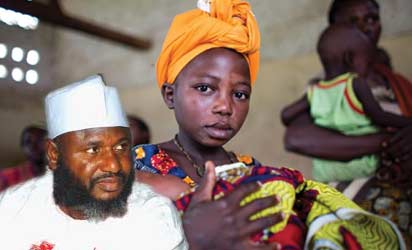
Senator Ahmed Yerima
By Denrele Animasaun
“The education and empowerment of women throughout the world cannot fail to result in a more caring, tolerant, just and peaceful life for all.” -Aung San Suu Kyi
The emotive assault in the last couple of days has renewed the debate for the rights of women in Nigeria. I am not going to rehash the high voltage of sentiments of the current protest movement but what I am going to say is that the current debate has open old wounds and it is high time we lanced the boil and let the healing and progress begin.
It is a known fact that Nigeria is not alone when it comes to the discrimination, violence and other injustices against women. We should though, not pride ourselves that we are not alone. When something is wrong, it is wrong, no matter how many people do it or practise it. We should instead, work towards readdressing the prejudices and imbalance against women. So without the proper and sensible dialogue, we will perpetuate the ever increasing inaction and nefarious acts against women in terms of poverty, deprivation and the deterioration of the quality of life for majority of Nigerian girls and women folk.
We cannot afford to let the same old chestnut of this is “our culture and our religious” reasons to colour our sense of decency and morality to condemn half of our nation to the rubbish heap. The facts are there for all to see: Nigeria ranks 118 of 134 countries in the Gender Equality Index. And according to the 2012 Gender in Nigeria report indicates that gender inequality not only exists in our country but it is at an alarming and worrying level.
The country’s lawmakers can best spend their valuable time (which we pay them so handsomely for!) to addressing the lack of gender balance in the economy, education, politics, health, access to justice and almost all areas of human development. The longer they look for distractions and more the citizens revert to their respective religious and tribal trenches and the less likelihood it would be for Nigeria to take its pride of place in the league of productive and civil society.
We have been in denial for far too long and so often we encourage such incorrigible attitude and discriminatory practices towards young girls and women in our country for peace of mind and to avoid disagreements. We are only storing problems for the future. The opportunity of a better and inspirational choice should not be for the rich and the educated, it should be for all irrespective of their religion, tribes or gender.
When the elite and the powerful lay claims to “saving” the virtues of the young girls from societal evils and ills by marrying them young, they are being economical with the truth. In fact, they are being delusional and uncaring. These young girls are too young, physically and mentally not ready to be at the beck and call of these men who should know better. These young impressionables are treated with kindness or respect and definitely it is not done out of altruism or selflessness.
On the contrary, these girls are traded like cattle and commodities, the life that awaits these young, naive and helpless girls is a life of servitude; making babies, keeping the households, rearing children, taking on responsibilities way beyond their capabilities. They often die in childbirth, or left with damaged bodies, physically and emotionally damaged. When they no longer serve their purpose they are often tossed aside for a young and newer models. So what happens to them after? They live a life of poverty, destitution and abandonment because they are dependent on the whims of their husbands.
This road leads to nowhere as we all lose out on the potentials of what these young women as they could have been educated, learnt a trade, given an opportunity to access adequate health care. The law should do more to protect the needs of girls and women. As it stands in Nigeria, the 80.2 million women and girls have a significantly worse life chances than men and also their sisters in comparable societies; 60-79% of the rural workforce is women but men are five times more likely to own land. In eight Northern states, over 80% of women are unable to read compared with 54% for men. 70.8% of young women aged 20-29 in the North-West are unable to read and write and only 3% of females complete secondary school in the northern zones.
We should be doing something to improve the lots of women, not reducing their rights and marginalising their opportunities in life. So enough of this disdain towards women, we must address the inequality and allow people to work their way out of poverty and penury. These are the salient issues that need to be addressed instead of physically and emotionally abusing young and vulnerable children.
Unless we look at the way we treat females in our society, we will continue to look for scapegoats. That is the case, where the men, women and the system continue to mistreat our womenfolk and further regress our society. We cannot afford not to educate our girls, and there has to be a conscious effort in order to remove the obstacles that may hinder their education and their development. Otherwise, the barriers to progress and wealth will continue to elude us.
The World Bank stated, that in Nigeria, if young Nigerian women had the same employment rates as young Nigerian men, they would add 13.9 billion Naira to annual GDP. We need to encourage our young women to live up to their full potential.
The sad fact is one-quarter to one-half of girls in developing counties become mothers before age 8 according to the United Nations Population Fund. The focus should therefore be on health and human rights of girls and women. It is the rights of all Nigerians all without exception to live up and be given the opportunity, to live up to their potential. Let’s not look only to our law makers, as they say charity indeed begins at home. So what are we doing as individuals, families and communities to better the lives of our women and young people? We are the ones to make the changes and nobody else.
Disclaimer
Comments expressed here do not reflect the opinions of Vanguard newspapers or any employee thereof.