
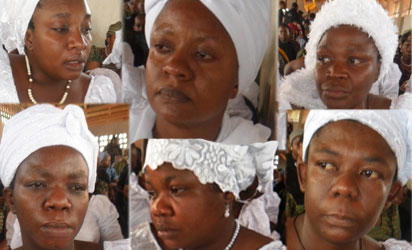
WIDOWED BY BOKO HARAM
By BARTHOLOMEW MADUKWE
Issues surrounding experiences of widows across the country have called for more attention, despite laws enacted by governors of some states, as the world celebrated International Widows’ Day last Sunday.
Sometime in 2001, the Government of Enugu State passed the Prohibition of Infringement of a Widow’s and Widower’s Fundamental Rights Law.
The law prohibits infringement of the fundamental rights of widows and other related matters. Subsection 1 of this law specifically forbids forcing a widow to drink the water used to wash her husband’s corpse.
According to a report by the Women’s Rights Watch, “three states have passed laws against punitive widowhood rites, Enugu, Edo and Oyo state”.
However, the report states that despite these laws, the mourning rites continued to be practised in these states in 2003.
Against this background, the United Nations Secretary General, Ban Ki-Moon, called on women not to loose their rights when they loose their husband.
In a statement marking the International Widows’ Day, Ki-Moon noted that globally about 115 million widows live in poverty, and 81 million have suffered physical abuse.
While bemoaning the worldwide incidents of human rights violation of widows, such as disinheritance, denial of right to land and property of their dead spouses, absence of social safety nets and outright denial of sources of livelihood, urged all to advocate for the rights of widows.
He said: “No woman should lose her rights when she loses her husband. Girls married to much older men are especially vulnerable.
”Let us use this International Widows’ Day to advocate for the rights of all widows so they can enjoy better lives and realize their great potential to contribute to our world.”
The international Widows’ Day was introduced to address poverty and injustice faced by widows and their children in many countries.
It was officially recognized by the United Nations in 2010 and is observed annually on June 23. Widowhood problem is universal; but of particular concerns are horrifying practices in some eastern parts of Nigeria.
In Igboland, is widow’s problem still being compounded by the Umuada (daughters of the land) who are often accused of making laws that make life horrible for the widow?
Widowhood practice differs. In some societies, the widow is locked up with the corpse. While in other climes, the widow is whipped by terrifying poison-carrying masquerades. She cannot hug or be hugged. She can’t shake hands or go to the market.
After the one-year mourning period, the widow is taken to the river for the Aja-ani ritual during which the aja-ani priest ‘rapes’ her.
In some societies, the widow is raped by 10 men, which serves as a means of cleansing her and making her available for other men.
A common practice in some parts of Nigeria is that when the man of the home passes on as a result of illness or accident, his wife is usually accused of being responsible for his death.
In other to prove her innocence in her husband’s death, the widow would be made to drink the water used in washing her husband’s corpse.
The consequences of her refusal to carry out the ritual include physical assault, banishment from the family or denying her access to her husband’s property, including the children.
It would not matter if the widow contributed her money, sweat and initiative to the acquisition of the property.
At such times, when the widow goes to lodge complaint at the police station, the common thing she would be told is “this matter is domestic and outside our area of authority”.
In some cases, the widow is compelled to take oath with kolanut placed on her dead husband’s forehead and complete the swearing with 2 broom sticks.
But the story, even among the Yoruba, is not better because the widow is often seen as a chattel. Her late husband’s property is then shared, along with farmlands and furniture. Often, a widow is the first suspect when the cause of her husband’s death is being investigated.
Children of women in this category have dropped out of schools due to poverty or lack of care from the husband’s relations. The widow and her children bear the double tragedy of losing their family head and facing unimaginable hardship.
Meanwhile, Convention on the Elimination of Discrimination against Women, CEDAW, described Human Rights violations against widows as “any distinction, exclusion or restriction made on the basis of sex which has the effect or purpose of impairing or nullifying the recognition, enjoyment or exercise by women, irrespective of their marital status, on a basis of equality of men and women, of human rights and fundamental freedoms in the political, economic, social, cultural, civil or any other field.”
In a related development, the Managing Partner of Partnership for Justice, PJ, Itoro Eze-Anaba, said, “Widows face discriminatory customary practices that constitute violations of their human rights. These practices violate their right to health, right to life, right to human dignity and right to freedom from discrimination.
“Nigeria has signed and ratified different regional and international human rights instruments that seek to protect the rights of women including widows from discriminatory practices. The government should without delay implement these regional and instruments.
“The National Action Plan, NAP, on the promotion and protection of human rights in Nigeria is a 4-year plan of action voluntarily adopted by the government to improve human rights in Nigeria. The NAP contains government voluntary commitment to end discriminatory practices against women including widows.
“During the review of Nigeria’s human rights situation in 2009 by the United Nations Human Rights Council in Geneva the federal government accepted to implement all the recommendations made by the Council including the domestication of all international instruments including CEDAW and the Protocol to the African Charter on Peoples and Human Rights on the Rights of women in Africa.
“Four years after the NAP as a government human rights agenda, nothing is in place to implement it. No government agency has the responsibility for its implementation. The government should take the necessary steps to fulfill these commitments.
Is should put in place a mechanism for implementing international, regional and national human rights commitments. The government should domesticate CEDAW and the African Women Protocol.
“States where these practices are rampant should pass laws against widowhood rites and create awareness about the damaging effects of these practices. The government should encourage widows to be financially independent. More importantly men should be encouraged to write their wills stating how their belongings should be shared when they die.” She added.
No doubt, one way of protecting widows is by law. The 1999 Constitution provides for such protection, under provisions that award basic human rights, but the specific laws to achieve these are inadequate.
Human Rights violations against widows are entrenched in ancient cultural practices that have managed to survive the times. Protecting the basic rights of widows, and safeguarding them from obnoxious practices, cannot be over emphasized in an environment where even enacted laws seem swayed.
Disclaimer
Comments expressed here do not reflect the opinions of Vanguard newspapers or any employee thereof.