
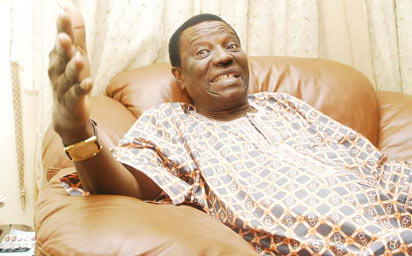
Iredia
By Jide Ajani
In this second part of the interview with Dr. Tonnie Iredia, Director of Public Affairs, DPA, for the National Electoral Commission, NEC, during the turbulent days, 20years ago, of the annulment of the June 12, 1993 presidential election, he explains the circumstances surrounding the obedience of the Commission to the court injunction which effectively stopped the announcement of the results of that election. He also speaks (or better said, he puts in proper perspective) on why Professor Humphrey Nwosu, then NEC Chairman, did not dispel the rumours about what happened to him immediately after the suspension of the transition programme.
Excerpts:
Why?
You won’t believe that the warrant and judgment by Saleh were served on us
by the then Attorney General, Clement Akpamgbo; so, there was actually nobody to run to because the Attorney General would have been the one we could have approached but here we were, he was the one who served the documents on us and I remember what he told the Chairman. He told the Chairman that ‘if you disobey, then you are on your own’; and so we knew that any disobedience was at our own peril.
We understood clearly that things had changed and the government we were working for had also changed its mind on some things. The government withdrew its original support. A young man, our Director of Legal Services, Buhkari Bello, very intelligent and strong-willed, told us that we could obey but that, this time around, he was going on appeal and the young man went on appeal. And while he was at the point of getting judgment, the government announced the suspension of NEC and the transition programme and that meant that the court was no longer in a position to take any decision because it was going to act in vain.
The statement suspending the transition programme was absurd because a statement, from the office of the then Vice President, Aikhomu, was sent out announcing the suspension of years of work. How did it hit the commission?
Just the way the ordinary Nigerian knew, that was how we at NEC got the announcement.
It looked anonymous.
It was not signed. But it was sent from the office of the Vice President?
Yes it was not signed but it was publicized and the government did not say it was not it that sent it out. That was how it went.
What happened to Humprey Nwosu during those trying days after NEC was dissolved? We heard stories of his being detained and slapped and shown the photocopy of a cheque he allegedly collected from MKO Abiola?
This is a very interesting part of this interview.
I had to bring my knowledge of the law to bear when those stories were flying about. I was not posted to NEC as a lawyer but as a journalist, but when these events started happening, I decided to be very careful especially when the order came that the election results should no longer be announced. I became very observant.
I went to Nwosu’s house every day once the transition programme was suspended because I understood his being at home to mean that, having been suspended from work, he could no longer go to office. But the public opinion then and the rumours had it that he was having a raw deal.
Yes! It was said that he was under house arrest?
That was the rumour in town.
I was always going to his house and I did not see any law enforcement officer that would make it appear as though his house was a place that was being monitored let alone arrested.

Iredia
I was always there; sometimes we would even have drinks, eat there.
Who were these ‘WE’ because, at a point, there was a split in the commission?
Yes, those of us who chose to always go there.
At that point in time, as is always the case with Nigerians because of greed and dishonesty, a few staff and members of the Commission who had been cornered by the administration to start saying the elections were not as good as we were claiming and that things were not properly done, were the ones retained and the rest of us asked to leave. That is Nigeria for you
Did Security operatives beat Humphrey Nwosu?
I never got to know if Professor Nwosu was physically manhandled to fall in line with the plan of those who wanted to stop the election. What I felt and this was essentially my feeling was that he may have been coerced to shut up. This feeling was borne out of the rather uneasy calm which built around our hitherto vivacious chairman. Before controversies set into our job at NEC, Nwosu was passionate about the job and known for his constant reminders to us all to work hard so that we can put our names in gold as the first set of election personnel to organize a credible election in Nigeria. He had indeed confided in me that the President had promised to put us in the National Honours list if we did a good job. In the dying days of NEC, the Nwosu I saw was a dejected man who suddenly found that working for a military government could have its dangerous dimension.
Was it true that a cheque was issued to him by MKO Abiola with a view to compromising him? If so, was the cheque displayed before Nwosu?
If that happened it must have been transacted at a place and time that were unknown to me. In any case, I very much doubt it. You could hardly have counted 2 people closer to Nwosu than me during the election operations. Thus, if I didn’t know, It is rational for me not to believe the allegation. The only reason why I have always tried to be careful with the issue is because I know that there is nothing Nigerian politicians cannot do to win an election. Even those who can see clearly that they have no chance will seek to corrupt the process. But in earnest, Nwosu acted at all times in his handling of election issues as a man of integrity. He could also not have been that naïve to have collected a bribe in cheque form which was like a receipt. I honestly do not believe the allegation. Instead I see the story as one of the many tales which evolved as a result of the inexplicable posture of the government of the day. For instance, I was shocked a few days after the annulment of the election to read in my bedroom in Abuja, a categorical statement in a popular column that I was hiding in the Palace of the Oba of Benin. It was indeed a time for stories.
How was the government able to divide NEC Officials?
As in most public institutions in Nigeria, prescriptive criteria like state of origin, ethnicity, sex, religion etc are always ready tools for dividing a previously united team. Again, in any issue that has a potential of leading to loss of job, many Nigerians change shape quickly. Some no longer associate with their friends let alone to agree with them. The rumour that the suspended NEC was about to be reconstituted played a significant role. Many officials quickly moved to invent stories that could keep them in office. Of course those of us –the chairman’s favourites had no hope. Jide, why not try to interview those who were retained? For me I had no interest any more in the convoluted NEC more so as I could easily return to my beat as a television interviewer at the NTA from where I had been deployed.
How was NEC dissolved and which instrument suspended the transition programme?
Let me be frank with you, I don’t know more about this topic than you. I had lost hope in the entire process when I was directed to suspend the display of election results-a directive which to me was a bad omen. Within a few hours of the directive, all the results nationwide except that of Taraba state had been received and collated with Abiola leading by a wide marginThe then Resident Electoral Commissioner for that state, Professor Pius Sada had also arrived with a pro-Abiola result. Without Taraba, Abiola had won the election. All top NEC officials and representatives of the 2 political parties at the collation centre were no longer unaware of the coming calamity. Should I address the press and go underground? Luckily the security agencies saved me from that suicidal thought as I was arrested or invited for a chat which kept me out of circulation for only several hours. I was so disillusioned that the anti -June 12 elements could not have elicited my interest even if they had had dissolved the entire Nigeria and not just NEC. Could I care that the election was annulled by an unsigned statement credited to no one and circulated to the media?
In what state of health was Humphrey Nwosu immediately after the suspension of the transition programme?
I thought he was hale and hearty from all I could see and could not understand why the rumour mill was replete with contrary reports. On the 28th of June 1993, my Assistant Director issued a statement which assured the nation that Professor Nwosu was well and was neither arrested nor questioned by security agents. Perhaps, he was asked to issue the statement. I couldn’t do it because I imagined that if Nwosu told the nation himself that he was well, it would make more sense. In retrospect, I can see that it was a report which needed corroboration by a medical doctor. Was I being difficult? Jide, don’t laugh. If you are appointed as a spokesman for an assignment be careful how you take on personal and domestic issues on behalf of your principal was through with NEC as I spent the next few days asking to be posted back to NTA but I got a letter posting me to the National Orientation Agency (NOA). Was I not lucky.
(Laughter) You were just being difficult?
Was I being difficult? Jide, don’t laugh. If you are appointed as a spokesman for an assignment, be careful how you take on personal and domestic issues. I was through with NEC as I spent the next few days asking to be posted back to NTA, but I got a letter posting me to the National Orientation Agency (NOA).
Really! What other things did you observe contrary to what Nigerians were peddling?
The only thing I observed was that the man (Nwosu) was not going to office and he could not convince me that it was because he was under house arrest. He had been suspended from office, so how could he go there?. That was why he was home.
I’m sure you still keep in touch with him. What vibes do you get from him whenever you talk?
Oh! He always feels that the main business of the day had collapsed and we had no business answering rumours.
How does the whole episode play out in your mind whenever you have cause to discuss it?
Yes! I’ve since had the opportunity to deliver lectures to public affairs officers of the electoral commission, and it was the first time I was seeing them after I left the system, so I was forced to talk to some of them about my experience.
There were some of them that I needed to apologise to first, because I left unceremoniously (I did not say goodbye to anybody); secondly, I did not heed the advice of some of them.
What was the advice?
They saw my leaving coming; they saw that government would not keep me there; and they also saw that the new Commission as composed would not retain me, though the new Commission was going to keep quite a number of our colleagues. Those who had this information wanted me to do some ground work so that I didn’t lose my job.
But all I did was just smile and told them that I couldn’t do that.
To start with, I am not a professional election manager but a broadcaster. It was government that deployed me to come and do this job in the first place. At that point, the Information Minister, Tony Momoh, did not think it was right for government to just deploy me like that. What I was told was that government’s reason was that the transition programme was very dear to government such that it needed every other agency of government to give its best for the process. So I was flattered that from NTA Benin, I was picked. So, I needed to apologise to those people.
I went there to work and if there was any opportunity for me to return to my first love, why should I make moves to stop it.
The second reason was that I thought I’d completed my assignment which was that I should go to the Commission and ensure that I project an image that Nigerians could believe in which was what I did. Before my time, the electoral body was really very notorious such that people used FEDECO (the Federal Electoral Commission) to described manipulative schemes. The belief was that the Commission was a manipulator of results and, by the time we came in, the image was very low and we were looking for all ways to cleanse that.
And one of the ways in 1987 under Professor Eme Awa was to insist that your acronym would be NEC instead of NECO for your National Electoral Commission?
That was elementary and ridiculous. I’m happy you were covering the beat that time in 1987. It was that funny and ridiculous that we didn’t want to be referred to as NECO but NEC. We didn’t want that ‘CO’. For me I’d thought my job was completed since our own NEC had been dissolved and so I felt I had no business in trying to build the image of the new electoral body. I’m a broadcaster.
And in any case, anything that needed to be said I had said up to the point of almost incurring the wrath of the judiciary. Because there were instances when I’d come out to tell the judiciary that it was trying to usurp our functions and the judiciary didn’t take kindly to this. I’d stepped on toes, I’d made friends and I’d completed my assignment, so I had no business staying back.
But if you had been approached to stay back by government, would you have agreed?
If government had sought my opinion, I would have turned it down because the first one that I accepted took the intervention of my late mother who cried because it was believed that if you turned down a military appointment, you were looking for trouble. If a directive came, I would have obeyed but if my opinion was sought I would have rejected it.
The truth of the matter was that I had convinced Nigerians that the process was going to be sincere, transparent and honest such that Nigerians had believed me. I’d explained everything either Professor Awa did or the actions of Professor Humphrey Nwosu.
More importantly, I was not impressed by the information management that the government put out regarding its decision to nullify the presidential election of June 12, 1993.
Elections in Nigeria continue to get worse one after the other. Though there is this semblance of peace and reduced violence on election day, do these constitute signs that the elections are free and fair?
Some Nigerians do not have a proper understanding of what a free and fair election is. A free and fair election does not only mean that people did not snatch ballot boxes or there was no violence; no.
For an election to be free and fair, people who are of voting age should not be disenfranchised. The present system has officially disenfranchised many people because, since 2010, only those registered before or by then are the only ones that are still able to vote. The people who have since become 18 have not been allowed to participate. You cannot have that and say elections are free and fair.
There is this problem with the voters register and even…?
(Cuts in) Since 2010, Nigerians are still participating in elections with temporary voter’s card – that does not make sense. In 2013, Nigerians should be talking about sophisticated voting system that clears completely manual monitoring of elections where you have military men who even end up allowing some people to vote while they turn away others because of pecuniary interests So, what type of free and fair elections are those? The Minister of Agriculture has said he wants to give GSM phones to farmers – people who are uneducated. So, when people say Nigerians are not enlightened enough for electronic voting, the question to ask them is, what are you going to do with voting electronically that you are not already doing with the GSM phones. And we all know the benefits of having technology-assisted election. We do not need a situation whereby holding of election paralyses every other thing. We all know that the political class does not want elections that are free and fair and electronically assisted. How come we are able to open account in Sokoto and withdraw money in Lagos? Why can’t I register in Abuja and vote in Lagos such that any other attempt to vote a second time is rejected electronically? The truth is that the people in government do not want free and fair elections because they would not win. We may not get the ideal of America or Britain, but we should move away from these obsolete things that we are doing.
One of the ways to have a free and fair election is to have a clean voters register so that we can prepare effectively, not this one that we do not have a clean and accurate register, you just waste money while printing excess cards for people to rig or where votes are more than the number of voters. Apart from that, all those who have died still have their names on the register and those who have come of age do not have their names and yet, we say we are having free and fair elections.
I have personally voted in a place where there were just 78people who voted, but the winner of that polling booth won win over 1,000 votes; you begin to wonder where the votes came from.
Appointing somebody thought to be upright would not stop rigging because that person would not be in every state, local government or ward or polling booth at the same time.
Final thoughts?
I have read the book by Omo Omoruyi in which he gives what he considers the real reasons for the annulment of June 12 and he has alluded to quite a lot of things which I think people should address their minds to.
Disclaimer
Comments expressed here do not reflect the opinions of Vanguard newspapers or any employee thereof.