
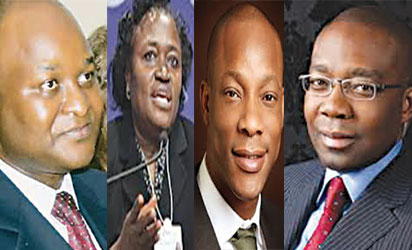
Tunde Lemo; Sarah Alade; Segun Agbaje and Aigboje Aig-Imoukhuede
By Babajide Komolafe
It is an almost trivial assertion to state that political imperatives and economic necessities often contradict each other. Central banks reside at the intersection of politics and economics and are therefore potential arenas of conflict between the preferences of politicians and what is considered prudent macroeconomic policy by appointed technocrats.
In anticipation of such conflict, politicians may try to fill leading positions at the central bank with likeminded agents and remove individuals with ideologically incommensurate views. This is the opinion of Laurenz Ennser-Jedenastik in a paper “Party Politics and the Survival of Central Bank Governors”.
Who will be the next Governor of Central Bank of Nigeria? That is a question dominating discussions in several quarters both locally and internationally. It became prominent subsequent to the announcement in March by the current and 10thGovernor, Mallam Lamido Sanusi that he would not be seeking a second time. Since then, there have been predictions and speculations on who would succeed him.
This is natural and human. But a significant benefit of the announcement of Sanusi, more than one year to the end of his tenure, is that it gives the government and the country the opportunity to discuss and consider the issues and criteria that should guide this choice which would greatly influence the direction of the economy and nation for another five years.

Tunde Lemo; Sarah Alade; Segun Agbaje and Aigboje Aig-Imoukhuede
Issues to be considered
As indicated above by Dr.Ennser-Jedenastik of University of Vienna, It is always a strong tendency for whoever is in power to choose a likeminded agent, somebody of the same political and economic ideology, who is ready to do the bidding of the government of the day. The consequence however is that once there is change in power, the CBN Governor would also be changed, and the economy would be vulnerable to policy summersaults.
Hence economic operators who spoke to Vanguard insisted that the federal government should look beyond politics, and consider the challenges of the job in choosing Sanusi’s successor.
“We should not bring in a politician” said Sir Sunny Nwosu, National Coordinator, and Independent Shareholders of Nigeria (ISAN). “It is a professional job that must be for technocrats who can manage information and every other thing. Because if a CBN Governor speaks, everybody will listen and respect him but a CBN Governor that speaks every day, will make a mockery of the office and would not command any respect”, he added. Maturity, he averred should be strongly considered. “Maturity is very very important”, he said.
Sharing the same view, Mr. Boniface Okezie, President of the Progressive Shareholders Association, government should choose a technocrat, somebody with track performance, somebody who is not autocratic, not political, who does not have hidden interest in the industry.
Sounding spiritual, Chief Timothy Adeshiyan, President Nigeria Shareholders Solidarity Association, NSSA, said that the CBN Act is a sacred Act and should be guided like the Ark of God. “The carrier must be holy, not a boss but as a servant though a lord. The next CBN governor must be somebody that sees the position as a position of honour and a sacred one that must not be subjected to politics. We should not choose somebody who will drag the CBN into partisan politics,” he said.
Mr. Victor Ogiemwonyin, Managing Director/Chief Executiver, Partnership Investment Company Limited stressed the need to consider sincerity, strength of character. “It will be important to have a strong CBN Governor who will be ready to stand strong when things are not going well. He must have sincerity of purpose and must show strong economic understanding. The next CBN Governor must build on what has been done so far by the last two administrations,” he said.
Field of Candidates
Definitely, there are financial and economic experts that meet these criteria, inside and outside the apex bank. A summary of the nine indigenous CBN governor show that five of them were from inside the CBN. Prior to their appointment they had either served in various capacities in the bank, or at board level.
Prominent among them is Chief Joseph Sanusi, the 7thGovernor. The other four were outsiders. They were either top bankers like Paul Ogwuma, the 6thGovernor or top economist like Professor Charles Soludo. Thus another issue that should be considered is whether the next governor should be an outsider or an insider.
Should the government decide to choose an outsider; there is an array of bank chief executives and top economist to choose from. These include, Mr, Bisi Onasanya, MD/CEO of First Bank, Mr. Segun Agbaje, MD/CEO of Guaranty Trust Bank, Mr Alex Otti, MD/CEO of Diamond Bank Plc and Mr. Aigboje Aig-Imoukhoude, MD/CEO of Acess Bank. Among them, the mprominent and widely speculated would be appointed is the Access Bank CEO.
Should the government decide to choose an insider from the board of the apex bank; the field of likely candidates is not as wide. This include erudite Professor of Economics, Professor Samuel Olofin, he represents the academia on the board, and was appointed in 2005. Next is Mr. Tunde Lemo, former chief executive officer of Wema Bank. He was appointed in 2004. Another likely candidate is Dr (Mrs.) Sarah Alade, the second female deputy governor of the CBN.
She was appointed in 2007 to man the crucial position of Deputy Governor, Economic Policy. Though not among the speculated successor, two things may however make her to be considered. One, in addition to being an economist by training, with Masters Degree in Commerce and Doctorate Degree in Management Science (Operations Research), she is the only board member, who like Joseph Sanusi, rose through the ranks of the apex bank. But she is not just a career central banker; she has held major and sensitive responsibilities in the bank.
She was appointed Director, Banking Operations Department in May 2004 and has served on the teams on major economic policy studies, and has been involved in the preparation of Central Bank of Nigeria’s Monetary and Credit Policy Proposals over the years. She was actively involved in the drafting of the Medium Term Economic Programme (MTP) for Nigeria and the IMF staff Monitored Programme/Standby Arrangement.
As Deputy Governor, Economic Policy, Dr. Mrs. Alade superintends over the Economic Policy Directorate, comprising the Research, Monetary Policy, Trade and Exchange, Statistics Departments and Financial Markets Department. As Chair of the Monetary Policy Implementation Committee (MPIC), she interfaces with operational departments and coordinates technical inputs for the Monetary Policy Committee (MPC).
In addition to these, she was a member of the Technical committee of the Vision 2010 and currently a member of the Technical Committee of Vision 2020 and member of the National Economic Management Team (EMT).
Second is the historical factor. Should the government decides to look in her direction, she would become the first female Governor of the CBN, and Nigeria would join the club of South Africa, Argentina, Botswana, Russia and other emerging countries, who have dared to entrust a woman with the most sensitive job in the economy.
Disclaimer
Comments expressed here do not reflect the opinions of Vanguard newspapers or any employee thereof.