
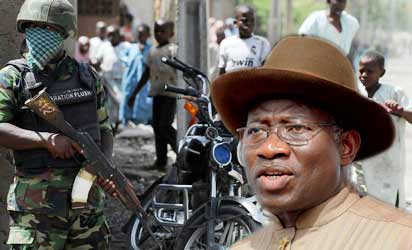
*Jonathan
The declaration of Emergency Rule in three northern states of Borno, Yobe and Adamawa by President Goodluck Jonathan on Tuesday to contain the rising tide of insurgency and terrorism in the country is perhaps one bold move the President has made since he assumed office in May, 2011.
Saturday Vanguard’s LEVINUS NWABUGHIOGU in this special piece analyzes the development vis-à-vis the flurry of commendations and contentions that have continued to trail it.
President Goodluck Jonathan has developed a thick skin. This is quite unusual. He is certainly growing in politics by the day, obviously defusing a growing notion that he is not as clueless as he may have been dubbed in some quarters.
For one, President Jonathan has been jolted in an aggressive but strategic manner to shame and tell his critics that he is in charge of the affairs of the country, leaving an impression that he can tackle the many problems of Nigeria, starting with insecurity.
On Tuesday, May 14, 2013, Jonathan’s long awaited sledge hammer finally fell on Borno, Yobe and Adamawa States. These are states adjudged to be the most troubled in the North where terrorism, insurgency, rebellion, impunity and unnecessary brutal killings of innocent Nigerians and perhaps, other nationals have been going on unabated in the last two years.
Jama’atul Alhul Sunnah Lidda’watiwal jihad also known as Boko Haram, an Islamic sect is termed the principal perpetrator of these ill acts. At first, their demands were not clear.
All what was known was a group of religious fundamentalists who promulgated their beliefs even though they were considered too extreme by many Nigerians. But they were bent on their mission of Islamizing the country via the implementation of Sharia law across the country.

In essence, they chose to start from their immediate environments in Borno and Yobe states. To make real their pursuits, they consciously arrogated to themselves a name that defines their philosophy: Jama’atul Alhul Sunnah Lidda’wati wal jihad, meaning “people committed to the propagation of the prophet’s teachings and jihad”.
That was in 2002. But not much was heard about the Islamist religious sect until in 2009 when a discrepancy erupted between them and the law enforcement agents which culminated in the death of the leader of the group, late Mohammad Yusuf.
Prior to the time, Mohammad Yusuf had faulted the participation of most leaders of northern states especially the governors who were full blooded Muslims in the affairs of the country.
He saw it as an illegitimate, non-Islamic venture and considered it too secular for their religious inclinations and preached a doctrine of withdrawal.
But the lid was to be let open when the group declared that “ western education is evil”, a phrase that gave it its popular name “Boko Haram”.
Thereafter, Boko Haram began to launch an onslaught against the state. Yet that did not define the reasons for their attacks,whether it was to avenge the death of their former leader, Yusuf or that the government institutions were fundamentally “haram”.
In the aftermath, the attacks permeated as Boko Haram carried out a number of suicide bombings and assasinations from Maiduguri to Abuja, and staged an ambitious prison-break in Bauchi, freeing more than seven hundred inmates in 2010.In November 2011, the group staged its most deadly attacks so far in Maiduguri as well as Yobe’s Damaturu and Potiskum, targeting churches, mosques, banks, and police stations.
At least 150 people were reported killed. These attacks elicited more international attention for the group, with condemnations from the head of the Organization of the Islamic Conference, the Pope, the UN Security Council, and the UN Secretary General.
Bombings on Christmas Day in 2011 targeting churches and killing dozens raised fears about the possibility of another spate of religious violence between Muslims and Christians.
Of course, it almost climaxed to that as killings became the lot of Christians in the North. At a time in 2012, the killings apparently took on an ethnic dimension with fear of another civil war breaking out across the federation. But somehow, the days rolled past by without war.
Events before the Emergency Rule Proclamation
Adamawa, Gombe, Bauchi, Kano, Plateau, Taraba and Benue States, all in the North had witnessed one artificial storm or the other. Though, it may be argued that Boko Haram was responsible for every uproar in those states, what is however unarguable is that the mayhems took the stance of the dastardly acts executed by the Islamic sect and so gave the promptings that it was the Sect.
But with the killings continuing unabated, the Federal Government last month thought it was time to stop the blood letting and eventually mulled amnesty for the members of Boko Haram against severe rebuttals by many Nigerians. But hardly had the Federal Government announced the plan to curb the nose-diving situation than the sect shot darts at the offer.
In reverse, the sect said it was the one to give amnesty to the Federal Government and indeed the Nigerian people.
Yet again, in its magnanimity, the Federal Government continued to toe the path of peace with the sect by inaugurating a Committee for Amnesty. With this, everyone thought that the sect would cease fire and reason alongside the government.
But like the proverbial stubborn fly that wants to follow the corpse to the grave, the sect turned a deaf ear and even heightened their activities making Borno State a killing field. Apart from kidnapping a nonagenarian former Minister of Petroleum Resources, Dr. Shettima Ali-Monguno and allegedly killing an Acting Chairman of Dikwa Local Government Area, Alhaji Machalla Umara on Friday, May 3, 2013, Boko Haram on May 7, barely 3 days after,
launched series of coordinated attacks on Police, Army and Prison formations in Bama town, Borno State, leaving no fewer than 55 persons dead. It was gathered that the gunmen first attacked the police barracks, and set them ablaze, killing some policemen, their wives and children in the attack.
Nasarawa Massacre
Even though it was not included in the emergency rule imposed by the President, Nasarawa State recently came under attack by members of a deadly militia group called Ombatse. About 100 Police, Department of State Security, DSS, officers were reported dead in Lafia.
The officers had gone to Eggon, the abode of Ombatse shrine on a rescue mission on the heels of a disturbing piece of news that the militia group was going about forcing all people of Eggon extraction in and out of Lafia to drink a particular concoction prepared from herbs, beating up and harassing anyone who failed to comply.
Unfortunately, the security agents sent to dislodge the sect were mysteriously hacked to death. This forced President Jonathan who was in South Africa enroute Namibia on bilateral deals to return to the country.
Declaration of Emergency Rule in Borno, Yobe and Adamawa States
The declaration of State of Emergency in Borno, Yobe and Adamawa States on Tuesday by President Goodluck Jonathan was seen as one brave move by the present regime to stem the tide of insecurity in the country especially in the North-Eastern geopolitical zone. In the reckoning of many Nigerians, it was a long overdue move.
But even at that, it came as a surprise to many Nigerians as many least expected it.
President Jonathan would bulge after many months of obvious dilly-dallying. But true to fact, given the compelling circumstances, it became extremely necessary to toe that line of action at least to reduce the carnage in the affected states. In his nation-wide broadcast on Tuesday to announce the decision, the President himself gave reasons why it was extremely necessary to declare emergency rule.
He said: “It has become necessary for me to address you on the recent spate of terrorist activities and protracted security challenges in some parts of the country, particularly in Borno, Yobe, Adamawa,Gombe, Bauchi, Kano, Plateau and most recently Bayelsa, Taraba, Benue and Nasarawa states. These unfortunate events have led to needless loss of lives and property of many innocent Nigerians including members of our security forces.
“The recent killing of security operatives by a cult group in Nasarawa state is particularly condemnable. I have directed that no effort or expense be spared in identifying and bringing to justice all those who had a hand in the killing of the operatives.
“The activities of insurgents and terrorists have been reprehensible, causing fear among our citizens and a near-breakdown of law and order in parts of the country, especially the North.
We have taken robust steps to unravel and address the root causes of these crises, but it would appear that there is a systematic effort by insurgents and terrorists to destabilize the Nigerian state and test our collective
resolve.
“Since I returned to the country after cutting short my visit to South Africa and aborting a planned state visit to Namibia, I have received detailed briefings from our security agencies. These briefings indicate that what we are facing is not just militancy or criminality, but a rebellion and insurgency by terrorist groups which pose a very serious threat to national unity and territorial integrity. Already,
some northern parts of Borno state have been taken over by groups whose allegiance is to different flags and ideologies.
“These terrorists and insurgents seem determined to establish control and authority over parts of our beloved nation and to progressively overwhelm the rest of the country. In many places, they have destroyed the Nigerian flag and other symbols of state authority and in their place, hoisted strange flags suggesting the exercise of alternative sovereignty.
“They have attacked government buildings and facilities. They have murdered innocent citizens and state officials. They have set houses ablaze, and taken women and children as hostages.
These actions amount to a declaration of war and a deliberate attempt to undermine the authority of the Nigerian state and threaten her territorial integrity. As a responsible government, we will not tolerate this.
“Previously, we adopted a multi-track approach to the resolution of this problem through actions which included persuasion, dialogue and widespread consultation with the political, religious and community leaders in the affected states.
“We exercised restraint to allow for all efforts by both state governors and well-meaning Nigerians to stop the repeated cases of mindless violence.
Yet, the insurgents and terrorists seek to prevent government from fulfilling its constitutional obligations to the people as they pursue their fanatical agenda of mayhem, mass murder, division and
separatism.
“While the efforts at persuasion and dialogue will continue, let me reiterate that we have a sacred duty to ensure the security and well-being of all our people and protect the sovereign integrity of our country. Therefore, we shall, on no account, shy away from doing whatever becomes necessary to provide the fullest possible security for the citizens of this country in any part of the country they choose to reside.
“We have a duty to stand firm against those who threaten the sovereign integrity of the Nigerian state. Our will is strong, because our faith lies in the indivisibility of Nigeria.
“Following recent developments in the affected states, it has become necessary for Government to take extraordinary measures to restore normalcy. After wide consultations, and in exercise of the powers
conferred on me by the provisions of Section 305, sub-section 1 of the Constitution of the Federal Republic of Nigeria 1999 as amended, I hereby declare a State of Emergency in Borno, Yobe and Adamawa states.”
Opposition kicks
Getting the inkling that a state of emergency was in the offing late last week, the two major opposition parties in the country, the Action Congress of Nigeria (ACN) and the Congress for Progressive Change (CPC) stoutly rose against it. In separate statements, the parties through their National Publicity Secretaries, Mr. Lai Mohammed and Mr. Rotimi Fashakin respectively said a state of emergency was not acceptable. They urged President Jonathan to resign if that was the last option
“If the imposition of emergency rule on the most affected states is the only viable option left for President Jonathan to tackle the crisis, then he should step down. Imposing a state of emergency on the states that have been mentioned, like Borno, Yobe and Nasarawa states will amount to shifting responsibility and unduly victimising the governors of those states, who have done perhaps more than the President, in dealing with the crisis, even though they are not in charge of any security apparatus,” the party said.
Similarly, CPC said “If he (Jonathan) does not have any value to add, he should quit. He should declare a state of emergency on his party, the PDP. The PDP is the problem of Nigeria.”
Their fear however was understandable because two of the states, Borno and Yobe fingered in the emergency decision are being controlled by the opposition party, All Nigerian Peoples Party, ANPP. On Nasarawa state, the President was smarter than his critics as he did not include the state.
Why allow the affected state governors and assemblies to continue? President Jonathan really scored a first which has made him different from some other previous leaders of the country.
Many people were surprised that he could declare a state of emergency and also allow democratic institutions to run. Many keen followers of the development said that is the point where the President shamed his critics who had thought that he will unseat the governors and the lawmakers while making the decision.
According to them, Section 305 of the 1999 Constitution that gave legality to the action did not stipulate that the governors and elected lawmakers of the affected states should step aside. Remembering that was what the former President Olusegun Obasanjo did during his regime in Ekiti and Plateau states, they said that Obasanjo erred in law.
Disclaimer
Comments expressed here do not reflect the opinions of Vanguard newspapers or any employee thereof.