
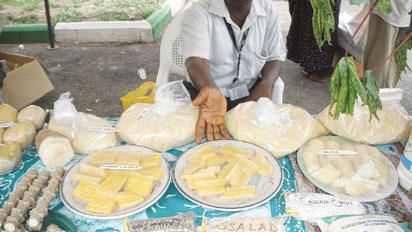
*Some varieties of the yellow cassava and their products being displayed.
By Ebele Orakpo
Vitamin A is known to be essential for good vision, proper development of embryos, healthy skin and mucous membranes. It helps cells reproduce normally, plays a role in immune system function, growth, bone formation, reproduction and wound healing. It then follows that Vitamin A Deficiency (VAD), considered a public health problem especially in Africa and South-East Asia, will lead to high risk of disease and death in children and pregnant women.
Reports say that about 250,000 – 500,000 malnourished children in developing world go blind each year from VAD, about half of them die within a year of becoming blind. As the saying goes, ‘it is better late than never,’ so although VAD was supposed to have been eliminated since 2010 going by the 2002 UN Special Session on Children, Nigeria is yet to get there.
But with the efforts of a team of researchers led by the International Institute of Tropical Agriculture (IITA) in developing vitamin A-fortified cassava, Nigeria is set to meet the target soon. The researchers said the cassava could help put an end to malnutrition due to vitamin A deficiency. In this chat with Mr. Adetoro Adeniyi of Cassava Breeding Unit, IITA, Ibadan, he speaks on what led to the development of Vitamin A cassava. Excerpts:
Motivation:
According to Adeniyi, the team was motivated to search for ways of improving the nutritional value of cassava, the fourth largest staple after wheat, maize, and rice with an average consumption of 600 grams per capita per day in Nigeria and having over 200 million people in sub-Saharan Africa relying on it.

*Some varieties of the yellow cassava and their products being displayed.
“When we realised that most people around South-West Nigeria in particular, always complained of eye problems as a result of consuming white garri made from cassava, we decided to think of how to improve the nutritional value of cassava. In the South-West, if someone has eye problem, they say may be he is consuming too much of garri. We then thought of what we could do to solve this problem of people developing eye problems as a result of consuming white garri.”
The Process:
“We started from the seed, to the flower. We crossed the flowers, got the fruits and seeds and after planting the seeds, we got different varieties. The cassava is heterozygous in nature, that means if you have 1,000 seeds from a cross, you will have 1,000 different varieties. So whatever seed you have, it will be a different variety unlike what you have in other plants that are homozygous in nature.
“So after getting the seeds, we planted them and after one year, we took the seeds from the nursery and planted them in the breeding nursery. From the breeding nursery, we took them to cloner evaluation. From cloner evaluation, we took them to preliminary yield trial. From preliminary yield trial, to advanced yield trial, then from advanced yield trial, we took them to uniform yield trial.
“At this point, we tried to see how they will perform in different places outside Ibadan. At the beginning, we might have had like 100,000 seeds but at the end of the five years, we did not have more than 20, 25 plants after we have done a lot of selections which we call recurrent selection,” said Adeniyi.
Characteristics we look for:
“We breed for disease-resistant varieties, varieties that have high dry matter and low cyanide and those with high yields. So after the crosses, we came to the variety that are yellow, yellow in the sense that they have beta carotene which is a vitamin A precursor, just like you have in carrots.The body converts beta carotene to vitamin A. The level of beta carotene in the cassava is an indication of the level of Vitamin A in it,” he said.


Mr Adeniyi
“So the garri and cassava you are seeing do not contain palm oil. You can see the yellow root and because we have different varieties, you see the difference in their yellowness, that is the difference in the level of beta carotene they contain. The fufu, garri, eba from the cassava are all yellow.”
Comparing the yield from the local variety and that of the vitamin A cassava, Adeniyi said; “The yield from the local variety is less than eight tons per hectare but with improved varieties, the farmer can have up to 200 tons per hectare. No IITA variety will yield less than 25 tons per hectare on the average unlike the local variety that will hardly give you 8-10 tons per hectare. So you can see that IITA has really helped the farmer.
According to the researchers including Dr Peter Kulakow, IITA Cassava Crop Leader, Dr. Norbert Maroya (IITA Cassava Breeder), Paul Ilona of HarvestPlus, Dr. Chiedozie Egesi (National Root Crops Research Institute, Umudike), Mr. Godwin Atser, (of IITA) and Jeffrey T. Oliver, “the yellow root colour of the vitamin A-rich varieties are products of over 20 years of breeding efforts for improved nutritional quality using traditional breeding methods involving hybridization and selection of cassava seedlings followed by clonal propagation of the selected desirable plants.”
They believe the development of these varieties is a major breakthrough that will change the nutritional status of people living on cassava-based food.
Disclaimer
Comments expressed here do not reflect the opinions of Vanguard newspapers or any employee thereof.