
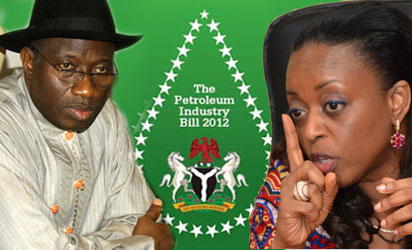
President Jonathan and Petroleum Minister, Diezani
By Dele Sobowale
“A group without a leader is a mob”. Dele Sobowale.
Two mobs are engaged in a face-off on PIB: those for and those against. Those in support stand to lose if the lack of leadership continues on both sides.
PIB 1 died with the last National Assembly, despite the efforts of the International Oil Companies, IOCs, the President of Nigeria (President Jonathan) and the Minister for Petroleum Resources, Mrs Diezani Alison-Madueke. If you don’t mind my saying so, I was one of those who sent PIB 1 to the graveyard of history.
For instance, a few days after Jonathan paid an official visit to Turkey, where he announced that PIB 1 would be signed into law before end of May 2011, I declared in my SUNDAY VANGUARD column that it would not happen. And when a few weeks after the President, Mrs Alison-Madueke was echoing her boss about the passage of PIB 1 in 2011, I again told her, it would not happen. History will one day record that one pen-pusher, writing for VANGUARD Newspapers, made the President and the minister to eat their words.
However, it was not only Jonathan and the Minister who were dusted in 2011; the other real losers were the Governors and the people of the Niger Delta, who stood to benefit most especially from the passage of the bill. It is not for me to fully disclose here how, and why, the bill was defeated in 2011.
But, let me state one important reason. In 2011, PIB1 was leaderless crusade. The major beneficiaries of PIB 1 failed to realize that they were involved in a battle to change entrenched interests and replace them with other interests. PIB represents a revolutionary change from the past; and like all revolutions, it entails its own groups of winners and losers. What was, and is still, at stake runs into trillions of naira.
The existing structures, in the petroleum sector, grew out of Decree 33; signed into law on 21 April 1977, by Lt-General Olusegun Obasanjo. The Decree created the Nigerian National Petroleum Corporation, NNPC, which replaced the Nigerian National Oil Corporation, NNOC. According to the preamble to the said Decree 33, “The new corporation is empowered to engage in all [emphasis mine] commercial activities relating to the petroleum industry..”.
The Decree we must realize was promulgated by a centralist military government under which there was little or no debate about matters, irrespective of how vital, once the top brass has taken a position. The Decree expectedly gave broad powers to the military Head of State. The switch from dictatorship to 1uasi-democracy, such as we now have has altered very little in the way NNPC operates – it is still operated according to the whims and caprices of the President of Nigeria.
Unfortunately for the oil producing areas of Nigeria, the NNPC, for 33 years (1977-2010), was under the control of Obasanjo, Shagari, Buhari, Babangida, Abacha, Abubakar, Obasanjo and Yar’Adua – none of them from an oil producing state. Thus all the inequities that were perpetrated during those years have produced the cumulative effect we observe today. Senator Enang of Akwa Ibom might have been too flippant when he announced without proof that 83% of oil blocks were owned by Northerners.
But, broadly speaking, he was correct that the presence of northerners in the sector was overwhelmingly higher than that of people from the Niger Delta. Dr Lukman Rilwan was the longest serving Minister of Petroleum, in addition to serving Nigeria’s turn at OPEC. Buhari and Professor Aminu join the list of Northern Ministers of Petroleum.
Even when someone from the Niger Delta was Minister – Etiebet and Etete – he served only at the pleasure of the Northern Head of State – Babangida and Abacha – among the longest military rulers. Perhaps, we will one day know the complete list of recipients of oil blocks which the rulers were “dashing out” as if it was their personal inheritance – instead of the commonwealth of millions of fellow Nigerians — dead and alive.
The underlying intention of PIB 1 and 2 remains the same – to introduce more equity into the system and remove the practice of “monkey owns the food, but baboon chop”. Unfortunately, the framers of PIB, being the “oppressed” or “victimized”, have made the mistake of thinking that “the facts speak for themselves”, namely, that everybody can see that the Decree 33 of 1977 was a statute which ultimately would promote large corruption resulting in a few people amassing “wealth without work” – because that is what has happened in the case of General T.Y. Danjuma (rtd) and the favoured few.
Despite the highly publicized philanthropic projects people like that engage in, it still amounts to giving back pittance from the bounties Decree 33 of 1977 provides daily. The mention of Danjuma is deliberate. He was the “power behind the throne of the Obasanjo regime at the time as the Chief of Army Staff. It was not a coincidence that he ended up with a gusher on his hands.
But, now things have changed, or are supposed to change. Elected presidents cannot give away the people’s properties, anyhow, without risking majour political and social upheavals. Second, the oil-producing areas, thanks to Obong Victor Attah’s Resource Control, have woken up to the injustice embedded in the present system.
Somehow, it must have occurred to Jonathan and his close associates, as well as other stakeholders in the Niger Delta, that, even if he serves two terms, Jonathan will one day go home and the power might switch to the north again.
Disclaimer
Comments expressed here do not reflect the opinions of Vanguard newspapers or any employee thereof.