
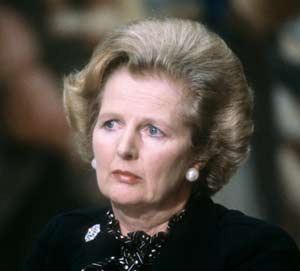
A picture dated September 9, 1980 shows British Prime Minister Margaret Thatcher attending the 5th Franco-British summit in Paris. Former British prime minister Margaret Thatcher, the “Iron Lady” who shaped a generation of British politics, died following a stroke on April 8, 2013 at the age of 87, her spokesman said. AFP PHOTO
By Muyiwa Adetiba
The view from the 14th floor of Britannia International Hotel at the Canary Wharf was pretty impressive. You saw sleek, modern buildings that dotted the skyline and housed some of the biggest banks in the world. You saw names of financial institutions that you had heard and read about.
You saw tall, modern apartment buildings that rose into the sky and penthouses that you would give almost anything to live in. You saw light rails snaking their way mid-air, round these tall buildings and cable cars that flew like big birds, over the buildings. You saw the interplay of chrome, glass and modern architecture.
In the night, you saw creative, carnival-like lights that gave life and light to the night skies. In the morning, the crisp but bitingly refreshing spring air hit your face as you made a brisk, five minute walk to the Hilton Hotel for breakfast with a few close friends.
This was not my first visit to the Canary Wharf. It was not my second. But I have never seized to be amazed at the vision that gave birth to what is known as ‘the city’— a place for business and businessmen. Canary Wharf was not always Canary wharf, the financial capital of the world.
For many years, it was known as Dockland Yard because of its sea port. The port served its purpose which was to bring goods to central London. Only a few people at the time could have imagined or envisioned what later became of Dockland Yard.
This was Sunday, April 7. A day later, the person whose vision I had just relived, passed on. Baroness Margaret Thatcher, perhaps the most powerful Prime Minister Britain ever had, died on April 8, at the age of 87. It was Margaret Thatcher and her team that envisioned Canary Wharf as the financial hub of the world, and moved with characteristic doggedness to achieve that vision, and create a place that became conducive to high finance and deals.
I had also relived another of her legacy a few days earlier at the airport when I had to show an authentic visa before I could be let into Britain. Until her era, Nigeria didn’t need a visa to enter the UK. She decided that Nigeria, along with certain–not all–commonwealth countries had to procure visas to enter the UK in order to control immigration.
Another policy of hers that I found distasteful was her open support for Southern Africa during apartheid. It is a no brainer to say apartheid would have fallen long before it did but for her clear support. As a young journalist, I found the position of Britain frustrating and I remember discussing this with the late Joe Garba who was then the External Affairs Minister. But she defended the interest of her country and her kith and kin the best way she knew. When Britain’s economic interests were threatened by governments like the Murtala Mohammed’s government, she made a U turn. The fall of apartheid thereafter became inevitable.
Its easy however, to forget what Britain was like before she took over the reins of power. The trade unions had become so powerful that they had disgraced many a Prime minister – labour and conservative – out of office. In a moment of frustration, James Callaghan, a labour PM once said he would emigrate if he was a young man. I remember getting to London on a wet May morning to meet the street littered with putrefying, stinking garbage that had been left uncollected for days; another product of the seemingly unending strikes in the country. Margaret Thatcher cleaned Britain up, literally and figuratively. The ‘once sick man of Europe’ as Britain was derisively called, got a shot in the arm and became a healthy, family man.
She was disdainful of the unions and those on the dole while wining and dining with the rich and the powerful. Britain became a capitalist state in almost everything but the name.
Her critics believed that the she destroyed the soul of Britain as a caring, welfare state when she reduced State support for the poor. But no one, not even her most vitriolic critics could deny that she was a transformational leader. Very few would argue that she gave respect and a voice back to Britain in international fora.
She had a vision and the strength of character to pursue this vision. It was inevitable that she would step on toes and make mistakes. The Falkland war raised her profile while the poll tax pulled her down. But she left office with her integrity intact and had remained scandal free save for the unfortunate incident of her son Mark who unwisely interfered in the affairs of Equitorial Guinea.
What about us? What legacy are we leaving behind? To those who think life is about the accumulation of wealth, let me say that I have never heard of or read a citation that mentions the number of containers a person has at the wharf or the houses he has in the country side.
Everybody who has a life has an opportunity to leave a legacy. Those who have the chance to transform their country or their community don’t know how lucky they are. The pursuit of material things should be the last thing a sensible person in leadership should do.
Baroness Thatcher has lived her life and left her legacy. What is yours going to be?
Disclaimer
Comments expressed here do not reflect the opinions of Vanguard newspapers or any employee thereof.