
By McPhilips Nwachukwu
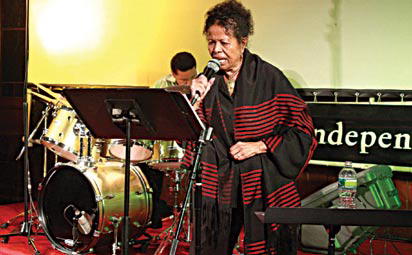
It was a historic moment last week, when an African American family of Sculptor Melvin Edwards came to Benin, Nigeria with cremated ash of his late wife, poet Jayne Cortez for final burial. The quiet and symbolic ceremony underlies the eternal connection between Africa at home and Africa in the Diaspora.
The ceremony was a quiet one. It was a wish that was ritually and historically symbolic. It was one last wish by a departing wife, mother and grand mother. In a more emotional sense, It was a wish , if not a prayer, from the dead to the living.
This wish was wired across seven seas. And in the fullness of time, it became a journey of ritual appeasement.
What happened that brilliant Sunday afternoon was simply a fulfillment of that African dictum that there is an eternal communion between the living and the dead.

Three men: Sculptor Melvin Edwards, his son, Edebor Donaldo and grandson, Akeem had travelled across the mythical seven seas to grant the wish of their dead wife , mother and grand mother,Jayne Cortez.
Before she died on 28 December, 2012 at the age of 78, the renowned American poet and and human rights activist had instructed her family that she be buried in Africa, the place she called home.
The late poet was an all round artist: a poet, performer , theatre director and an active change agent. Besides writing a couple of poetry works published with her imprint, Bola Press,Cortez founded the Watts Repertory Theatre company for which she served as it’s artistic director.
She had an unflinching belief in the power of art as a mobilisation vehicle for the propagation of political causes and hence, the use of her work in the registration of voters in Mississippi in 1960.
Being her desire to be brought back to Africa, the Cortez’s family felt obliged to grant that significant request by their ancestral home loving wife and mother.
Having concluded the rites of burial under the blessing of His Majesty, Oba Eriadiuwa of Benin, the Edwards’ sitting by the sea side restruant of Lagos Motor Boat Club, Awolowo road in the company of Professor JP Clark looked fulfilled.
Gazing intensely at the going and coming of the sea wave, one needed not to be told that their grieving hearts had been transported again to that same coming and going that shaped the ritual of their coming to Africa to mark a historic moment.
Donaldo, late Cortez’s son, spotting black T shirt atop a jean trouser and Akeem grandson , also wearing a T Shirt a top a blue faded jean trouser, sat quietly and watched their father and Clark ate launch.
And time came to talk:” I am a retired Professor, Melvin began. “As couples we spent time in many parts of Africa. We stayed in Zimbabwe, South Africa, Nigeria and Senegal. Jayne was an intensely African person. She even wrote a poem, which she dedicated to Nelson Mandela before he was released from prison. That poem was titled, Mandela is Coming. It was both poetry and music.”
Continuing he said : “ she wrote poetry that had to do with Africa and African experiences. She wrote poems that reflected African culture. And by culture, I mean everything art. It was poetry, music, religion, philosophy, science and all of that. She was in fact, a very remarkable woman.
So, when she died , we made contact with some of the people we had known in Benin , who took our request to the Oba of Benin and he granted our request. In fact, he granted my wife’s request really.
On granting us the request, we prepared to come. The coordinator between us and the Oba and the place is Chief Daniel Innieh. This ceremony is not just a mere ceremony. It is a very important one. In fact, very important to us as African Americans. It shows that we want to come home. In other words , this is to say that this is our place.
For us as a family, it is one great experience. I am here, my son is here and my grandson is here also. It is a great experience because all of us have come to observe and share in this great experience.”
Giving further insight into his late wife’ life, sculptor Edwards, who is known for his land mark sculptural installation, Lynch Fragment, a work inspired by the Civil Rights Movement in America noted that no other poet of American origin made more impact on American poetry than Jayne Cortez.
” She did poetry in a very unique way. One of the unique ways was by combining poetry, music and song in a musical accompaniment.” He said.
Continuing he added that : “At the same time, it was an international impact and an important one both in the literary, aesthetic, political and social realities of our world. She did all of these in a special and unique ways.”
With over twelve collections of poetry to her credit, late Cortez, who with Ghanaian writer, Ama Ata Aidoo founded the Organisation of Women Writers of Africa also organised the project called Slave Route: The Long Memory.
Her works, he said, were read and performed in universities, festivals, museums in Africa, Europe and Asia.
In line with tradition, the Edwards revealed plans to design and construct a befitting house at the Sapele road , Benin burial site for the late poet.
According to him, ” we are quite aware of the tradition of house and burial in relation to the house. We will develop the place and there is no question about that . So that in the future people will know who is there, adding that “ the burial site is as significant as it is symbolic given the ritual of libation which is usually performed at burial sites in Africa.”
Describing his mother as “ a very powerful poet, Donaldo, first son of the late poet said that her mother’s deep love for Africa reflected so much in her works to the extent that she drew most of her images from Nigeria.
He noted that it was the same intense love and yearning for the home land of Africa that culminated in her desire to be brought home to be given final burial.
In the same vein, sober looking grandson, Akeem described his grandmother as a “ very close, strong, intellectual and hospitable person.” He however regretted that he only came to Africa the first time on the occasion of the burial of his beloved grand mother.
Disclaimer
Comments expressed here do not reflect the opinions of Vanguard newspapers or any employee thereof.