
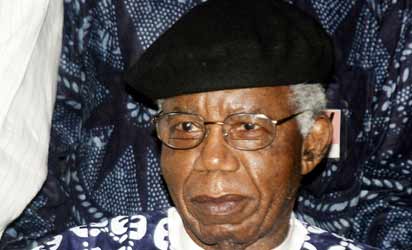
Late Prof Chinua Achebe
By Denrele Animasaun
“It is the storyteller,who makes us what we are, who creates history. The storyteller creates the memory that the survivors must have – otherwise their surviving would have no meaning.” – Chinua Achebe
Chinua Achebe, the internationally celebrated Nigerian author, statesman and dissident who gave literary birth to modern Africa with Things Fall Apart, has died. He was 82. I was in my office when I heard of the passing of our elder, Chinua Achebe. The news shook me to the core, then I scrambled to the nearest computer pot. I was stunned there was no mistake, it was true that Chinua Achebe was no more.
I had to call my son, who although at 23, had never been on Nigerian soil, but read Things Fall Apart at his secondary school. When I told him the news, he paused and then he said of how lucky we were to have read his books. I tried to think why I was bereft, I felt I lost someone close. Then I realised I have. Through Chinua Achebe’s novels we in our individual ways caught a glimpse of the man and his mastery.

Late Prof Chinua Achebe
Chinua Achebe had influenced many a writer and Nelson Mandela said how reading his novels made the walls of the prison invisible. Many of my non-Nigerian friends had read Things Fall Apart and many were converts of his novels as a result. Many of the UK newspapers carried his passing and all were very complimentary of the man. And so they should, after all many had read his books and some had been present at some of his talks .
Things Fall Apart has sold more than eight million copies worldwide and translated into more than 50 languages. The novel has been a staple of many schools the world over. He was a critic of Western literature, of that he said:” Until Lions write their own history, the tale of the hunt will always glorify the hunter “ and he was right, our history can only be told by us and not from an outsider’s clouded view of the then colonial’s terminology of the “savages”.
He was vehemently critical of Joseph Conrad’s Heart of Darkness, which was a standard reading for millions around the colonised countries. He set a standard and blazed a trail; without a doubt has been responsible for founding and developing African literature by an African. “Nobody can teach me who I am. You can describe parts of me, but who I am – and what I need – is something I have to find out myself.” – Chinua had said. Until his death, Prof Achebe was the David and Marianna Fisher University Professor and Professor of Africana Studies at Brown, New York.
He twice rejected being named a Commander of the Order of the Federal Republic(CON) on the basis that the Nigerian government was riddled with greed and corruption. “The reasons for rejecting the offer when it was first made have not been addressed, let alone solved. It is inappropriate to offer it again to me,” he said when it was offered the second time.
He said at the time how he had watched events in Nigeria with alarm and dismay. He said “I have watched particularly the chaos in my own state of Anambra where a small clique of renegades, openly boasting its connections in high places, seems determined to turn my homeland into a bankrupt and lawless fiefdom” and “ I am appalled by the brazenness of this clique and the silence, if not connivance, of the presidency,” continued Achebe .
President Jonathan responded that Achebe’s claim “clearly flies in the face of the reality of Nigeria’s current political situation” and he expressed hope that the writer would “find time to visit home soon and see the progress being made by the Jonathan administration for himself.” I guess Achebe knew enough and he said that ”Nigeria is what it is because its leaders are not what they should be”.
I’ve had trouble now and again in Nigeria because I have spoken up about the mistreatment of factions in the country because of difference in religion. These are things we should put behind us,-Chinua Achebe once wrote.
As Achebe told The Associated Press in 2008, that “age was respected among my people, but achievement was revere”. As the elders said, if “Storytellers are a threat. They threaten all champions of control, they frighten usurpers of the right-to-freedom of the human spirit — in state, in church or mosque, in party congress, in the university or wherever.”
Achebe was irascible and he defined himself as a protest writer, with restraint. Whatever the restraint he had he managed it well with grace and aplomb . Like an astute observer he noted that he feared what could become of his beloved country, Nigeria, that should a leaderless uprising took over what was a bad government will only be replaced by one much worse. He was right. If the word should side with the people against the “ the Emperor” that oppresses his or her people.
The last word: when asked how he felt being seen as the founder of African Literature , he said “I resisted that very, very strongly. It’s really a serious belief (of mine) that it’s risky for anyone to lay claim to something as huge and important as African literature… the contribution made down the ages. I don’t want to be singled out as the one behind it because there were many of us – many, many of us”.
Chinua Achebe left his work, his legacy and for every child, adult that open up Things Fall Apart or any of his other books they will not be alone, they will in fact be opening up to a world from the past and complex characters who can be from anywhere in the world. Achebe came with a purpose and he did more by writing.
He changed the way Africa was portrayed by the colonials and the outside world. He was always uncompromising and he, indeed wrote what he wanted and he did not want his life to be dictated to by anybody but him. We are indeed thankful to have had him in our midst and for him to have been one of our own. We will always be accompanied by this ebullient imaginative, creative purposeful, patriotic African soul.
Disclaimer
Comments expressed here do not reflect the opinions of Vanguard newspapers or any employee thereof.