
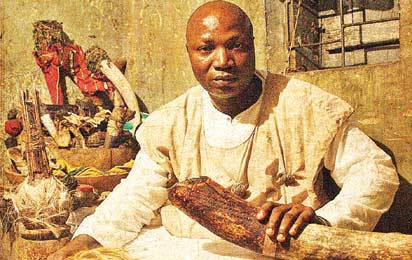
*Orisa Odu, (deity of blessing and protection)
By Japhet Alakam
In continuation of its bid towards the promotion of lens based media, the Centre for Contemporary Art, Lagos last week opened another unique and visually compelling photographic exhibition by Adolphus Opara tittled: “Emissaries of An Iconic Religion”.
The photo-documentary series which brings together portraits of traditional Yoruba priests from three different western states in Nigeria opened on 9th March, 2013, at CCA,Lagos and will run till 21st April 2013.
The exhibition which is the first major solo exhibition in Nigeria of the Lagos-based photographer shows series of portraits of diviners from the regions of South-Western Nigeria which invoke the symbols and narratives of indigenous religious beliefs, as well as its relevance and function within the society.

*Orisa Odu, (deity of blessing and protection)
Complex issue of religion
The exhibition which is in line with the Centre’s past records of organising exhibitions that generate debates, as usual, looks at the complex issue of religion; especially as practised by Africans.
Emissaries features fifteen images from the twenty strong “Emissaries” series made by the artist between 2009 and 2011 that offer a unique and visually compelling photographic portrayal of the custodians of indigenous religious beliefs.
Some of the works include ; Orisa Imole(deity of defence and judgment) with a young man, Chief Aderemi Awogbemi pictured with several shrine objects, Orisa Lajoomi(deity of children), Orisa Odu(deity of blessing and protection) and others.
Through the body of work which pushes the boundaries of contemporary portraiture, Opara highlights some of the existing tensions between the cultures of animistic belief and organised religion.
The works also engage the sensitive debate surrounding the demonisation and denigration of traditional religion instigated by colonial and missionary rhetoric.
The exhibition according to the curator, Jude Anogwih offers opportunity for viewers to share diverse views about religion particularly the Yoruba traditional religion. Though the artists is not calling for a return to the local system of worship, he says, “I want to tell the story of our roots and need to know it and preserve it, if possible, document it before it finally goes into extinction.”
One important statement about the images, is that apart from the artistic work and colour, Opara created photographs that exude confidence, pride and dignity for African religion unlike most presentations by the West that present Africans in the way they want to see Africans.
Emissaries of an Iconic Religion goes beyond the reportage and documentary style characteristic of Opara’s work. It stands apart from his “Rugbol” (2009/10) series, or his ongoing projects Shrinking Shores (2011–) and Cocoa (2011–) in its contextual assertions and stylistic composition.
Opara attempts to re-assert the importance, the centrality and the vitality of local belief systems despite the incursion of external pressures.“
Arresting and uncanny, these images of diviners from the regions of South-Western Nigeria engage our identities in the 21st century and its evolving meanings. Whilst a return to traditional belief is not advocated nor rejected, an engagement of their role within contemporary society is warranted.
These large-format, painterly images, imbued with luxuriant colours attempt to re-assert the importance and vitality of local belief systems, in spite of external pressures.
Adolphus Opara has exhibited widely, both locally and internationally. His recent exhibitions include Contested Terrains, 2011, Tate Modern, London; African Lace, 2010, Museum fur Vulkerkunde, Vienna, Austria; African Photography Encounters, 2011, Bamako, Mali among others.
Disclaimer
Comments expressed here do not reflect the opinions of Vanguard newspapers or any employee thereof.