
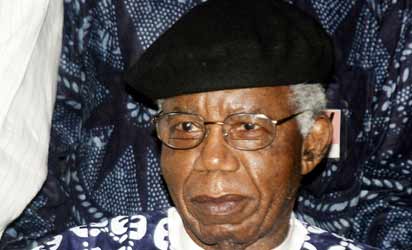
Late Prof Chinua Achebe
By McPhilips Nwachukwu
Achebe’s remarkable journey into the creative turf began in 1958 with the publication of classical novel Things Fall Apart. Set in the fictional community of Umofia, the novel anthropologically explores the Igbo life completely destroyed by the arrival of the White man, whose coming into the peaceful community created serious socio, political and cultural conflicts. The novel, using the character of its hero, Okonkwo presented the continent ofAfrica in its realistic portrait against the background of permittivity and uncultured painted in the narratives of Western writers.
The publication of Things Fall Apart was successfully followed by the publication of Arrow of God. The novel adjudged by many people as one of the best of Achebe’s creative offerings like its predecessor, Things Fall Apart, also engages the colonial conflict that was the order of the day and particularly examines power as a destructive force.
After Arrow of God, Achebe in 1964 wrote another interesting novel titled No Longer At Ease. This third novel, which concludes the first three of Achebe’s novels tells the story of Obi Okonkwo, a split character, who is destroyed by the conflict created by the old world of his grand father Unoka in Things Fall Apart and the new world in transition of his father, Okonkwo.
Achebe’s first three novels were written in a very organic manner. While the first two novels look at the problem of disconnection created by the arrival of the white man, the third novel presents to the world a wounded soul, who carries the psychological scar of conflict in the person of Obi Okonkwo.

Late Prof Chinua Achebe
After the the first three novels, Achebe in 1966 wrote another significant novel, seen in many quarters as a prophetic novel,A Man of the People. Achebe’s Man of the People drew the ire of the ruling establishment because it addressed the issues of corruption and ineptitude that occasioned the politics of the first Republic and ends on a note of military take over.
Achebe’s early novels were read and interpreted from the prism of masculinity. And perhaps to assuage the feelings of his readers and especially, his female readers, in 1987, he published Anthill of the Savannah. The novel tries to address the plight of Africa’s marginalised women using the character of Beatrice, a new voice that represents a new generation. The novel tries to close the imbalance created in the previous novels where the women are kept in the marginal ends.
In the genre of short stories, Achebe published about seven. They are Marriage Is a Private Affair (1952) ,Dead Men’s Path(1953), The Sacrificial Egg and Other Stories( 1953), Civil Peace (1971)and Girls At War(1973).
Achebe also wrote poetry. He published the following poetry collections; Beware Soul Brothers(1971), Don’t Let Him Die( 1978), Another Africa(1998), Collected Poems( 2005) Refugee Mother and Child and Vultures.
A famous critic and internationally acclaimed award winning novelist. He also published a number of land mark critical essays including; The Novelist As A Teacher(1965),An Image of Africa: Racism in Conrad’s Heart of Darkness(1978), Trouble With Nigeria (1983), Hopes and Impediment Morning Yet on Creation Day (1975).
The man , who was variously addressed as the Iroko of African literature and a legend, a loving father and a brilliant teacher also wrote for children. His children’s books include, Chike and the River, which he called novel for boys, How the Leopold Got His Claws, The Flute and the Drum.
As a writer, Achebe wrote with depth and employed the English language to good use in the projection of rich Igbo language culture and tradition. He wrote in a very simple and unique style and through his writing evolved a strong ideological vehicle with which he fought for self and communal identity.
Achebe closed the chapter of his interesting writing career with the publication in 2012 of wave making autobiography, There Was A Country. The book sub titled , A Personal History explores the development of Achebe as a writer, his critical positions, political visions and his intercessory roles in Igbo life and during Biafran civil.
Disclaimer
Comments expressed here do not reflect the opinions of Vanguard newspapers or any employee thereof.