
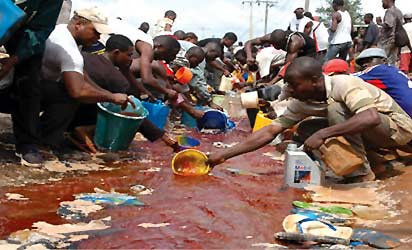
*File Photo: Activity at a vandalised oil pipe
By Dele Sobowale
“Destiny is not a matter of chance; it is a matter of choice. It is not a thing to be waited for; it is a thing to be achieved”. William Jenning Bryan, 1860-1925. (VANGUARD BOOK OF QUOTATIONS p 38).
From the first annual Nigerian Economic Summit Group, introduced by Chief Ernest Shonekan, in 1992, till today, the complex issues summarized as development had been on the front of the national agenda. Development, apart from leading to improved economic, social, political and personal welfare was expected to lead Nigeria towards what many had regarded as our own manifest destiny.
Often stated but not yet realized, was the notion that it would make our country the largest economy in Africa and truly make Nigeria the giant of Africa. Several reasons have been offered to explain the gap between the dream and the reality. Out of all the multiple causes of our low development, despite our universally acknowledged potential, perhaps, the single most important is the change from collective cake baking to cake sharing.
Permit me to use an analogy which should drive the point home, especially at this time when we are embarking on reviewing the 1999 constitution – which like all the military imposed constitutions, had merely aided in fostering our under-development.
Imagine, if you can, a set of kids to whose fathers had rolled up their sleeves and worked, tirelessly, to raise them well; gave them the best education at the time; taught them the lessons of thrift and hard and differentiated work; inculcated the spirit of self-reliance; and, above all, left a society where crime did not pay.
Each household (read region) competed with the others for progress because theirs was not a society where “Wealth without work” (apologies to Ghandi) was celebrated. During the era, their communities were growing as far as any in the world.
Poverty was negligible because idleness was abhorred; there was dignity of labour; a university professor was as highly paid as a Permanent Secretary and there was near food self-sufficiency. That was Nigeria until 1966. There was true federalism anchored on the principle of derivation.
The Western Region, which then included Edo and Delta, established agricultural research institutes to diversify its export base and to produce intermediate products. The Eastern Region went all out to find markets for its coal. The North was famous for the groundnut pyramids and for leather tanning – among other things.
Agriculture was truly the backbone of the Nigerian economy and since each region’s revenue was a function of how much it earned, cake sharing was out of question. The first military coup, apart from the lasting damage it did to our corporate political existence, also introduced centralization of revenue and “cake sharing”.
That, by itself, would have retarded our growth and march towards economic greatness. The discovery of crude oil in large volumes exacerbated the problem such that, today, only a few of the states created from the balkanized regions can survive on their own internally generated revenue.

*File Photo: Activity at a vandalised oil pipe
The sudden influx on huge oil revenue had blinded successive military regimes to the dangers ahead as we moved from three regions to thirty-six states – about thirty of which depend on the federally allocation revenue. Our transition from cake bakers, a productive group, to cake sharers, a consuming collection of beggar states, had all but guaranteed that economic progress would be retarded and the struggle for political supremacy will intensify.
Unfortunately, it has not yet dawned on us that murderous political struggles can never allow the sort of cooperation which can promote rapid economic growth. Bad politics is killing the nation more than anything else.
In a nation of bakers, where everybody is, to a great extent, self-reliant, there is very little fear of being “cheated”; in a nation of sharers, the suspicion is pervasive. Indeed, it is inevitable that more for A means less for B, C, D etc. Furthermore, it is even killing all the incentive to be self-reliant. Let me again give an example.
South Africa is blessed with large deposits of coal; so is Nigeria. On the eve of our independence in 1960, both South Africa and Nigeria generated a great deal of their power from coal. Today, about 15% of South African power supply, now about 45,000MW or 6,750 MW comes from coal. That is 2,500MW more than Nigeria generates from her hydro and gas fired power plants.
The Jonathan government which had been asking us to clap, for providing 4,250 MW, will probably declare a public holiday and expect us to dance in the streets if they ever achieve 6,750 MW. Yet, power generation in Nigeria started with coal. But, no sooner did oil revenue become the mainstay of our economy than we abandoned coal powered plants. Instead of learning about new developments that could have made coal an option for generating power, we scrapped it.
Under the original principle of derivation, Enugu, Anambra and, at least, Ebonyi, would not only have been able to establish their own coal-based power plants, they would have pursued, with vigour, other uses for coal – including export. But, why should Enugu care to develop its coal potentials when the government can simply sit at home and collect its own share of the “national cake”?
For that matter, why should the people of the state, or any other state care how the states revenue is spent? After all, it is nobody’s money; nobody worked for it. The demonstrable absence of ownership of state funds constitutes the fundamental reason why no appreciable effort is made, nationwide, to increase the size of the cake and why the citizenry had accepted mind-boggling corruption as the norm in governments.
On the other hand, if Enugu state has greater control over its coal deposits and can develop them, not only to generate power for its people, but, to earn revenue from the physical and chemical processing of coal, the state would not only be self-sufficient in power generation, it might become the first state enjoying un-interrupted power supply.
Given its central location in the Southeast and parts of the Middle Belt, it might then be able to attract investments in various sectors. Unfortunately, such opportunities are foreclosed because of the existing arrangement, a rogue type of federalism, which encourages governments, nationwide, to take the easy way out and pursue hand-outs from Abuja instead of promoting state entrepreneurship.
Sadly, Enugu is not alone. Virtually every non-oil producing state and its government, irrespective of political party in power, had taken the easy way out for development. States and zones have embarked on what they consider development plans. Economic Summits are frequently announced and undertaken.
Communiues are issued promising diversification, increasing foreign direct investment, FDI, and creating millions in new jobs. Just as frequently, the nation’s army of unemployed, especially youths, wait in vain for the promised jobs. Why have we been failing?
The reason, to me is simple. We have created, at state and local levels, governments that are economic beggars. And as everybody knows, beggars don’t create jobs; they take from those who have. The over-dependence of states on federally distributed revenue had left the nation with few engines of development – which is what states and local governments should represent.
Consequently, all the governments of Nigeria, irrespective of political party, lie about their abilities to create jobs; and, when they create a few thousands, they then set in motion their propaganda machineries to make Mount Everest out of the smallest ant hills they have achieved.
The truth is there is no substitute for derivation and the healthy competition it might foster among states – even if it means giving more to the current oil producing states. As it is the future of oil as dominant global commodity is cloudy; but clearer is the fact that several nations have, in recent years, discovered their own oil deposits.
Each new oil producing nation reduces our market share while simultaneously increasing the number of our competitors. Only God knows when crude will become a commodity so widely available that t will become a buyers’ market and prices will head for the basement.
In fact, crude oil prices getting as low as $70 per barrel will unleash social unrests in this country which will make the Arab Spring appear like child’s play. But, by then, it will be too late to diversify our economy; to introduce true federalism based on derivation and to promote healthy competition.
Very urgently, we need to return to “That day of starting out….
Disclaimer
Comments expressed here do not reflect the opinions of Vanguard newspapers or any employee thereof.