
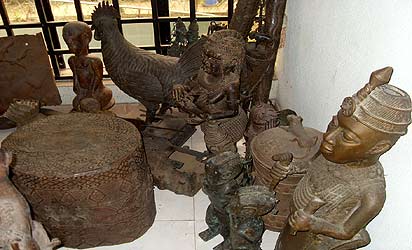
*Sculptures
By CALEB AYANSINA
NOK Art came to lime light in 1928, when Col. J. Dent Young found a small terracotta head amongst the gravels from tin mining operations near the village of Nok in the Jos Plateau of Central Nigeria.
Nok style terracotta sculptures have been found in a wide contiguous area extending over 500 by 150 kilometres from Kagara to Katsina Ala. In all the sculptures from this area there is a uniformity of characteristics, particularly noticeable in the triangular or semi-circular shape of the eyes, whose pupils are represented by deeply pierced holes.
However, Vanguard investigation revealed that most of these Nigerian ancient artefacts have been trafficked to Europe and America, and held by both Public Institutions such as Museums, Universities, Galleries, and private individuals.
In August 2010, French authorities through its Directorate of Custom and Excise seized near Paris, 5 Nok (Terracotta) Statuettes; the oldest one dates back between 1400 BC and some 700 BC from its citizen who was coming in from Africa.

*Sculptures
But as the saying goes, French-fries were neither invented in France nor English language was invested in England.
Consequently, Nok terracotta’s were neither invented in France nor in other parts of the world except Nigeria, therefore, whether they were stolen or taken away, they are making their ways back to their country of origin; Nigeria, as the French Authorities handed over the 5 Nok Terracotta figures to the Nigerian Government.
At the handing over ceremony in Abuja last week, the Director General of the National Commission for Museums and Monuments, NCMM, Alhaji Yusuf Usman spoke on three ways of collecting Nigerian Artefacts by foreign countries.
He said, “The first wave
was during colonial period first by invading forces of imperial Britain such as the Benin Punitive expedition of 1897 and later by western anthropologists who carried out field work in various parts of the country. The second wave of collection was in the 1960s and 1970s when the civil war provoked large exodus of our artefacts through our borders with neighbouring countries.
“The third wave of exodus of Nigeria artefacts, which is the illegal excavation and looting of heritage, archaeological sites and museums by unscrupulous Nigerians and their foreign collaborators.
“Although the looting of heritage and archaeological sites and museums has been an age long and worldwide problem, in Nigeria the problem reached epidemic proportions in the 1990s, when Nok and North Western Nigeria’s archaeological sites especially Kwatar Kwashi were massively raped and ripped off of their priceless objects.
Law enforcement agencies
“As for antiquities in our museums, it is pertinent to state that no theft has been recorded from the collection of the National Museums since 1990 to date.
“As we strive to protect what we have in our museums, we need the support of community leaders and the law enforcement agencies to police our heritage sites to prevent looting and our border to prevent illicit export of our heritage resources.”
Also, the French Ambassador Jacques Delabriolle explained that “this return is made in accordance with international law and within the framework of a French policy aiming at fighting the illicit imports, and especially illegal imports of cultural goods.”
Continuing, he added that “we do hope that this return of seized goods will confirm the excellent relations which exist between France and Nigeria, and that it will help preventing further illegal trafficking of items which are part of the Nigerian heritage, and belong to the Nigerian people.” In his remarks, the minister of Tourism, Culture and National Orientation Agency, Chief Edem Duke noted that art trafficking did no good than distorting stories of the different nationalities and cultures.
He said federal government had initiated modalities of returning illegally exported Benin objects to foreign countries, while challenging security operatives to compliment government’s efforts by preventing such trafficking at the country’s borders.
Disclaimer
Comments expressed here do not reflect the opinions of Vanguard newspapers or any employee thereof.