
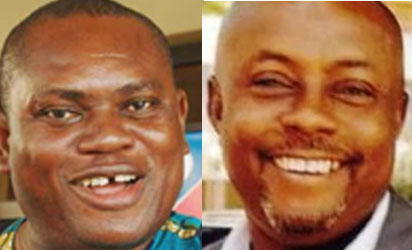
Silva and Amadi
By Obi Nwakanma
Today, the solitude in me remembers Ogbonna Amadi and Sylva Eleanya, two former colleagues here in the Vanguard, whose deaths this passing year robbed the journalism profession in Nigeria of two of its most talented reporters and technicians of the newscraft. I had arrived the Vanguard to be Features Editor in January 1994 bristling with redesign ideas for the features at the Vanguard.
However, by a series of deft shuffling and reshuffling by then Editor, Frank Aigbogun, I ended up on the Sunday Vanguard, where I suppose I was to show my paces. Needless to say, that my first two weeks in the Vanguard felt like a hazing and I was levitating mostly.
Ogbonna Amadi was one of the reporters who first warmed to me; he with my old pal, Yereba Kina, also in features were already establishing their names in the field as entertainment reporters – Ogbonna in Music and entertainment, Yereba in the movies as a film critic. The times were acute and exciting; full of robust and daring men, who gave the city of Lagos of the late 80s and the 90s the jazzy feel of something imminent, broken, and beautiful. The beauty was of the terrible sort, drawn mostly from the loud and raucous energy of the city. 

Among the most vital developments in that period was what we now call “Nollywood” – the emergence of the new local film industry shot on cheap budgets but which soon blossomed into a billion dollar industry. Adequate tribute has not been paid to the gritty and pioneering spirits that helped to launch the now ubiquitous “Nollywood” films; all kinds of experts now talk “Nollywood,” but it was a tradition built by a generation of then young Nigerian reporters who drew attention to a generation of actors who were then emerging from universities late in the 1980s.
The kernel of that movement came drawn mostly from actors trained at the University of Jos Theatre and the actors trained by the late Ola Rotimi at the University of Port-Harcourt Theatre School, some of whose first real stage appearances were on Rotimi’s play, Hopes of the Living Dead, which had opened and toured in 1986. But I digress a little.
I did mean to say that those rookie actors who came on later to dominate the new thing called Nollywood had in their early film careers from the 1990s, the likes of Ogbonna Amadi and the also now late Yereba Kina in the Vanguard to thank for providing the powerful interrogatory searchlight and penetrating gaze that helped to establish them in the public consciousness. Without the works of these men, with a few others, I dare to say, there’d have been no Nollywood.
Ogbonna was particularly drawn to the music scene, and was complementing the work of Tony Okonedo, then the dean of the metro party circuit, to report the vibrant cultural energy of the city of Lagos. He brought into great relief, by his piquant style, the lives of those who became the new stars of that new horizon. Fiercely independent, and colorful, Ogbonna had a quick temper and something of an abrasive tongue.
He was fearless and he was blunt. But that was one of the things I loved about him: he had no time for cant, and he was a lively and convinced disputant who stood his ground on matters in which he felt strongly. He was also, well, clubbable. Ogbonna loved to see himself as an “Aba boy” – because he grew up in that city too- but he soon came to love Lagos even more fiercely; he thrived in this city; he gave it soul, and he gave it a dash of spirit.
Some of that soul and spirit departed from Lagos with Ogbonna’s death. And so too with Sylva Eleanya, whom I called “Silver Shadow.” It was always quite a thing in those days to see Sports Editor Onochie Anibeze, Tony Ubani, and Sylva, the sports photographer work. They complemented each other well, I suspect because, as a photographer, Sylva Eleanya had much more than flair.

Silva and Amadi
He had a clear, professional relationship with the camera, and he took some of the more astonishing shots on the sports pages in the Nigerian newspaper. I was dumbfounded by these deaths in this past year. Every death is shocking certainly, and all good things must come to an end, and all that, but it was in the manner of the dying – the quick, surgical cut of these deaths – that was most shocking.
It throws light once more, on the primitive state of Nigeria’s emergency care system. Had there been better quality of public healthcare, particularly facilities to evacuate or transport patients to the Casualty wards quickly enough, and the presence of trained emergency care providers, these men might have had a slight window of opportunity to live.
Indeed that small, vital window is crucial, and often makes the difference between life and death. Betterstill, there ought be in the lessons of these deaths, the necessity for greater personal responsibility too – the need for regular annual medical checks; particularly to check the lipids and cholesterol levels; a little more care with diet, regular exercises – all that good stuff.
What shocks more certainly is the finality of it all; the reality that we now carry these faces only in memory, and that the fierce absence of their physical being tells on those who have shared in their lives up to this year: their children, their spouses; their mothers and fathers, their friends, lovers, peers – those who have been interconnected with them to the deep dance of life. The year is always a gaunt hole, swallowing the excess of life. Last week, it was the turn of two powerful men: Andrew Owoeye Azazi, former National Security Adviser to the president, and Patrick Yakowa, governor of Kaduna state.
They went to the creeks to a burial and flew to their own demise. There is brewing controversy about those deaths now; hints of sabotage. But it is not my leave to delve into what all that means in this essay. I just want to leave a little thought to those who mourn them – their friends and families – to remember them, as we rush into the frenzy of Christmas; as we forget their faces and their footprints; as the year closes, and as we are drawn to this annual shebang called Christmas – to send good thoughts to those who will not be in the mood to celebrate Christmas this year. But to those who can, we also say, Merry Christmas.
Disclaimer
Comments expressed here do not reflect the opinions of Vanguard newspapers or any employee thereof.