
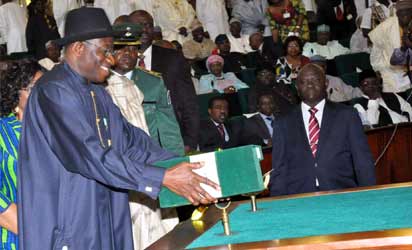
File photo: PRESIDENT GOODLUCK JONATHAN LAYING THE 2013 BUDGET PROPOSAL BEFORE THE JOINT SESSION OF THE NATIONAL ASSEMBLY IN ABUJA ON WEDNESDAY (10/10/12). STATE HOUSE PHOTO
By Dele Sobowale
[The proposed benchmark is] “based on a well established econometric methodology of estimating oil price moving averages”- President Jonathan, during presentation of the 2013 Budget.
At last, after thirteen years of return to civilian rule, the Executive branch of government has presented to the National Assembly, NASS, next year’s budget in the early parts of the third quarter of the year. Dr Ngozi Okonjo-Iweala, the Federal Minister of Finance, has demonstrated that she, more than any of her predecessors, since she left the office, in 2005, recognizes that time is also an economic variable –just like capital and human resources. For once, the NASS is now under pressure to pass an Appropriation Bill before the end of January, if not by December 31st of 2012. It will be interesting to see how the legislators handle this “hot potato” handed to them much earlier than usual.
However, they can take shelter under the excuse that that the 2012 Budget had been so badly implemented, and much of it still needs to be touched to raise a valid query regarding the soundness of the 2013 Budget since it should naturally be founded on the end year projections for 2012. The Speaker of the House of Representatives, Mr. Tambuwal, appears to have taken that approach when he roundly condemned the execution of the current year’s budget.
The 2013 Budget has inadvertently landed in the NASS at a time when several vexatious matters have been placed on the national agenda at once; and there seems to be no end in sight. Security problems, which were once overwhelmingly paramount, have now to contend with the consequences of flood nationwide; unemployment reaching revolutionary levels; unbridled corruption in high places; the final surrender of Bakassi to Cameroun; government’s failure to implement budgets and achieve the results promised each and every year; and the pervasive lack of confidence in the national leadership from the president to most state governors.
SHAKY FOUNDATIONS – 2012 BUDGET AND $75 PER BARREL BENCHMARK
The N4.92 trillion budget proposed for next year is about 4.7% higher than the budget for 2012 which stood at N4.7 trillion, most of which has not been implemented. Specifically, funds to Ministries, Departments and Agencies of the Federal Government which, according to provisions of the Appropriation Act, should be released as and when due, were often withheld for months after they were due. Consequently, most capital projects are either at a standstill or have been abandoned by contractors. Tambuwal pointed to the result of the nationwide assessment tour of projects slated for 2012 by the government itself, which presented a dismal report. Every Ministry or Agency of government complained about funds withheld except for recurrent expenditure – mainly to pay salaries and very little else.
The poor execution of budgets in 2012 has been a pattern established since 2000 when the government of Olusegun Obasanjo started the flagrant disregard for the Appropriation Act by failing to execute annual budgets. In no single year, since that first full year budget, presented by an elected government, has the budget been treated with the seriousness it deserves. Even Okonjo Iweala’s first tour of duty, as Federal Minister of Finance, was not different from the others. Her failure in that respect was masked by the success achieved with debt reduction. This time around, with no obvious success to shield her performance on budget implementation, questions are being raised about her ability to work with people who are admittedly NOT world class – such as she had been accustomed to at the World Bank. Instead of the instant success which debt reduction represented, she stumbled into the subsidy removal trap and her profile had never been lower.
The confidence which finance ministers must induce in the people they lead had been eroded. Now, the tour reports will definitely place the administration under severe pressure; questions will be asked whether the government of President Goodluck Jonathan is capable of delivering the dividends of democracy – which has proved elusive for the vast majority of Nigerians since 1999.

PRESIDENT GOODLUCK JONATHAN LAYING THE 2013 BUDGET PROPOSAL BEFORE THE JOINT SESSION OF THE NATIONAL ASSEMBLY IN ABUJA ON WEDNESDAY (10/10/12). STATE HOUSE PHOTO
Certainly, a government which, in three years, has failed to implement its budget should understand why people will be skeptical about its ability to deliver on the next one. The Ministries, Departments and Agencies, which have failed woefully in the past thirteen years, especially the last one year, are still headed by the same individuals whose poor performance has placed Nigeria in this sad situation. One does not have to be a professional gambler to know that the odds are stacked against a positive turn around. As the lawyers say, “You can’t give what you don’t have”.
Mr. President, check the MDAs
Jonathan will be well-advised to take a hard and honest look at the Chief Executive Officers of the MDAs if he expects better results from the 2013 Budget implementation process.
While the human factor represents the most important element in the budget for 2013, and for all budgets for that matter, the other indispensable element is the soundness and honesty underlying the assumptions which provide the foundation for the budget. In this regard, the determination of the benchmark adopted for crude oil in the budget. The president, based undoubtedly on advice from the Ministers of Petroleum and Finance, insists on basing the budget on $75 per barrel; the National Assembly, or at least the House of Representatives, prefers $80 per barrel.
The difference of $5 per barrel represents 6.25% of the revenue which will ultimately be generated. While the administration would want Nigerians to believe that it bases its claims on “well established econometric methodology”, it is not totally being honest with the people. There is no universally acceptable methodology which applies to all oil producing countries. The econometric model selected is also determined by the objectives which the users of the model want to achieve.
The shambles of an illegal Excess Crude Oil Account
Unstated, but demonstrably true, is the fact that the Federal Government, has been operating an illegal Excess Crude Oil Account. Also, undeclared, but also a fact is the need by the Federal Government to increase the $1.5 billion in the Sovereign Wealth Fund, SWF, which the state governments are contending in court. The higher the difference between the actual selling price of crude and the benchmark price, the more money the Federal Government can withhold from the pool of funds to be shared by the three tiers of government. Even when some of the money in the “Excess Crude Account” is shared every quarter, the process still represents forced interest free credit from the other tiers of government to the Federal Government. What the Federal Government is asking the NASS to approve, based on $75 benchmark, when current prices are over $100 per barrel, and are expected to go higher in the first half of 2013, is a bigger pool of funds in the Excess Crude Account for the Federal Government to manipulate at will to the disadvantage of the other tiers of government.
For all the states of Nigeria, but most especially for those states devastated by flood, the time has come for them to be pro-active and support the NASS by insisting that, at least, $80 should be adopted as the benchmark for the budget in 2013.
Okonjo-Iweala has never hidden her disdain for the constitutional provisions which inhibit her and the government she serves from committing fiscal rape of the states. Obviously, she regards leaving a hefty amount in the Excess Crude Account and the SWF as her major objectives the second time as Federal Minister of Finance. While she is on more solid ground with SWF, which represents saving for the future, she is totally wrong on wanting to continue to operate the illegal Excess Crude Account. It is presumed that anybody taking up the job of the Federal Minister of Finance would have studied our laws and must have been prepared to abide by them. It is totally unacceptable for Okonjo-Iweala, or any other Minister for that matter, to propose continuing disobedience of our laws by the government she serves – on account of self-serving agenda.
What to expect from the budget
Based on the track record of this government and its predecessors, the 2013 Budget will, most probably, go down in history as another exercise in futility. It will not be implemented and NASS will do nothing.
Disclaimer
Comments expressed here do not reflect the opinions of Vanguard newspapers or any employee thereof.