
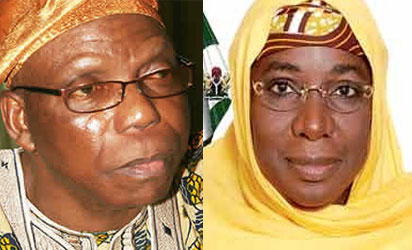
NUC Executive Secretary, Prof Okojie and Education Minister, Prof. Ruqqayatu Rufai
BY IKENNA ASOMBA
Amidst Federal Government’s concerted efforts to ensure the teeming secondary school leavers and youths gain increased access to university education through the establishment of nine new conventional universities in February 2011, worries and criticisms have continued to trail the decision.
As the nation rolled out the drums to celebrate its 52nd independence anniversary penultimate Monday, an academic, Olujimi Kayod has argued that the establishment of the nine new ivory towers may not address the rot bedeviling the nation’s education, its economic growth and development.

NUC Executive Secretary, Prof Okojie and Education Minister, Prof. Ruqayatu Rufai, .
However, he noted that the country should establish or upgrade its Polytechnics to specialised universities and de-emphazise traditional courses such as engineering, law, medicine, accountancy, banking & finance and a host of others.
Even though most pundits argue that the National Universities Commission’s approved 500 admission quota for each of the new universities makes little or no impact to salvage the plight of the over 500,000 candidates that are not likely to secure admission despite having the cut-off marks stipulated by the Federal Government in the last Universities Tertiary Matriculation Examination, Kayode, who was Director of Nigerian Institute of Journalism, Lagos, has a different view.
According to Kayode who spoke to Quadlife in an exclusive interview, the pertinent issue is not the number of students admitted but the quality of the graduates. This, he said, can only be engendered by the establishment or upgrading of Nigeria’s polytechnics to ‘specialised universities,’ rather than building more conventional universities.
The old good days
Recalling the old good days between 1948 until a point in the late 1980s, the Head, Department of Journalism, Lagos State University-Adebola Adegunwa School of Communication (LASUAASOC), noted that gone were the days when foreigners stream to the country for quality education.
He said; “In our days at the University of Lagos (UNILAG), we had the Bangladeshis, Sierra Leoneans, South Africans, Britons, Americans, Zimbabweans, Kenyans, Togolese and Ghanaians studying with us in this country, because they value our education system.
Today, even with the proliferation of universities, it’s now a commonplace to see Nigerian parents send their children to neighbouring Ghana, Benin and Togo to acquire education. This is an irony! And oftentimes, I have pondered on how we could trace back our missing link and get our priorities right.
“I think we got it wrong when we tried to liberalize the university system for all manner of students to come in. Unfortunately, we opened the door for everybody without restructuring the curricula to care for various manners of students coming in.”
Setting the priority right
“As an academic, I’m not concerned about the ruling political party in the country. My concern is for us to get the education sector right. Because when this sector is right, one can beat his chest in anticipation of an improved economy, which will come about by the high number of self-employed graduates our ivory towers will churn out annually.”
In an emotion-laden voice, the don asked; “What’s wrong in say, having a Bachelor’s degree in skills-based vocational courses like catering, fashion designing, barbing, hair dressing, plumbing, welding, arts/craft and their likes? We have been getting it wrong by the undue emphasis placed on conventional degrees like law, philosophy, engineering medicine, physics and the likes.
“I’m not trying to denigrate these courses, but the earlier we establish or upgrade our polytechnics to specialised universities to suit into our basic needs as a nation, the better our chances of making the list of top economies of the world.”
HND/BA, BSc. dichotomy
The journalism lecturer also stated that another problem dragging the nation’s education sector back is the unnecessary dichotomy placed between certificates acquired in polytechnics and those acquired in universities.
“Sometime ago, the Federal Government came up with the idea of upgrading about five polytechnics into universities. This is the easiest means of establishing the specialised universities. Rather than spending huge amount of money going round in circles, why not invest in all federal polytechnics, giving them infrastructural upliftment and converting them to specialised universities?”
Kayode reiterated that if this is done, it will lead to an improved skilled youth population, since not everybody is bookish enough to undergo the traditional courses offered in our ivory towers.
Disclaimer
Comments expressed here do not reflect the opinions of Vanguard newspapers or any employee thereof.