
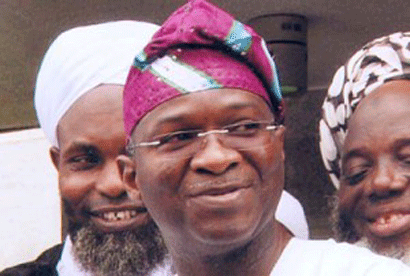
Fashola
By Ocheherome Nnanna
THE recent announcement by President Goodluck Jonathan that Lagos, the former capital of the country, will be given a special status is a welcome development, though belated. Better late than never, they say and I always concur.
According to the President, the metropolis is responsible for about 52 per cent of the nation’s economic and commercial interests. Majority of Nigeria’s non-oil revenues, especially through the Customs and the ports, as well as Value-Added Taxes, VAT, are derived from Lagos, which still maintains the designation as the nation’s economic capital.
A large chunk of the Federal Government’s holdings in terms of buildings and landed property were cornered by the high and mighty connected to the government of former President Olusegun Obasanjo through the drainpipe of its so-called monetisation and privatisation of government assets.
This affected its estates in the Lagos Island/Ikoyi axis. The Federal Government still controls so much land and so many institutions in the Apapa/Ojo axis that are not easily subject to privatisation. Some can only be given out on closely-monitored concession due to their strategic importance to the economic and security interests of Nigeria.
These include the many army, navy, air force, customs, immigrations, prisons, ports and related institutions.
Also, as the capital of Nigeria up till December 10, 1992, the bulk of funds realised from the oil boom of the 1970 and some of the Gulf War oil windfall of 1990/1991 were invested in Lagos, as evident in the massive road and flyover bridges infrastructure still serving the city, though poorly maintained.
In fact, the Third Mainland Bridge, the nation’s longest bridge, a tourist attraction and one of the prides of the nation but not properly projected as such by governmental agencies charged with that responsibility, is a recent federal infrastructural investment (completed in 1994) compared to the flyovers built during the General Yakubu Gowon era.
Given these special attributes of Lagos as a former capital of Nigeria, its commercial capital and the custodian of the second largest amount of federal presence after Abuja, Lagos should never have been abandoned.
It should not have taken so long for the federal authorities to resume caring for Lagos because the “political expediencies” that necessitated the abandonment expired long ago. Let me spend a little time to analyse these “expediencies”.
Even though the plan to develop a new capital was originally conceived by Nigeria’s first ceremonial President, Dr Nnamdi Azikiwe, who favoured the relocation of the capital to a virgin territory around the centre of Nigeria, the actual official selection of Abuja and preparations towards actualising the project came through the Justice Akinola Aguda Panel set up by the General Murtala Mohammed regime.
Following the adoption of its recommendations, Decree Number 6 of 1976 was promulgated and the Federal Capital Development Authority, FCDA, set up.
Preparation of the 8,000- square kilometre city proceeded at a leisurely pace until certain events in 1990 and 1991 forced the regime of General Ibrahim Babangida to fast-track Abuja’s development and “bolt” over there.
Lagos/Ibadan Axis Press
Over time, the presence of the capital in Lagos had made the so-called “Lagos/Ibadan Axis” of the Press a powerful weapon in the arsenal of the pro-Awoist anti-North political class.
The North-controlled Federal Government had become very uncomfortable because the views of the Press and its supportive human rights and civil society activists and groups often triggered regime changes through coups or attempted coups.
It made political protests and Labour/student unrests difficult to contain, and the Northern political establishment often found itself torn between being forced to make so many concessions to the West and mounting repressive measures to get its way.
The Orkar failed coup of April 1990 really rattled the Babangida government. The lucky incident of the Gulf War oil windfall of 1990/1991 brought in a lot of extra billions of dollars which Babangida spent largely on Abuja to enable him escape the harassment of Lagos.
Incidentally, that move assisted in no small measure in stabilising our democracy, as no serious coup plot has taken place ever since.
The attitude of abandonment of Lagos is almost akin to the attitude of the French colonial masters when they were rejected by the people of Algeria and Sekou Tuore’s Guinea in their effort to convert their former colonies in Africa into “French Africa”.
While willing countries like Senegal, Cote D’Ivoire, Cameroun, Gabon and others were rewarded with continued financial, technical, security and other supports, the French authorities looted and destroyed structures they had built in Guinea and Algeria, thus forcing these new countries to start from the scratch after independence.
Abdicated commitments
The Federal Government abdicated its commitments to Lagos when it moved to Abuja. The President Obasanjo regime gave as its condition for maintaining its facilities in the state, the electoral “capture” of Lagos. Obasanjo went as far as illegally withholding local council funds and creating Federal Roads Maintenance Agency, FERMA, militia specially to frustrate the Bola Tinubu regime’s capacity to run the state. After failing in their political ventures the ruling class simply went back to abandoning the state. Today, the worst parts of the state in terms of road and bridges maintenance are in the Apapa and Ojo areas because neither the federal nor state government is ready to show responsibility despite the revenue both sides get from these areas.
The new special status that the President Jonathan government plots for Lagos has not been spelt out. I suggest that it should be a partnership above politics, bearing in mind the economic and socio-political importance of Lagos to the country. There is no clan in the country that is not adequately represented in Lagos. That alone says a lot.
Lagos is a state. It is part of the South West. But it has never been, and will never be a tribal enclave, and must never be viewed by anyone in that light, and thereby denied its right to full attention by the Republic of Nigeria.
Happy Independence!
Disclaimer
Comments expressed here do not reflect the opinions of Vanguard newspapers or any employee thereof.