
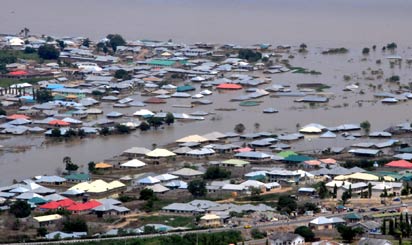
File: Flood in Lokoja
By Kingsley Adegboye & Ebun Sessou
Experts and environment stakeholders have continued to blame the Federal Government for the flood currently ravaging the nation. At different occasions, they have said that the consequence of floods being experienced in the flood-prone states of the federation could have been prevented to a great extent if government had listened to warnings and advice by experts to prepare for climate change which has become a reality.
The experts accused the Federal Government of being insensitive to the plight of the people by not putting appropriate measures in place to tackle the challenges of climate change as other nations have done.
At a conference of the Nigerian Academy of Science in Lagos last week on the forthcoming Annual Meeting of African Science Academics AMASA-8, which is billed to take place in November, the president of the Academy, Prof. Ibidapo Obe who decried government’s nonchalant attitude towards the reality of the present problem, said climate change had been predicted 15 years ago without any step taken to stem its anticipated impact.
Institute of Building
Also, the immediate past Commissioner for Environment in Lagos State, Mr. Muiz Banire, had noted at a forum organised by the Lagos State chapter of the Nigerian Institute of Building NIOB, recently that the Federal Government over the years turned deaf ears to all the entreaties on her to build dams to store excess storm water and dredge rivers, especially Niger and Benue rivers to create cavity for capacity to hold water.
He said accusing Cameroon of inundating the nation with flood water by releasing water from her Lagdo dam is misplaced because according to him, Nigeria was to have built her counterpart dam for water retention since the eighties, but she refused to build even when Cameroon built hers in 1982.
According to him: “The Federal Government is insensitive to the plight of the people and until government makes the welfare of the people the crux of governance and centre of development, we will continue to expose the people to avoidable danger and unnecessary hardships. 
“The number of people killed and displaced and the property destroyed will be on the increase unless necessary measures are taken as the effect of climate change will continue to affect the people, as with the intensity of rainfall, water will always find its level. Thus all mitigative and adaptive measures must be taken to tackle the effects of climate change while emergency management machinery should be oiled and made ready all the time,” Banire stated.
Prof. Obe added that “climate change is a big issue that has been with us for a long time. We saw it when we went to Ghana. In March, we all saw its effect but it seems Nigerian government is sleeping over this serious issue”.
Lamenting the consequence of flood disasters across the country as currently being experienced, he stated that if the government had done enough in terms of prevention, adaptation and mitigation against climate change, what is happening in those states that have been ravaged by floods would not have happened.
He said: “If we can predict very well the amount of water that is coming, know the size of out channel then, we will be able to know what level of overflows to expect. The fact is that, climate change will not only cause flooding in flood prone areas, it will also cause draught in draught prone areas.
“It will bring about more draught in the Sahara region and more water in the South. Obviously, the government has not responded properly because in advanced countries, there are signs and warnings all over the place that people should be prepared for climate change and Nigeria is not excluded”, he noted.
Urging Nigerians to be prepared for disasters, he said, although Eko Atlantic City project in Lagos is a beautiful idea, it has destroyed the ecosystem. “I live in Lekki and whenever it rains, one needs to wait for hours, if not one would have to swim. What we are doing to the environment only means that we are taunting the environment and we are inviting the environment for war which we are not prepared for.
“When we keep disturbing the nature, it will react. Nature has a way of reacting. We need to understand that we need to conserve nature. The fact that every house is fenced in Lagos has also contributed to the negative effect of climate change”, Obe said.
Explaining the adverse effect of climate change, Prof. Babajide Alo, Dean, Faculty of Environmental Sciences and former president, Nigerian Environmental Society, noted that the road between Lokoja and Abuja down to the South is impassable currently because of flooding. He said the people are cut off in the North and South and the link between them is broken, pointing out that it has also been reported that houses have been eaten up to the roof.
Issue of climate change
“We have been talking about this issue for the past fifteen years. The issue of climate change has been on the table of the government since the 90s. We all have realised that climate was changing as far back as the 90s. We have been making noise about the fact that we need to prepare because the risks are there. The challenges will be daunting when they come and that is exactly what is happening now.
“All we need to do as a nation, is to be prepared and drop all the fire brigade measures that we are used to. We are just reaching a point where we ought to have been since fifteen years down the lane. In 2011, I told the nation openly on a TV station, that this nation will be in for a big trouble if climate change impact starts showing up in the country and I didn’t know that it could be so soon”, he said.
Urging the residents in Lekki to be at alert, he said, the residents of Lagos who are living in Lekki are going to be under water in 2099. His words: “I said it using the scientific data that we have on our ocean surges and flows that the entire Lekki which is called Phase 1 will be under water by 2099. But the State government has been taking measures thereby setting up series of climate change mitigation and adaptation measures towards ensuring that all the nice houses in Lekki don’t go under water by 2099.
“We are also imploring the federal government to speedy up in its actions towards ensuring that the nation is not flooded. And that is the reason for the forthcoming Annual Meeting of African Science Academics AMASA-8, in Lagos. “Climate change can be mitigated, we can set up adaptation measures to correct and accelerate the impact that it can cause. We can only reduce the effect of climate change but they are inevitable.
Disclaimer
Comments expressed here do not reflect the opinions of Vanguard newspapers or any employee thereof.