
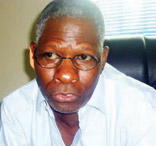
Ezekiel Gomos
By Taye Obateru
Mr. Ezekiel Gomos ( OFR) former Secretary to the Plateau State Government is the Executive Director of the Jos Business School. He spoke on Nigeria’s 52nd Independence Anniversary to Saturday Vanguard.
What is your assessment of Nigeria after 52 years of independence?
After 52 years of Independence, Nigeria has not translated its huge human and natural endowments to real socio-economic development.
Despite the enormous crude and natural gas resources that the country has been exploiting for nearly half a century, the number of Nigerians living below the poverty level has been rising.

Ezekiel Gomos
Nearly all the infrastructure in the country, both the ones inherited from including colonial government, and those that were developed by revenue from agricultural / solid minerals, and the grandiose projects that came along with the oil boom have virtually collapsed. Our social infrastructure- particularly education and health are still in very bad shape.
On the whole, the quality of life of the average Nigerian has not really improved since independence as measured by the country’s position on the Global Human Development Index where today Nigeria is ranked 142 out of 169 countries..
But it has not all been negative. I must point out that the country has been able to record some significant progress in certain areas like in sports development, like in individual human achievement and in some areas of physical development.
Why do you think Nigeria has not got it right especially on the economic and social fronts?
A key explanation for Nigeria’s poor performance in the social and economic fronts is that we have been very undisciplined with the management of our resources especially earnings from crude oil.
Profligacy, especially by the Federal and State Governments, coupled with widespread corruption have led to massive wastages of the huge revenue that Nigeria received from 1970 to date. In addition, there is the widespread lack of planning and fiscal prudence in running government business. We see government business as nobody’s business, especially educational, health, public infrastructural facilities
Most people agree that poor or selfish leadership has been a major problem limiting the country from achieving her potentials. How can the country get out of this problem?
It is true that Nigeria has not been blessed with the kind of strategic and transformational leadership that could have really driven the country’s socio-economic development. You will agree with me that long periods of military dictatorships gave rise to mediocre, unserious and at times, out rightly greedy leadership at Federal, State and even Local Government levels.
What Nigeria needs today, more than ever before is a leadership that is visionary, values/ethically- driven and is strong enough to drive positive change in the attitudes of the followership.


We also need to have a responsible followership who should be prepared to hold the leadership accountable, who should ask questions and demand answers from their leaders.
So for Nigeria to get out of the present conundrum, we urgently need every one to exercise qualities of leadership- integrity, responsibility, commitment, being values- driven etc in his/her little corner ,ie in our families, in our small offices, and in our big arenas. In short, the task of getting Nigeria out of its present problem is not only the responsibility of people in position/power, but every citizen has a role to play.
What positive strides would you say the country have made since independence?
Like I said earlier, Nigeria has made some positive strides in certain areas. Many individual Nigerians have accomplished significant feats in many areas of human endeavour on the global scale.
Whether it is in the arts, where we have giants like Soyinka, and Achebe, or science with giants like Philip Emegwali, or in sports, or business where entrepreneurs like Aliko Dangote have been listed as the richest man in Africa, I think Nigeria as country has produced giants in every field.
In the same vein the country has made some progress in other areas. We are beginning to lay the foundations for stabilizing our democracy, though it will take some time before we achieve this. The development of Abuja from scratch, into a very modern city by African standards is another achievement worth celebration, though for the huge amount that has been spent in getting Abuja to where it is, one wonders whether another Abuja wouldn’t have been built.
We have built numerous other facilities like airports, industries, schools/universities’, hospitals, express roads, fly-over bridges etc across the country though our well known penchant for poor maintenance has eroded the value of these facilities.
Can Nigeria catch up with the rest of the world in the years to come?
Yes, it is possible for Nigeria to catch up with the rest of the world. As I said, this can be possible when Nigerians at all levels including at the family level, begin to demonstrate integrity, responsibility, commitment, accountability- when we live by values we preach, when we see our resources as being for the progress of common good, and when we see public office as an opportunity to serve and make a difference in the lives of the people and not as an opportunity to make a difference in the life of the occupant of the public office.
Nigeria can catch up when we channel our resources into productive investments and not into consumption only.
Nigeria can begin to catch up when we build and strengthen our fundamental institutions and make them enduring so that no matter the changes in the leadership of such institutions or changes in the political scenario, the country continues to move forward. I am talking of institutions like the Judiciary, Legislature, the Police, the EFCC, the ICPC, the Customs, CBN, NDIC, SEC, etc
When institutions are strong and enduring, they help to stabilize democracy. When institutions are strong, ordinary people ie the followership, can be emboldened to demand answers and accountability from their leaders and elected representatives. A stable and strong democracy can help to propel economic and social progress
What is your dream of Nigeria in the next five to ten years?
Because the problems and the level of rot in our system is very deep, I see the next five years as not yet Uhuru. It will take more than five years for any meaningful change and difference to be made in the situation in Nigeria.
This is not to say that the situation is hopeless. No. Rather I expect that if we are to make any serious progress, the Transformation Agenda should be refocused in trying to strengthen the key institutions that will provide stability for our democracy and make leaders to focus on improving the situation of the larger populace, pursuing the common good and making the light to shine in their respective corners.
Disclaimer
Comments expressed here do not reflect the opinions of Vanguard newspapers or any employee thereof.