
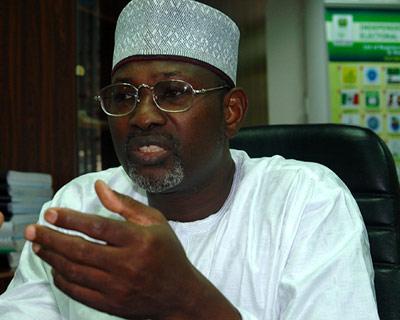
*Jega
By Jide Ajani
In this second part of our investigation into the power tussle between Professor Attahiru Jega, National Chairman of Nigeria’s Independent National Electoral Commission, INEC, and his national commissioners, we reveal the incongruity in the responsibilities of the Chief of Staff to the INEC Chairman, Dr. Mahmud Magaji, and the authority of national commissioners. This report will also show that the Peoples Democratic Party, PDP, and its proposed investment and contract-seeking limited liability company may be attempting to exploit the loophole being created by the power tussle at INEC for gains in the 2015 elections.
A CHIEF OF STAFF FOR ALL SEASONS
Just before the award of contracts for some of the materials to be used for the 2011 general elections, some committee were set up to carry out due-diligence on some bidding companies. Pieces of information made available to Sunday Vanguard in the course of investigating this story on the power tussle between Professor Attahiru Jega, National Chairman of Nigeria’s Independent National Electoral Commission, INEC, and his national commissioners, suggested that some committee members went as far as traveling out to conduct verification exercises on the claims made by some of the companies. The companies numbered a little less than two dozens.
To the greatest surprise of the commissioners after the due diligence and just a few days to the final decision on which of the earlier vetted companies would get some of the contracts, an instruction “was handed down through the Chief of Staff, Dr. Mahmud Magaji, that a fresh exercise would have to be conducted all together”, a very dependable INEC source said.
A fresh set of companies were re-processed, Sunday Vanguard was told.
Upon cross- confirmation, another source close to the Chairman’s office pointed out that “what actually happened was that it was discovered that some of the companies earlier vetted were discovered to belong to some leaders of some political parties and it would have been very dangerous for the contracts to have been awarded to those companies; some of the commissioners did not know this but this information came upon the National Chairman late and he had to swing into action”.
It was this sudden change of processing that accounted for the lateness in delivery of materials for the 2011 general elections.
The bone of contention today, however, by some of the commissioners Sunday Vanguard spoke to was not actually whether it was through the Chief of Staff that the instruction was handed down but that “it is improper for a Chief of Staff to the National Chairman to carry out proprietary oversight on assignments carried out by national commissioners.
“Do you know what it means for an individual to be appointed as a national commissioner?
“Do you know the processes involved?
“The security checks?
“Then you now have an appointee of the National Chairman ‘working’ on files prepared by national commissioners; what sort of thing is that”?
In fact, at the recent retreat of INEC at Protea Hotel, Maryland, Lagos, the commissioners were up in arms against the Chairman over the appropriateness of having his aides in attendance when ‘The Commission’ holds its meetings.
Sunday Vanguard learnt that at that meeting, the commissioners frowned at Jega’s continued “abuse of procedure”.
Over time, according to INEC sources, “the Chairman’s aides sit in during the Commission’s meetings. The Chairman has a number of aides, that is personal staff, who sit-in at meetings. Except when he is not in town (which is rare) the Chief of Staff takes up a seat as if he is a national commissioner and even acts above national commissioners and this has not been healthy”.
At the INEC commission’s retreat, the commissioners insisted that henceforth, they would not sit at meetings purportedly ‘The Commission’s’ meetings and have the Chairman’s aides attend. The compromise position was that the Chief of Staff could be permitted to attend meetings while other aides should not.
WHAT THE LAW SAYS
Constitutionally, there is no where a Chief of Staff to the National Chairman of INEC is recognized.
Indeed, Section 153 of the 1999 Constitution as amended refers to the establishment of some federal bodies among which is INEC.
Section 154 speaks to the appointment of members of ‘The Commission’, about how the appointments shall be in consultation with the National Council of State and vetted by the Senate; and Section 158, which speaks to the reasoning that ‘The Commission’ shall not be under the control of any other authority or person -“154. (1) Except in the case of ex officio members or where other provisions are made in this Constitution, the Chairman and members of any of the bodies so established shall, subject to the provisions of this Constitution, be appointed by the President and the appointment shall be subject to confirmation by the Senate.
“(3) In exercising his powers to appoint a person as Chairman or member of the Independent National Electoral Commission, National Judicial Council, the Federal Judicial Service Commission or the National Population Commission, the President shall consult the Council of State.
“158. (1) In exercising its power to make appointments or to exercise disciplinary control over persons, the Code of Conduct Bureau, the National Judicial Council, the Federal Civil Service Commission, the Federal Judicial Service Commission, the Revenue Mobilisation and Fiscal Commission, the Federal Character Commission, and the Independent National Electoral Commission shall not be subject to the direction or control of any other authority or person.”
In Third Schedule Part I (Federal Executive Bodies), Section 14 states:
“14. (1) The Independent National Electoral Commission shall comprise the following members –
(a) a Chairman, who shall be the Chief Electoral Commissioner; and
(b) twelve other members to be known as National Electoral Commissioners, who shall be persons of unquestionably integrity and not less than fifty years and forty years of age, respectively.
“(2) There shall be for each State of the Federation and the Federal Capital Territory, Abuja, a Resident Electoral Commissioner who shall –
“15. The Commission shall have power to –
(a) organise, undertake and supervise all elections to the offices of the President and Vice-President, the Governor and Deputy Governor of a State, and to the membership of the Senate, the House of Representatives and the House of Assembly of each State of the Federation;
(h) delegate any of its powers to any Resident Electoral Commissioner; ….”
In the Third Schedule, reference is made to ‘The Commission’ and not just the Chairman of his Chief of Staff as having ultimate powers.
Sunday Vanguard has been made to understand that over the years, previous INEC Chairmen had operated under the paradigm of negotiated authority, which sees to it that the national commissioners regard the National Chairman as first among equals and, therefore, accord him necessary deference while, he, in turn, treats them as national commissioners that they are, without the needlessly over-bearing activities of a Chief of Staff.
After the first in this series was published, Sunday Vanguard was informed that some directors in INEC and national commissioners jubilated “because they had been operating under this incongruous atmosphere”.
ENTER ADOKE, PDP AND 2015
But if you think the power tussle is just a matter for Jega and his 12 commissioners, the new dimension of extraneous intervention from the executive and the Peoples Democratic Party, PDP, is another major concern for Nigerians as the country prepares for the 2015 general elections.
Whereas Jega had sent a memo to Mohammed Adoke, SAN, Minister of Justice and Attorney General of the Federation, seeking clarification on his status as the ‘Chief Executive’ of INEC, “the response of Adoke in stating that the chairman can not operate as a chief executive was too swift. It was as if the ruling Peoples Democratic Party, PDP, was the one responding to the Chairman’s memo”.
In truth, Sunday Vanguard was informed last week that the recent announcement by the PDP to set up a limited liability company that would source for contracts is a source of worry. “The company that PDP plans to set up would be able to source for and get contracts from MDAs as well as government bodies, INEC inclusive. The party may not come out openly to, say bid for contracts from INEC, but what we are hearing now is that it may use fronts to secure contracts from INEC (which is not new any way) and this would not be good in any way”, a top INEC official said last week.
Continuing, the source explained: “What is happening now is that some people have deliberately chosen to misread what the Chairman is trying to do and which is to seek more independence for the commission and allow it more latitude to conduct freer and fairer elections. Jega believes that some of the ambiguities of today need to be cleared before the 2015 elections but some people are injecting poison into the debate in such a manner as to ambush the project. For instance, has the Chief of Staff whom some people are not trying to tar, just been appointed?
Did he resume work last week? So why are people just trying to cry wolf where there is none?”
However, another issue which has just been shot down is the likely amendment being sought by INEC to the Constitution and the Electoral Act. The commission wants a situation whereby it can appoint its Resident Electoral Commissioners, RECs. Presently, the President appoints.
But in the face of the perceived growing over-bearing inclination of the INEC Chairman, even some of the commissioners are frowning at such an amendment.
“If the chairman has enthroned a regime whereby his Chief of Staff appears to be acting like the deputy chairman of the commission, what guarantees are there that when a constitutional amendment which allows the commission free hand to appoint RECs is carried through, the nation wouldn’t have succeeded in creating a monster?”, a national commissioner asked last week.
During the 2011 elections, “it was Professor Jega who single-handedly proposed and appointed the vice chancellors of universities as returning officers for the presidential election in the states”, Sunday Vanguard was told.
The elections were conducted by INEC staff in collaboration with national commissioners in charge of some states and RECs. But the vice chancellors announced the results.
A former senior official of INEC who was part of the building of the commission since 1987 wondered “what point Professor Jega wanted to prove when he appointed the vice chancellors. Are these not the same heads of universities where exam malpractices occur? Have we not heard of instances where vice chancellors were involved in unwholesome activities? Was he trying to tell Nigerians that once university vice chancellors announce a result, it means the election had gone very smoothly?”
UNIQUENESS OF INEC AND THE VOTER REGISTER
Sunday Vanguard was made to understand that three countries in the world operate the type of electoral body in Nigeria – South Africa, Mexico and South Korea.
Nigeria’s uniqueness has to do with its composition which is of an odd number of 13 members (the Chairman and 12 national commissioners).
Sunday Vanguard discovered that in a country like Guyana, decisions of its electoral body are sometimes deadlocked, with the United Nations being called in some times to resolve some thorny issues.
But the problem INEC has been saddled with in the last 13 years has been the voter register.
Nigeria’s voter register is one of the most comprehensive in the world because of the categories of data captured and the centralization of the register.
In the United States for instance, a report by the Jimmy Carter Centre reached a conclusion that the register should be more central in nature and should also have more features for individual records. The register is domiciled in the state.
But the Carter Centre concluded in its report on HOW TO BRING GREATER DEMOCRACTIC PRACTICE TO US ELETION SYSTEM (BUILDING CONFIDENCE IN US ELECTIONS) dated September 2005, that effective voter register remain a bedrock of the democratic process (read elections). Co-chaired by former President Jimmy Carter and James A. Baker, the report also concluded that it would be better if states compile a comprehensive top down of register of voters.
Nigeria’s register which is centralized is such that if an individual registers in say Sokoto and finds himself in Lagos on the day of election, he can not vote.
Yet, this is in a country where money transfers are done and cash withdrawn across the country on a daily basis. Which again takes us back to the almost N100billion expended on the registration of voters preparatory to the 2011 elections.
INEC, information available now suggests, is more disposed to electronic voting.
Sunday Vanguard learnt that the proposal for the expenditure to be involved is being worked on by the commission now.
How much this would come to is still being worked out.
So, what has Nigeria achieved with the N100b spent on a register that is about to be junked?
Still, INEC’s Jega has the opportunity to change things for the better in so far as he conducts his affairs in such a manner that the legacy he’s trying to build and sustain would not leave more problems for the commission and Nigeria when he leaves office.
Disclaimer
Comments expressed here do not reflect the opinions of Vanguard newspapers or any employee thereof.