
By Jim-Rex Lawson MOSES
Introduction
The heat from the earth’s own molten core can be converted into electricity in many ways, from large and complex power stations to small and relatively simple pumping systems. This heat energy, known as geothermal energy, can be found almost anywhere—as far away as remote deep wells in Indonesia and as close as the dirt in our backyards.
Many regions of the world are already tapping geothermal energy as an affordable and sustainable solution to reducing dependence on fossil fuels, and the global warming and public health risks that result from their use.
For example, more than 8,900 megawatts (MW) of large, utility-scale geothermal capacity in 24 countries now produce enough electricity to meet the annual needs of nearly 12 million typical U.S. households (GEA 2008a). Geothermal plants produce 25 percent or more of electricity in the Philippines, Iceland, and El Salvador.
The United States has more geothermal capacity than any other country, with more than 3,000 megawatts in eight states. Eighty percent of this capacity is in California, where more than 40 geothermal plants provide nearly 5 percent of the state’s electricity. thousands of homes and buildings across the United States, geothermal heat pumps also use the steady temperatures just underground to heat and cool buildings, cleanly and inexpensively.
What is Geothermal Energy?
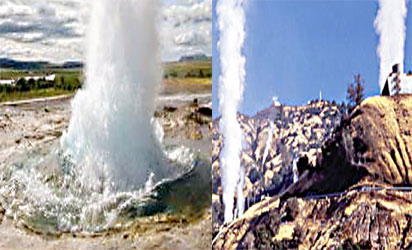
The term geothermal energy is derived from the Greek word geomeaning earthand thermosmeaning heat. Hence, geothermal energy is the heat energy emanating from within the earth’s core. You could use hot water (hot springs and geysers) and steam inside the earth’s crust to produce electricity and also heat buildings.
An interesting ecological fact is that geothermal energy is a renewable resource. The water levels are recovered by timely rainfall and the heat is produced within the earth. Therefore geothermal energy is not a depleting resource like petroleum.
The temperature inside the earth’s core is way higher than the temperature of its surface. This is because of the radioactive process, which constantly takes place in the rocky crust within the earth. Geothermal energy is used directly by people around the world to heat their households and also to generate electricity.
Working of Geothermal Energy
The temperature is 100 degrees Celsius three miles beneath the earth’s surface. This is the boiling point of water and such a high temperature can be used to generate a steam-powered electric power plant. However, drilling three miles below the earth, though possible, is a Herculean task.
Instead, geothermal hotspots are identified to derive geothermal energy. A geothermal hotspot is an area that transmits excess internal heat from the interior of the earth to the outer crust because owing to the reduced thickness in the earth’s mantle. Geothermal hotspots can, thus, be used to generate electricity. Methods
One of the chief methods to generate electricity from geothermal energy is by pumping hot water into sedimentary hotspots. The steam generated by this method is used to produce electricity. The condensed steam is, again, circulated into the permeable sedimentary stream of a hotspot.
Another method is to use volcanic magma. The temperature of partially molten magma is approximately 650 degrees Celsius. This heat is used to boil water to generate electricity.
Some geothermal plants also use hardened magma that is, also, extremely hot. This system uses hot dry rock. Pipes are looped through these hot dry rocks through which water is circulated. The heat of the rocks converts the water into steam prior to transferring the heat to a steam generator.
What are the environmental impacts?
Flash technologies allow the geothermal fluid to expand and release gases into the atmosphere when the steam is created. Binary technology keeps the geothermal fluid contained, using heat exchangers to capture heat to provide steam. Though these air emissions represent tiny quantities and generally do not pose any serious environmental threat, the chemical characteristics of geothermal resources are highly site-specific. Dissolved gases usually include carbon dioxide (CO2), methane, hydrogen sulfide, ammonia, nitrogen and hydrogen.
Groundwater contamination, which can be easily prevented, is the principal pollution concern. The disposal of water and wastewater may cause significant pollution of surface waters and ground water supplies. Still, used geothermal fluids are generally collected and re-injected. This maintains pressures in underground reservoirs, but also allows for recycling and reuse.
The best geothermal resources are sometimes located at remote sites that may have significant wilderness, scenic or recreation value. While requiring relatively little land itself, the siting of a geothermal plant – like remote wind farms — may cause land impacts when new transmission lines are connected to power plants in these rural regions.
Advantages of Geothermal Energy
Geothermal energy has more advantages compared to various other forms of energy. A few advantages of geothermal energy are given below:
*Geothermal energy is eco-friendly energy and is popularly known as a clean energy. The reason behind this is that geothermal energy is not extracted from fossil fuels and emits only about 3% C2. This is one of the major advantages of geothermal energy.
*Human race is facing serious environmental problems such as global warming and pollution. Hence, it is vital to switch to renewable energy sources such as geothermal energy. Geothermal energy is derived from the heat generated by the earth’s core and from water. Yearly rainfalls replenish water level in the earth and the heat is constantly generated within the earth’s crust.
*One of the biggest advantages of geothermal energy is that harmful emissions from a geothermal plant are very low compared to traditional power plants. A geothermal plant does not emit toxic liquids or any form of harmful gases. The only gas emitted is C2, that too in very small quantities. The water reservoirs are replenished with recycled salt and minerals along with excess water that is pumped into it.
In future, geothermal energy is expected to be efficiently used instead of other forms of energy. The reason is that it is a renewable form of energy that is not only clean but can also supply continuous electrical power. Geothermal energy is available 24 x 7 and is produced within every country. This means, a country with a large number of geothermal plants becomes less dependent on imported fossil fuels.
The Geothermal Resource
Below the Earth’s crust, there is a layer of hot and molten rock called magma. Heat is continually produced there, mostly from the decay of naturally radioactive materials such as uranium and potassium. The amount of heat within 10,000 meters (about 33,000 feet) of Earth’s surface contains 50,000 times more energy than all the oil and natural gas resources in the world.
The areas with the highest underground temperatures are in regions with active or geologically young volcanoes. These “hot spots” occur at plate boundaries or at places where the crust is thin enough to let the heat through.
These regions are also seismically active. Earthquakes and magma movement break up the rock covering, allowing water to circulate. As the water rises to the surface, natural hot springs and geysers begin to occur.
Seismically active hotspots are not the only places where geothermal energy can be found. There is a steady supply of milder heat—useful for direct heating purposes—at depths of anywhere from 10 to a few hundred feet below the surface virtually in any location on Earth. Even the ground below your own backyard or local school has enough heat to control the climate in your home or other buildings in the community.
In addition, there is a vast amount of heat energy available from dry rock formations very deep below the surface (4–10 km). Using a set of emerging technologies known as Enhanced Geothermal Systems (EGS), we may be able to capture this heat for electricity production on a much larger scale than conventional technologies allow.
A panoramic view of the Geysers geothermal power plant in Geysers, Calif. The site, located above Santa Rosa, is the largest geothermal development in the world.
How Geothermal Energy Is Captured
The most common current way of capturing the energy from geothermal sources is to tap into naturally occurring “hydrothermal convection” systems where cooler water seeps into Earth’s crust, is heated up, and then rises to the surface. When heated water is forced to the surface, it is a relatively simple matter to capture that steam and use it to drive electric generators. Geothermal power plants drill their own holes into the rock to more effectively capture the steam.
There are three designs for geothermal power plants, all of which pull hot water and steam from the ground, use it, and then return it as warm water to prolong the life of the heat source. In the simplest design, the steam goes directly through the turbine, then into a condenser where the steam is condensed into water. In a second approach, very hot water is depressurized or “flashed” into steam which can then be used to drive the turbine.
In the third approach, called a binary system, the hot water is passed through a heat exchanger, where it heats a second liquid—such as isobutane—in a closed loop. The isobutane boils at a lower temperature than water, so it is more easily converted into steam to run the turbine. The three systems are shown in the diagrams below.
The choice of which design to use is determined by the resource. If the water comes out of the well as steam, it can be used directly, as in the first design. If it is hot water of a high enough temperature, a flash system can be used, otherwise it must go through a heat exchanger. Since there are more hot water resources than pure steam or high-temperature water sources, there is more growth potential in the heat exchanger design.
One concern with open systems like the Geysers is that they emit some air pollutants. Hydrogen sulfide—a toxic gas with a highly recognizable “rotten egg” odor—along with trace amounts of arsenic and minerals, is released in the steam. In addition, at a power plant at the Salton Sea reservoir in Southern California, a significant amount of salt builds up in the pipes and must be removed.
While the plant initially started to put the salts into a landfill, they now re-inject the salt back into a different well. With closed-loop systems, such as the binary system, there are no emissions; everything brought to the surface is returned underground.
Disclaimer
Comments expressed here do not reflect the opinions of Vanguard newspapers or any employee thereof.