
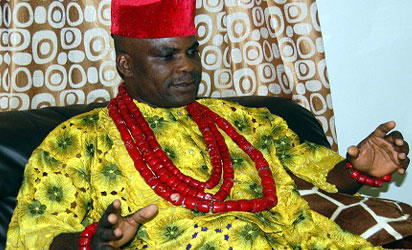
*AVM Ararile
By Emma Amaize
In this interview, the Ovie of Umiaghwa-Abraka Kingdom in Ethiope-East Local Government Area of Delta State, His Royal Majesty, Lucky Ochuko Ararile, Awaeke 1, pioneer Coordinator of the Federal Government’s Amnesty Programme for ex-militants and a retired Air Vice Marshal, AVM, speaks on his metamorphosis from the barracks to the palace.
He also shares his vision on the great tourist potentials in Abraka, which have not been explored; his reservations on the split of old Abraka kingdom; his growing up; plans for his people and limitations as a monarch. Excerpts:
What was the transition like; I mean from military to the palace as the monarch of Umiaghwa-Abraka kingdom.
Well, it is a call to duty. Indeed, it is a big honour to be called upon by one’s community not just to serve but also to be their king. If I tell you now that it was one of my post retirement plans, I will be telling you a lie. The year before I was to retire, I was given the amnesty job; it was a very tasking and exhausting exercise for me. So when I retired, I gave myself one-year leave, I refused to do anything. I just enjoyed being idle. I was sleeping and waking up at 10.00 am instead of 5.00 am as I used to do.
Kingship
My plan was that after resting and appraising things, I would set up a finance company, which was why I acquired my certificates in the first place. As the one-year leave was finishing, the kingship issue came up. The community sent a chief to inform me that I was their choice to be king.
I told the emissary that that was not part of my post- retirement plan and that I would support anybody chosen from our ruling house. To cut a long story short, they made two more trips to Abuja to inform me the community was adamant. Thereafter, I consulted some of my colleagues that have passed that route for their advice.
My military colleagues do not believe I am now a royal father.
For some of my former colleagues in the Nigerian Air Force, it is yet to sink in that Air Vice- Marshal Ararile (rtd) is now a traditional ruler. The Chief of the Air the Staff alluded to it when he came here. However, here I am. As you know, this is not a political call where you are called to “come and chop”.
It is a call to serve. Whatever you are able to achieve within the context of the present constitutional reality depends upon the support, goodwill and capacity of your subjects. Absence of deployable resources is the main challenge monarchs face.
So, how are you adjusting to your new role?
Strictly speaking, the job description of a monarch is not different from a military commander’s: welfare issues, dispute resolution, social issues, etc. I have really not been too far from my people. I had always thought of retiring home, but not at the time I did.
Actually, but for the change in the policy that one has to have a PhD to be a lecturer, I would probably have picked up an appointment here in Delta State University, Abraka. That is why I obtained master’s degrees. My intention was to come back here and help in some way to improve the standard and the quality of knowledge you could get at Delta State University. I will still consider it because to me it is not closed.
How did you grow up, where and what was life like at your younger age?
Actually, I can say that my early life was in Kaduna, my father fought in the Second World War; after the War, he went through demobilization; so it is a coincidence that I ended up in the demobilization process in Nigeria. When he was demobilized, he was attached to Nigeria Railways; he was, from time to time, posted to many places along the railway locations.
He was in Jos, Jangidi and Kafachan before we eventually got to Kaduna. My elder brother was born in a town before Kafachan. I grew up in Kaduna and my early school was at Army Children’s School. I was about seven years old when my uncle came to Kaduna to take me to the then Midwest Region to stay with my grandmother.
Aje Butter pupil
I thought I was coming for a brief stay but it turned out to be a one-way ticket. I was enrolled in primary II at the Baptist Primary School, Erho-Abraka, and, being from an urban center (Kaduna), my English was relatively better than most of my mates; so I was like an ‘aje butter’ although my grandmother was a tough lady. I accompanied her to the farm and always enjoyed helping with house chores.
Talking about Umiaghwa-Abraka kingdom, what we used to know is Abraka kingdom, what happened to the old Abraka kingdom?

*AVM Ararile
Abraka kingdom is now two kingdoms, Umiagwa-Abraka and Oruarivie-Abraka kingdoms. There had been agitation over the years by some elements in Oruarivie to have their own kingdom. I am from both sides and it is a fact that we now have two kingdoms; there are merits and demerits but, whatever the merits, I think it is the failure of the elite to have allowed it to happen.
In fact, looking at it rationally, there was no basis for the split, but those who wanted the split insisted and deployed all their resources, while those who felt that it was illogical sat on the fence. The few individuals that pursued the split succeeded and it must be said that they were and are strategically myopic.
How do you relate with the Oruarivie-Abraka monarch?
Well, I have no problems with him. Whenever we meet, we relate cordially but as to the interaction of the two kingdoms, the basis and the reasons for the split have not been well advertised and understood. Therefore, going forward, we must enumerate, discuss and understand the reasons for the split. Then, we can determine what we can do together and what we cannot do together.
In other words, you have no regrets being be a king now. Are you from the royal family or it was just bestowed on you?
It is an honour as well as a responsibility. In the old Abraka kingdom, we had eight ruling houses, ours is a rotational monarchical system, it moves from one ruling house to another. So, when it gets to a ruling house, a choice is made. Even now, we already know the ruling house that will produce the next king after my departure and that person must be acceptable to the community. These are settled issues.
I believe that you are a Christian; I want to know if your present assignment as a royal father is in anyway clashing with your religious beliefs?
I am a Christian but I allow everybody to follow whatever he or she believes in. In this kingdom, we have Christians; people of various denominations, there are Catholics, Baptists, Pentecostal, etc; we equally have traditional religions here, not just one.
There are different types of deities we have here, and whoever wants to serve any of these deities is free to do so. But, as a Christian, my role is to try to convert them, I cannot force them, and I am not being forced to carry out any of those functions.
You promised when you were receiving your staff of office, some months ago, that you would fast track the development of the town. I want to know how far you have gone on this promise and what are the challenges?
How far in just over three months? My promise is that I will make a difference in the life of my people. This is because I have a passion for my people and their needs. I like doing things differently, as I did in the units I commanded in the Air Force. Within the constraints of resources, I tried as much as possible to make a difference. It is the same passion that I am bringing into this calling. I no doubt recognise the constraints, both in terms of legalism and resources.
As I alluded to earlier. a king has no resources that are constitutionally provided for the discharge of his responsibilities. At the end of the day, at the grassroots level, you are the first point of contact. Yes, you have the three tiers of government: federal, state and local governments, but, when anything happens, the place to come to for the people is the palace. Be it individual, community and even national problems, it is usually the traditional rulers everybody runs to. Yet they have neither constitutional authority nor funding.
Collaboration with government
Whatever we do, we have to collaborate. It is imperative that we cooperate and collaborate with government at all levels. This is very important in order to ensure synergy and efficient and effective utilization of resources. That is my take-off point.
Blueprint
I am happy the Delta State governor has adopted bottom-up approach to development which essentially means we at the grassroots will identify the projects that we need. I intend to come out with a blueprint of what we need; we want to tell the government what our requirements and needs are.
It is not for somebody to just come, no matter his kind- heartedness and just dump a project. In this village, we have many boreholes yet water supply has not been reticulated since independence. So the practice of carrying buckets to the river to fetch water is still on.
Layout
We will also ask the government to assist us to do some planning because if you go to Abraka urban, that is where you have the university, you see many houses, which residents cannot access with their cars, you cannot access your house even with Okada (motorcycle), because the streets are not planned.
The basic thing is to lay out the streets, even if they are not tarred, let the streets be laid out. They can be tarred in future when there is money, but at least, let them be demarcated and marked out and left as such.
We need industries
Abraka is supposed to be one of the newest towns in the state, but sadly it is a slum, a big slum, so we want to avoid that here, the opportunity that we have, given that we are relatively undeveloped, a virgin land as it were, will be exploited in order to avoid the mistakes of the past.
It will enhance the quality of life, it will enhance the value of properties and the benefits would be tremendous. So we want to get government to assist us with the planning, the community is enthusiastic about this idea. We have to plan, and of course, we need industries too.
Abraka, as far as Nigeria and Delta State is concerned is the headquarters of cassava, but surprisingly, the federal government- owned cassava-processing factory that is in Erho-Abraka has been moribund for decades; we need to set up small- scale industries, preferably in areas where we have comparative advantage like in cassava, palm produce, in agriculture generally.
Tourist destination
Because of the beauty of the River Ethiope, Abraka is a tourist destination. I believe that after oil, tourism is the second gift that God gave to Nigeria that we have not utilised. That calls for private participation. We have an excellent tourist destination in the Abraka Turf and Country Club where my coronation was held.
University degree versus skill acquisition
We have the land and the human capacity and because Abraka is a university town, we have the human capacity in abundance but they lack the skills to make them employable. So in addition to their educational qualifications, the youths need the skills that can guarantee them employment.
Hence, the need for skill acquisition centres. But for the bastardization of the education policy, we would not be facing these problems now. The demand for skilled labour is very high. That is why I am happy that government at all levels is waking up to the need for technical education.
Delta State government has tasked monarchs to assist on security particularly on kidnapping; I want to find out how you are coping with it?
I am happy that in my own case I do not have these problems. I have said it severally that the vigilante in this community is relatively well organised and disciplined. But, generally, issues of security must be dealt with holistically. To proffer solutions, a cause and effect analysis would have to be done.
The major cause, to my mind, is unemployment of the youths. This has manifested in deviant and criminal behaviour such as armed robbery, kidnapping and cultism. We face a very grim situation in this country because we have a generation of youths that have not had any form of employment and therefore have low self-esteem and little or no work ethics.
So when eventually the jobs are provided, we would have difficulty making them work. Dealing with the effects is a different thing altogether. Success will depend on the information gathering capability of the security agencies, the security architecture and doctrinal orthodoxy; inter service relationships, reduction of the quantity of illegal arms in circulation, immigration policy and a host of other factors well beyond the scope of this discussion.
The basic expectation of the Niger Delta people has not been met by the Federal Government, what is your take on this?
Well, honestly, I must tell you that today, the Urhobo nation feels marginalized and in fact, more than that, we appear to be an endangered species within the current political milieu. I think if I get it correct, most of the ethnic nationalities have a representation in the government at the centre; it is the first time, we, the fifth largest tribe in Nigeria and for whatever it is, are not having representation.
What is worse, when the Federal Government appointed more than 90 ambassadors recently, not one slot was given to the Urhobos. We are not asking that people should receive less so that we can get, we are asking for what legitimately belongs to us, as the fifth largest tribe in the country, and that is not asking for too much.
It needs to be reversed, so we appeal to the president to look at the error that has been committed, be it error of commission or omission, let it be rectified so that we know that we are being carried along, as not just Niger Deltans, but as South-South people. This is our presidency, we fought for it, all of us fought for it; if there are benefits, it should go round, we are not asking for more than what is due to us.
Are the Urhobos carried along at the state level, what is your candid assessment of what Dr. Emmanuel Uduaghan?
In terms of the state, I will say the Urhobos are fairly represented but their impact is not being felt. The Urhobo politicians in government now will give account of their stewardship to the Urhobo nation in the not-too-distant future.
As regards the performance of the governor, I am looking at the situation of things. I have heard the governor say that he is into many mega projects. They have mentioned a leisure park in Udu, independent power project somewhere at Oghara, Free Trade Zone in Koko, I have heard all these, which I understand are all ongoing. We hope that all these projects are completed as soon as possible so that we will reap the dividends of democracy, as the politicians will say.
Disclaimer
Comments expressed here do not reflect the opinions of Vanguard newspapers or any employee thereof.