
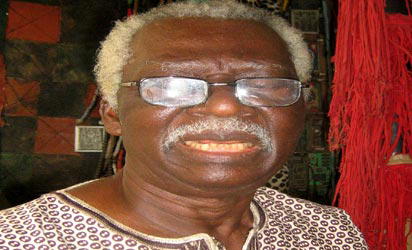
*Bruce Onabrakpeya
By JAPHET ALAKAM
Prof. Bruce Onobrakpeya is a household name in Nigeria’s creative industry. He is one of the most documented and oldest practising Nigerian artists. The renowned printmaker, painter and sculptor who is also the founder of Bruce Onobrakpeya Foundation (BOF) has exhibited in leading galleries across the globe, including the famous Tate Modern London, National Museum of African Art of the Smithsonian Institute, in Washington DC etc.
Last Thursday,Onabrakpeya turned 80 and as expected his birthday was marked with series of arts events across Nigeria, US and Ireland. At his modest studio in Papa Ajao Mushin, Art on Sunday caught up with him and he bares his mind on a wide range of issues. Excerpts
Series of activities were lined up for your 80th birthday celebration both in Nigeria and outside, how do you feel for the recognition?
I think my first word is gratitude to God for what he has done for me, for health I got for developing the creative profession, the destiny that led me to the chosen profession and the intellect that God has given to me. I am most grateful to God and I am also very grateful to the environment, including all the people, the schools, the government, the cultural engineers, the journalists, the people who makes it possible for art to be created , enjoyed and disseminated. After God, I am grateful to all of them that made it possible for me to work and do what I have done that have given me recognition and this loud ovation.
Despite your exploits in the art industry, the awards and all that you have achieved, you still said that at 80 you are not done, how do you mean?
I think I described art as life and then when they say when are you going to stop doing arts? I ask the question, when does one stop feeling, when does one stop expressing oneself and it goes on fore ever, even if you are a very old man, you can still feel what is going on, if it is cold you feel cold, if the weather is hot you feel it and all these are things for expression and so as long as you are alive, all these things keep happening to you and you keep expressing them. If one is a writer, one expresses them in writing, if one is an artist one puts them in drawing, painting or sculpture. You see one never stops.

*Bruce Onabrakpeya
Then the other thing that I had also mentioned is the fact that the end of one particular thing is the beginning of another one. In other words, one art piece is an idea that seem to be put together in one small form, leads to another one because the process of creating one thing opens up other ideas which could be followed in another work.
So it is like a chain reaction like an atom, one leads to the other and it continues to go. The works that comes out that I did not complete by the time it is completed some ideas come to be out of it. There are certain things that were not properly done that has to set upon and done again in another way to get something better and before that one is finished something else comes in, so the world keeps going. In that case, really one can’t stop, you just go on, go on until one can not see again or one can not feel anything again and that is the time one stops. And you know what that time is, I keep going, I feel great, I am grateful to God.
The Bruce Onabrakpeya Foundation that organises the yearly Harmattan workshop has tutored many artists and brought fame to Agbarha Otor, but despite the success of the workshop, you are still not done with it?
Well, right now I think I am grateful . The result that has come from there is something that we can talk about as a success story, but that does not mean that we’ve actually reached the peak. We are still growing and there are still a lot of things to be done in order to make the Workshop reach wider public, reach more people in Nigeria and abroad,and then create more artists, we have that as our task.
The number of people who started with us was small but gradually it is growing and we were mainly from Lagos but now people from other parts of the country are there, people from West Africa and people from America, Canada and Belgium are there.
We want to make this Harmattan workshop something that can draw people from all parts of Africa and all the continents of the world. It is a continuous growth, but the level we are now, we are grateful, it is a success story but that is not the peak because we are still growing.
You are a product of the Zaria Art school that produced great artists known as the Zaria rebels, after your set has the school been able to produce such people again?
Yes, I want to say that Zaria has produced other generation of artists and if I want to mention one generation, it is the generation that produced Dele Jegede, Kolade Osinowo, David Dale etc. In a school such as Zaria, you have generations but sometimes the generation may emerge after 5 or 10 years, but there continue to be generations of people coming out and curbing different societal and generational issues so that is Zaria.
We happen to have come with a philosophy that the people who are coming behind still draw from them, but the people who are coming out now have different messages and they are producing works that are fine. I want to say that the generation that came from Zaria also branched into Nsukka and now developed the Uli concept so you see that Zaria is one and other generations that have been coming are producing good things.
There is this saying that Art education is on the decline, if it is so what is the way out.
I don’t believe that, my impression is that art is on the move, because the response and enthusiasm from the teachers and lecturers who bring their students to Agbarha Otor for the workshop and the clamour for visits from schools to the place is encouraging.
So with the interest that is in the air about arts, I think art is growing. In the olden days we have only Yabatech and Zaria that have art departments but now every state have a university and they offer art courses. Apart from the universities, we also have polytechnic and colleges of education and they all have art departments, so you know have art been taught in all the schools and if you put the number of the students reading art you find out that the number is growing.
What is your take on the return of the stolen works to the country?
It is a good thing that the cultural property that left the country years are been returned. We are praying that more and more should be returned. The concern in many quarters is that when these things return, how do we look after them. While the museums and monuments are there, they are doing things to make sure that what ever comes back is properly displayed to the benefit of every one.
I know for sure that some corporate bodies have joined the Federal government to improve our personal museum and I think that improvement should spread to the states so that any thing that is returned will find a proper place for display.
What you just said reminds me of the destruction of art works at Murtala Muhammed International Airport, So won’t such fate befall the returned works?
For now I have not seen any deformation, but we just mentioned this last Sunday at Freedom Park, when government or private bodies become very uninterested in art works that has been created, it is for the people to draw their attention and talk about it so that whatever wrong that has been done should be repaired.
It is the same thing that we did with the artifacts that were outside.
Disclaimer
Comments expressed here do not reflect the opinions of Vanguard newspapers or any employee thereof.