
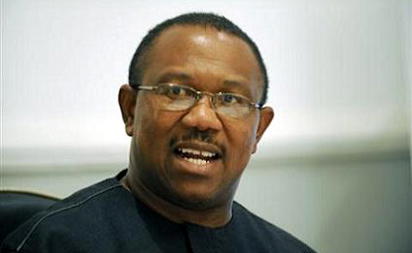
*Gov Peter Obi
by Ochereome Nnanna
When Governor Peter Obi of Anambra State held a media parley with journalists in Lagos recently, one of the questions I asked him was the true status of Anambra oil and gas resources long rumoured to exist.
It was based on this “rumour” that Orient Petroleum, chiefly owned by the government and people of Anambra State and other stakeholders, was floated about a decade ago to drill for oil and refine some of it while the remainder would be barged down the Niger for export.
It was with euphoria that Obi announced that “very soon” journalists would be invited to witness the commissioning of Anambra’s oil wells. When I received a text message from his major domo, Valentine Obienyem, to attend the event which took place on Thursday, October 31, 2012, it was the oil wells and the Onitsha River Port that I wanted to see most out of the many new mega-factories that were lined up for official opening.
But alas! It was not to be. On the official programme of the day, the commissioning of the oilfield and refinery were to be the last items before President Goodluck Jonathan would depart the state. However, the protocol was changed and the commissioning was done first, without the media having the opportunity to see what they were really all about.
Up till today, the whole story about the phenomenon that made the President to officially pronounce Anambra State as the “newest oil-producing state in Nigeria” is shrouded in utter controversy. Not much has been said about the size of these oilfields, other than that the oil is in “commercial quantity”. Not much is known about the number of barrels per day we can expect from them. All that the President said was that for the state to start collecting its derivation royalties the bureaucrats at the Federal Ministry of Petroleum Resources would need to tie up the technical loose ends.
It will also require legislation to determine whether Anambra will now become one of the Niger Delta states.
More importantly, is the potentially dangerous issue of who owns the land – and the oil. The Orient Petroleum is sited at Aguleri Otu. But the land on which the oil wells that feed it stand is under dispute by Kogi and Enugu states. As most national dailies focused on the arrival of Anambra State as an oil producing state the day after the commissioning, the pro-North Trust newspapers paid copious attention to the grievances of some groups from Kogi State who claimed, through a youth leader, Ibe Abah, that the oil is piped to the Orient Refinery from Odeke land in Ibaji Local Government of Kogi State. From the tone of their concerns, there might be another case of “curse of oil”, this time manifesting in communal clashes and perhaps disruptions, unless the issue is handled to the satisfaction of those who feel they are stakeholders. Surely, there is much to be expected from this issue beyond oil production and the activation of the nation’s first private refining factory.
The second history-making event was the commissioning – at long, long last – of the Onitsha River Port on the same day. It was completed by local contractors, Inter Bau, at the cost of N4.6billion. If everything goes according to plan, Onitsha is likely to be the most successful of the river ports that will dot the Niger at Koko, Oguta, Onitsha, Lokoja and Baro. The reason is simple: Onitsha has one of the largest markets in Africa, and the industrial town of Nnewi is just a stone’s throw. The two giant cranes that would be lifting containerised cargoes from barges were demonstrated. Apart from the large warehouses, there is also a huge container depot and oil tank farm.
What made August 31 a special day in the history of Anambra State specifically and Nigeria at large, was that the Onitsha River Port, which was conceived during the President Shehu Shagari regime in 1981, has been serially sabotaged. A former Minister of Communications, Mr Olawale Ige, during his brief stint in 1990, sought to cancel the project because according to him, there was no need for it!
Even when the late President Umaru Yar’ Adua decided to complete the dredging of the lower River Niger to make it navigable and clear the way for the construction or completion of the river ports, some Ijaw leaders openly kicked against it, saying it would endanger the livelihood of those living further downriver, something that a thorough environmental impact assessment, EIA, could easily prevent. The bottom line of it all was that, in line with the civil war policy of denying the Igbo people any direct access to the Atlantic Ocean, every move made to actualise the project was truncated.
It has taken the regimes of the late Yar’ Adua and the current one of Goodluck Jonathan to shut the door on the odious past and begin a process that will make the River Niger the useful resource that other great rivers of its type in the world, such as the Nile (Egypt), Amazon (Brazil), Danube (Germany), Tigris and Euphrates (Iraq), Seine (France), Thames (England) Mississippi (USA) and Yangtze Kiang (China) are for the economic and social development of the world.
The President also committed very strongly to the construction of the Second Niger Bridge to link the South East and South-South to the rest of the country. The “ground breaking” is to take place in March 2013.
President Jonathan expressed his joy that majority of the projects commissioned were private sector-financed factories – Orange Drugs, SabMiller, Krisoral, in addition to Orient Petroleum, which, according to him, will fetch a total of 10,000 jobs.
Indeed the pace of industrialisation will now pick up in the state. But Onitsha, as a city, has to be completely “rewritten”. Right it is a total junk city, bedevilled by rubbish, pigs and indiscriminate commercial activities.
Disclaimer
Comments expressed here do not reflect the opinions of Vanguard newspapers or any employee thereof.