
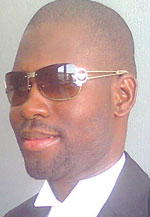
Mr Ikenna Okpala
BY LAJU ARENYEKA
“Everyone has the right to education,” says Article 26, section one of the Universal Declaration of Rights. Everyone – blind, deaf or autistic. Everyone – including the thousands of physically challenged children who roam the streets of Nigeria in search of alms.
According to the 2006 national census, there were 3,253, 169 persons with disability in Nigeria, with nearly 39 per cent of school age. Experts expect the number to increase.
For many, the average Nigerian child born with a disability does not stand a chance; but not in the eyes of Mr. Ikenna Okpala. “His chances are as good as any other child’s,” he said. And with good reason too: this lawyer and alumnus of the University of Lagos was born blind.
“Being visually impaired is just the absence of sight. It doesn’t affect the other senses,” he told Vanguard Learning. Mr. Okpala, however, agrees with experts who spoke to Vanguard Learning that education for children with special needs does have its peculiar challenges.
He said; “We live in an underdeveloped country where a large percentage of the population is illiterate. How do you expect an illiterate man and his illiterate wife who have a blind son to be aware of opportunities to educate him?”
Dr. Kunle Adebiyi, a lecturer at the Department of Special Education, Federal College of Education (Special), Oyo, said; “Because of lack of sensitization, many are not really aware that such people can get good education. We need to sensitize the general public to communicate with such people. Schools, banks and other buildings should be built with them in mind. Currency identifiers should be put in place for the blind, and newspapers should also be written in Braille.”

Mr Ikenna Okpala
If sensitization concerning learning for the physically disabled child leaves much to be desired, then awareness about unseen disabilities such as autism, are nearly non-existent. This is the view of Oke Martins, the brain behind Austism Associates, a non- governmental organisation that helps solve Autism Spectrum Disorder and related developmental disabilities in Nigeria.
According to him; “There are some conditions that are well known and to some extent, have available provisions, but there are some other conditions that aren’t well known and have scant provisions. The big challenge with unseen disabilities such as autism is that they have no physical features, and as such, millions of Nigerians living with it are undiagnosed, and there is barely provision for them.”
Autism Spectrum Disorder (ASD) and autism are both general terms for a group of complex disorders of brain development. These disorders are characterized, in varying degrees, by difficulties in social interaction, verbal and non-verbal communication and repetitive behaviours. “Autism is now regarded as a global epidemic, reports say that it is the 3rdmost common disability in the world,” Martins said.
“As I am talking to you now, there isn’t a single centre for learning for people with autism that is government- owned. Even those that are set up by individuals are in cities such as Lagos, Abuja, and Port Harcourt,” he added.
Speaking at a press briefing in Abuja earlier in the year, the Minister of Education, Professor Ruqayyat Rufa’i said that six zonal autism centres will be established for early detection and treatment of autism as part of federal government’s effort to address issues of autism. She also said her ministry has been training the regular classroom teachers on “methods and techniques of handling children with autism in an inclusive classroom setting.”
The ministry’s actions, though long overdue, will hopefully provide a more conducive learning environment for children with special needs. Ikenna Okpala said; “I started at Pacelli School for the Blind, and I learnt how to live and manage as a blind person, and then I proceeded to Federal Government College Ijanikin. There, it was a major challenge because many teachers were oblivious of the fact that there were blind students in the class.
“A teacher would just enter the class and start copying a note on the board, and clean off as soon as he was done. I had to develop another approach. After classes, I would get people to read their notes out loud to me. I would write them out, and translate to Braille. Many of my teachers didn’t even know they had such a student in their class until it was time for test, and I would bring out my type writer.”
Although new technologies have made it easier, educating children with special needs is no walk in the park as per the amount of money involved. The facilities are quite expensive. A Braille machine costs about N150,000. How much more new technologies such as the Jaws and the embosser? It is no wonder that Nigeria is lagging behind in this respect.
According to Adebiyi; “It costs about ten times more to educate a child with special needs than an average child. Generally, the government is trying, but they aren’t doing enough.”
Awareness, resources, and a social support system; the three-fold answer the Austism Associate boss gave in response to a solution to this dilemma.
Disclaimer
Comments expressed here do not reflect the opinions of Vanguard newspapers or any employee thereof.