
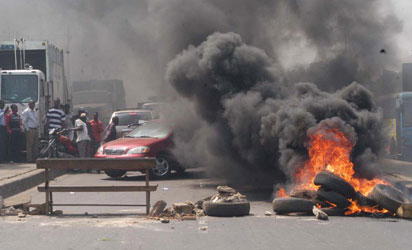
Road block and bonfire…major symbols of the workers protest
This is the tenth edition of the serial on OWEI LAKEMFA’s latest work: “One hundred years of trade unionism in Nigeria”. The nineth part was published yesterday.
SO strong was the JAC’s influence and so successful was this strike that four months later, the traditionally conservative unions in the education sector formed their own JAC, and went on a country-wide strike “for the first time in the history of Western education in Nigeria.”

Road block and bonfire…major symbols of the workers protest
This teachers’ strike which ran from October 1-9, 1964 was over their insistence that a national joint industrial council be established for the education sector in accordance with the agreements on the Morgan Commission Report. The teachers won and the council comprising sixty members was established under the chairmanship of Justice J. A. Adefarasin.
The political strike that floundered: As the country slid into political anarchy and electoral fraud, the JAC in December 1964 called another general strike, the third in fourteen months! The Federal Government having just fought a scalding battle with labour, decided to settle for the Nigeria Union of Teachers, NUT, General Secretary E. E. Esua as chairman of the National Electoral Commission charged with conducting the December 1964 general elections.
Matters came to a head on December 28, 1964 when the President, Dr. Nnamdi Azikiwe, disagreed with the Prime Minister, Alhaji Abubakar Tafawa, over alleged malpractices in the nomination of candidates for the elections scheduled for December 30, 1964. Balewa was infact rumoured to have put Dr Azikiwe under temporary house arrest to pressure him to support the elections. The same day the president – prime minister disagreements on the elections became public knowledge, the JAC met and passed a resolution:
“That it will not stand by while the elementary rights of the citizens of Nigeria to freely elect their representatives and government is being shamefully denied the citizens of this country; that it will call country-wide sit down strike with effect from 10 a.m. on December 29, 1964 and refuse to offer the co-operation of the workers until steps are taken to ensure that the freedom we so dearly paid for is preserved and that this is demonstrated by the free vote of the citizens of this country in electing those who will govern them; that the election scheduled for December 30, 1964, be postponed until a free and fair election can be guaranteed.”
The December 1964 general strike was effective in Lagos, Enugu, lbadan and a few states. It was mainly spearheaded by the militant railwaymen and the public workers unions. It petered out on January 6, 1965 having wobbled all along. The powerful JAC which humbled the Federal Government in June was six months later unable to sustain a similar strike.
Preparations and mobilisation
There were five principal reasons for this. First, the strike notice by JAC which was less than eighteen hours was too short. So no preparations and mobilisation were carried out before the strike. Even workers willing to carry out JAC directives only joined days after, due to lack of communication.
Secondly, unlike the June 1964 general strike which had to do with wage increases and enhanced conditions of service, this strike had no clear economic advantage to workers nor did it address their immediate problems. The workers clearly were neither ripe nor ready for a purely political strike. Thirdly, workers belonged to various political parties, so calling a purely political strike that was tied to scheduled general elections was a somewhat a slippery path to take.
Fourthly, leaders of the less radical United Labour Congress, ULC, whose president Haroon Adebola was the JAC chairman, disassociated themselves from the strike and asked workers to ignore it. Fifthly, the Balewa government backed by the Northern Region administration of Sir Ahmadu Bello was able to isolate the JAC in that region through its supporters in the Northern Federation of Labour.
Commission’s wage zones
The Northern Region government had made nonsense of the Morgan Commission Agreements of June 1964 by unilaterally reviewing the Commission’s wage zones. It collapsed the four wage zones in the region from four to two but in a deft move, it increased the nationally agreed wage increases by a further 10 per cent for its workers.
The Northern regional government in creating this divide and rule strategy, and attempting to derail the agreed federal wage system had said that the extra wage increases it introduced was “in appreciation of the good leadership and maturity shown by the labour leaders (in the North) in bringing to an end the last nationwide strike.”
Morgan Commission member, T. M. Yesufu, wrote that the Northern Region government’s unilateral action “… destroyed both the elements of officialism and bargaining, as well as the moral force to implement the rates.” So when the JAC called the December 1964 political strike, labours leaders in the North saw it as pay back time for the Region government’s gesture.
Uba Ahmed, a trade unionist who was to later play a not too complimentary role in the Labour Movement, disassociated northern workers from the strike. Ahmed who spoke as secretary of the Northern Federation of Labour blackmailed the JAC leaders like Michael Imoudu and Wahab Goodluck as partisan politicians who wanted to use workers for their selfish purposes. Although the last general strike failed, JAC had generally fought well; the Balewa government could not fully recover from its June 1964 smacking.
Robin Cohen argued that following the June 1964 general strike “The support of the army and police force in particular was now in question. Both the army and the police had been called to suppress the strikers… significantly for later events, the army had been used to suppress a political demand to which they were not entirely unsympathetic… it seems clear that the 1964 strike helped provide a staging ground for the army’s own intervention eighteen months later.
With the JAC and the battles it fought, there was hope that it would succeed in unifying the four labour centres in the country and become the sole labour central organisation. Following the failed political strike, the United Labour Congress (ULC) and the Nigeria Workers Council, NWC, broke ranks with the other labour centres in the JAC to form the Trade Union Supreme Council, TUSC. With that, the glorious JAC died.
It was not the JAC alone that died; the Balewa administration could not survive for too long also. On January 15, 1966, the army struck, and it fell. The new Head of State, General Johnson Aguyi-Ironsi met leaders of the four labour centres on February 14, 1966 and told them that “The trade unions will now be required to play a more constructive role”.
Perhaps if the Tafawa-Balewa administration had harkened to Labour’s cries against the massive rigging of elections especially in 1964 and not used armed soldiers against civilian protests, the January 15, 1966 coup might not have taken place, and the subsequent counter coup and civil war might have been avoided. This may as well be a mere conjecture.
MINISTERS WHO SHAPED THE FACE OF LABOUR
The Federal Ministry of Labour is responsible for government’s social engineering; it is, therefore, a major ministry. Since the pioneer Labour Minister, Chief Samuel Ladoke Akintola was appointed in 1952; there have been twenty nine Labour Ministers. They have been so many because over half of them spent an average one year in the Ministry.
The longest serving is famous patriot Chief Anthony Eromosele Enahoro who served for eight years from 1967 to1975 under the General Yakubu Gowon military regime. He is followed closely by Chief Joseph Modupe Johnson, JMJ, the former Second World War soldier-turned politician who served as Labour Minister for seven years from 1957. The Labour Minister with the shortest stay in office is Senator Ibrahim M. Kazaure who was Minister for thirty five days from February 10, 2010.
Mbu, the youngest labour minister
On another hand, the youngest Labour Minister in Nigerian history is Chief Mathew Tawo Mbu who was 23 years when he was appointed Labour Minister in 1953 under the Balewa administration. Chief Mbu in a 2009 interview with Vanguard spoke on this appointment at such a young age. He had said: “I think it was destiny. When I was appointed the Labour Minister, I was so young that Pa Imoudu, the then Labour Leader, refused to have a handshake with me saying this boy is too young to be a Minister”.
Another Labour Minister, Dr. Emmanuel Mbella Lifafa Endeley, who served from 1952 to 1953 lost his nationality and was de-Nigerianised. The first Labour Minister, Akintola was a teacher at Baptist Academy, Lagos; a journalist, and later a lawyer and leading politician. Akintola who was imbued with the power of oratory was opposition leader in the Federal House of Representatives, and Premier of the Old Western Region. He lost his life in the first Military coup on January 15, 1966.
His successor in the Ministry, Dr. Endeley was from Anglophone Cameroon that was administered as part of Nigeria. He attended the Native Authority School in Buea his home town, Government College, Umuahia, Yaba Higher College, Lagos and the Nigeria School of Medicine. He and twelve others from Cameroon were elected into Nigeria House of Representatives, Lagos and the Eastern Nigeria House of Assembly.
Dr. Endeley was appointed Labour Minister in 1952. Cameroon like Togo, had been one of the German colonial territories seized by the victorious European allies and shared by Britain and France. The British share were the northern and southern Cameroons. On February 11, 1961, a Plebiscite was conducted to allow the people of the two areas decide whether they want to be part of Nigeria or Cameroon as they originally were.
The Northern Cameroon by 292,985 votes to 97,659 opted to join Nigeria and was renamed the Sardauna Province. On the other hand, despite Endeley’s spirited campaigns that his people remain part of Nigeria, they decided by 233,571 votes to 97,741 to join French Cameroon. So Endeley became a Cameroonian.
Chief Festus Samuel Okotie-Eboh who was Labour Minister from 1954-957 was a flambouyant, colourful and controversial politician. He had joined the British Bata Company as a clerk and rose to become a manager. He studied Business Administration in socialist Czechoslovakia but returned to become one of the staunchest anti-socialist politicians; like America’s Senator Joseph Raymond McCarthy, Okotie-Eboh could sniff out a communist thousands of kilometers away. He is best known in Nigerian history as a Minister of Finance.
An August 2007 British Broadcasting Corporation, BBC, investigative programme reignited claims that Okotie Eboh was one of the politicians the British Colonialists rigged elections for in the 1950s in order to ensure that the NCNC swept elections in the South to actualize their plan for a Northern Peoples Congress, NPC, alliance with the NCNC to form the post-colonial government.
Disclaimer
Comments expressed here do not reflect the opinions of Vanguard newspapers or any employee thereof.