
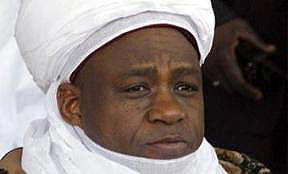
Sultan Sa’ad Abubakar of Sokoto
by bashir adefaka
Undoubtedly, the Sultan of Sokoto is the head of the Seat of Caliphate and Muslim Community in Nigeria. The 20th occupier of that exalted position, Alhaji Muhammad Sa’ad Abubakar III, is most time of the day occupied with issues about bringing peace and stability to the northern part of the country. The Boko Haram insurgency has seriously undermined the peace and unity of this country.
It is only unfortunate that few years into his reigns, a big national security challenge, virtually unprecedented in the history of the country, erupted from his own side of the country, the North, which has placed more burden on the shoulders of the retired General than it should ordinarily have been.
A recent visit, on the eve of the ongoing Ramadhan fasting by this writer, to the palace of the foremost Nigerian leader, who was rated 4th most influential African leader, showed the many efforts he is making to see Nigeria intact.
At the occasion to announce the moonsighting for the beginning of the fasting, the Sultan appealed to those behind the current wave of violence in the country to sheath their swords and embrace dialogue because, according to him, dialogue remains the best option in resolving all problems.
“It is also pertinent here, to express our total commitment to ensure peace, peaceful coexistence and unity of our great country,” he said in a statement issued through the Secretary to the Sultanate, Alhaji Attahiru Hussaini.
At several fora, the Sultan, in his characteristic leadership manners, moved not only to douse the tension from the callous insurgency of the terrorist group but also to disabuse the minds of those who erroneously believe that the action of the group is supported by Islam.
Speaking at the 2012 symposium organised by NASFAT in Abuja, recently, Alhaji Sa’ad Abubakar said it was wrong for anyone to nurse such a belief.
He then cautioned religious leaders against inflammatory comments capable of causing disunity among the adherents of various religions in the country saying the concept of Jihad in Islam had been misconceived and misinterpreted “as fighting or killing people who refused to accept Islam.”

Sultan Sa’ad Abubakar of Sokoto
For the fact that he is seen as the leader of Muslims in the country, the statement by the Sultan should be taken as that which represents the entire Muslims instead of giving listening ears to what the group said especially as it bothers on Islam. Of course, Sultan is the leader of Muslims and he alone can speak for the Muslims.
Although the Christians continued to blame the Muslim Community for not doing enough to curb the activities of the terrorist group but failed to believe that the Muslims are also at the mercy of the terrorists as figures showed that more Muslims had died in the terrorists attack put together.
Besides, it is also difficult to stop or curb what one does not initiate. Since the Sultan or Muslim Community in Nigeria did not start and is not responsible for the killing of people and destruction of properties and places of worship, both the Muslims and Christians can only join forces with the constitutional authorities in tackling the menace; especially now at a time that the sect had even disrespectfully defied the noble call of the Sultan and Muslim Community as well as disregarded the Holy month of Ramadan to launch fresh attacks, this time, in Sokoto the Sultan’s domain.
Wise and well meaning Nigerians know that there are many dimensions to the problem. The former Garrison Officer Commanding, Three Division of the Nigerian Army and former Minister of Communications, Major-General Tajudeen Olanrewaju said: “You see, the collapse of Ghadaffi was why those fundamentalists migrated from Libya and Islamic State has been declared in Mali so that, from Libya, people are migrating with arms and ammunitions to cause Boko Haram.
That is the assumption. There are people that are trained with arms and ammunitions in Nigeria and so the NSA should look at it in those two ways. If that is the case, he has to be proactive. What you have as Boko Haram in the North is what you have as militancy in the South; the banditry, the robbery, the kidnapping and it is the same urban terrorism,” he stated.
“So these people can migrate to anywhere. The arms are coming from all the borders and people are making money from it just like the subsidy money. You have to look at that side and tackle it from the source,” General Olanrewaju had said in an exclusive interview with Vanguard recently.
Another prominent Nigerian, who spoke under anonymity, also wondered: “Where Boko Haram’s violent activities have become the Muslims’ headache or doing is unfounded. It is basically a national and general problem that must be tackled collectively if truly solution is desired. Because hiding under the Boko Haram challenges to call for the break up of the country will know no success; not in the sense of impossibility but – in reality – in the sense that even the broken pieces will at each level continue to see the same problem,” he said.
The former Sudan experience is not far in memory: it was claimed by Southern (Christian) Sudan that the problem of former Sudan was Northern (Muslim) Sudan and frantic effort was made to break up the country into Sudan and Southern Sudan each now independent of the other. It’s not for this piece to state if the Southern Sudan has ever known peace since the break up or not but Sudan under Al-Bashir has never regretted it took place.
Hence, the earlier Nigerian leaders (Muslims, Christians, politicians) return to the basis and think out a common front against the bloody challenges, the better. Boko Haram is not the basis for judging the acts of Muslims but the Qur’an and tradition of Prophet Muhammad.
When Prophet Muhammad entered Madinah, he met Christians, Jews and pagans on ground. He did not enforce his faith on them neither did he declare war on them; rather it was the pagans who later thought they could not subject themselves to the faith propounded by another mortal.
So, neither the Sultan, nor Islam is the cause of Nigeria’s insecurity. The problem is insincerity and cheer hypocrisy on the part of people who are supposed to banish poverty in the land but are now spreading it by their unchecked corrupt practices, self-centredness, greed and wickedness.
They laugh in their native regalia smiling to the bank while their people languish in abject poverty; playing politics with the destiny of this country. We must work together with one mind, one spirit, and one purpose for Nigeria; our fatherland to move forward.
Importance of Iftaar
By Harun Razaq
Iftaar: means breaking the fast, (or the first meal eaten after the sun-set by a fasting Muslim especially during the month of Ramadan). Iftaar is one of the meritorious acts of the month of Ramadan and is often done in jama’a (congregation), with people gathering to break their fast together.
The importance of providing Iftaar to the fasting Muslim cannot be overemphasized in Islam because the Prophet (SAW) stressed its importance. For example, Zayd Ibn Khaalid al-Juhani said: The Messenger of Allah (SAW) said: “Whoever gives iftaar to one who is fasting will have a reward like his, without that detracting from the reward of the fasting person in the slightest.” (Narrated by al-Tirmidhi, 807; Ibn Maajah, 1746.Classed as Saheeh by Ibn Hibaan, 8/216 and by al-Albaani in Saheeh al-Jaami, 6415).
It is also reported that Abdullah Ibn Umar would not touch his meal for Iftaar except in the presence of some indigent and orphans who will share the meal with him. (See “Sab’una Mas’alah fis Siyaam) Also, many of the earlier Muslim such as Dawuud al-Taa’i, Maalik Ibn Dinar and Ahmad Ibn Hanbal used to give up their Iftaar for others. (See Fatwah of Shykh Salih Munajih no.12598)etc.
As regard what is meant by giving Iftaar, Shaykh Ahmad Ibn Taimiyyah said, is giving him food that would be enough for him to break his fast. (Al-Ikhtiyaaraat Fiqhiyyah 109). In other words, those who cannot afford to give enough food should give the little they have.
Because there is a report, which states that “Allah grants this same reward to him who (does not have enough) gives a fasting person a single date or a drink of water or a sip of milk to break the fast”.
No doubt, Iftaar is famous among Muslims world-over owing to its importance during the month of Ramadan. Prominent in the act of sponsoring Iftaar are some individuals and organizations from Saudi Arabia who feed fasting Muslims in selected area annually.
Also, recognizing the importance of Iftaar is the United State of America, which has Muslims in the minority, has since 1996, through United States Department of State, held an annual Iftaar dinner for community leaders from US society and faith groups as well as foreign policy officials.
But, it is disheartening that many of the present Muslims in Nigeria particularly the rich do not value the act of providing Iftaar to the fasting Muslims; with exception of few Muslims who has in recent time been sponsoring Iftaar and one of them is Hon. Kazeem Ademola Alimi member, Lagos State House of Assembly, representing Eti-Osa Constituency I.
Disclaimer
Comments expressed here do not reflect the opinions of Vanguard newspapers or any employee thereof.