
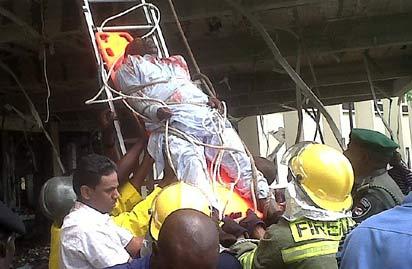
Rescue operation at the scene of the blast
By Jide Ajani
Shattering the peace in Abuja on the last Friday in a month of peace that Ramadan is, Boko Haram this day last year brought its fight to the door step of the international peace body, the United Nations House in Abuja.
Leaving in its wake 20 dead and several scores injured, that dastardly act marked the second time a suicide bomber would be used in Nigeria by the dreaded Ahlan Sunnah Lid Da’waati wal Jihad Yaanaa (brothers), popularly known as the Boko Haram sect – the first was the bombing in June, of the Police Force Headquarters in Abuja.
The group has since perfected this strategy, using it to carry out several attacks in the country.
It marked the very second time in the history of terror in Nigeria that a suicide bomber would be used – the first being the attack on the Police Force Headquarters in Abuja.


But the attack on the UN House presented the dreaded Ahlan Sunnah Lid Da’waati wal Jihad Yaanaa (brothers), popularly known as the Boko Haram sect as being very co-ordinated in its terror activities.

Rescue operation at the scene of the blast
Before that attack, the general belief was that the group was a rag-tag conglomeration of riffraff with no clear mandate; or a group of criminals being used by some politicians to destabilize the Goodluck Jonathan administration.
Even the Americans have since decided on how to handle the group. It recently designated three of its members as terrorists but fell short of designating the group as a Foreign Terror Organisation, FTO.
Ambassador Jonnie Carson, Assistant Secretary of State for African Affairs, during a congressional sub-committee hearing in the US, explains the position of America on Boko Haram.
According to him while making his presentation, he said, “We have indeed designated three individuals, who we think are in top leadership positions inside of Boko Haram. But we have not designated the entire organization because we do not believe that Boko Haram is a homogenous organization. We believe that it is an organisation of several parts. We believe that the individuals that we have designated (as terrorists) represent a core group who lead a part of Boko Haram which is desirous of attacking not only Nigerian targets and interest, but also Western and international targets and interests.
“We believe that the larger element of Boko Haram is (only interested in and doing everything) to discredit, disgrace the Nigerian government; discredit, disgrace and embarrass the Nigerian government by carrying out attacks against Nigerian government, security and the civil institutions, attacking politicians, attacking government officials and judges. But the both of the organisations, we believe to be mainly aimed at going after Nigerians equally.”
The day of the attack on the UN House was like any other day in Abuja.
The intelligence community had gathered pieces of information which suggested that an attack was being planned for the capital city and, therefore, secured most public buildings.
That Friday morning, the tranquility of the United Nations’ House environment was shattered by the twin bomb blasts which brought down parts of the two-winged, four story building.
Perhaps, had the building been a perpendicular structure, the number of casualties may have been much more.
Had the building also not had its in-built fire-extinguishing devices in place, the casualties may have been much more hurtful.
Indeed, the 20 dead may not have met the expectations of the perpetrators of the dastardly act – See Horror List of UN House.
The suicide bomber knew how best to gain access into the building and he went for it: Through the back door.
He rammed through the two gates.
Even the security men who tried to stop him from driving through ended up becoming the first casualties.
But they still tried, three of them, because they slowed the suicide bomber down.
The suicide bomber drove through the gates at about 10:20 am.
He ended up where he wanted, at the ground floor of the massive building. But the structure of the building created a safety net.
It was the last Friday of Ramadan, before the Eid-Elfitri celebrations already slated for Tuesday and Wednesday, August 30 and 31, respectively. Majority of Muslim faithful in the nation’s capital had no doubt planned last minute shopping and travel plans for the anticipated Sallah. And, of course, for Abuja residents, the prospects of a long holiday were in the air.
Findings indicated that as at the time the blast occurred, at least 275 officials working in the UN House system had clocked in for the day’s work.
Apparently well coordinated emergency rescue efforts, as well as practiced fire drill contributed in no small measure to the seeming small number of casualties, taking into consideration, the high impact of the explosion.
Sources informed Sunday Vanguard that, the bomber, apparently focused on recording maximum effect, crashed through the two gates and rammed his vehicle right through the glass doors, stopping at the front of the reception to detonate the second bomb, having detonated the first bomb after crashing through the first gate.
It was gathered from eye witness accounts that at about 10.23 am, the suicide bomber crashed into the building in a metallic colour Toyota Camry with registration number Kano A Y 38 NSR. The car became mangled after the explosion.
The car blew to pieces along with all those in the reception at the time of the incident. Security officers at the entrance and the reception who tried in vain to stop the bomber were the first wave of casualties from the blast.
Parts of the car went up in flames immediately after the blast which also destroyed virtually all the glass windows of the building. The entire ground floor adjoining the reception was a complete mass of blood, water, sand and dust.
The impact was so strong that even buildings some 400 meters away got their windows also shattered.
Most of the expatriate staff, Sunday Vanguard gathered, reacted fastest to the blast, as most of them scampered out of the building to the fire muster point, before finally relocating to the nearby Turkish Embassy building site to take shelter.
Investigations further revealed that, all the expatriate staff was taken in American Embassy and Defence Headquarters ambulances to the State House clinic.
By that Friday night, the body count had risen to 18 deaths and hundreds of injured personnel, mostly working in the 26 agencies of the United Nations housed by the five story complex. The last confirmed figure by NEMA was 20 dead.
The rescue operations that day appeared swift. Within a short period, Ambulances from various organizations like the Federal Road Safety Commission, FRSC; National Hospital, which is situated opposite the building, National Emergency Management Agency, NEMA, Police, Civil Defence, and Nigeria Air Force, were everywhere rushing the dead and the injured to the National Hospital. At about 1.00 pm, the facilities at the National Hospital had been over stretched and some of the victims had to be evacuated to other hospitals such as the Garki Hospital, Julius Berger Clinic and Abuja Clinic.
By 2.35 pm, a total of 14 deaths had been recorded, with eight corpses deposited at the National Hospital Mortuary and another 6 at the Garki Hospital Morgue. The number of injured ran into hundreds.
There was an outpouring of condolences from all over the world that day.
Today, it is one year and many suicide bombings after.
Nigeria continues to grapple with the attacks by Boko Haram across states in Northern Nigeria.
It is hoped that the group would not attempt to make an anniversary statement by co-ordinating any form of attacks on this day. (See a survivor’s story)
Horror List of UN House
Those Affected – 275
Injured – 68 (46 males, 22 females)
Dead – 20 (17 males, three females)
Kids affected 20
Properties damaged – Cost yet to be determined
Rescuers – FRSC, NEMA, Police, Civil Defence, Fire Service, UN Staff, National Hospital Staff
Disclaimer
Comments expressed here do not reflect the opinions of Vanguard newspapers or any employee thereof.