
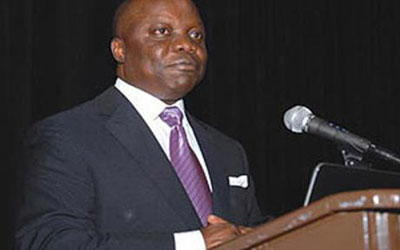
Gov Uduaghan
Being a paper delivered by Delta State Governor, Emmanuel Eweta Uduaghan at the Business Hallmark public policy forum, in Asaba on August 24,2012
HOW can the Niger Delta region march on with or without controlling their famed oil and gas resources?
If I were to interpret this further, I might assert, can the Niger Delta region succeed without controlling their resources? The poser can be expanded. Can Nigeria succeed without controlling Niger Delta resources? I shall provide my perspectives in the course of this presentation.
Resource control became a political term from the efforts of Niger Delta peoples to get a fairer share of their God-given resources and more say in their own affairs in relation to the rest of Nigeria.

Gov Uduaghan
Resource control in that sense, therefore, has become a rallying cry for the long-suffering peoples of the Niger Delta region and understandably subject to various interpretations depending on the individual’s stand in the country’s often fractious socio-political and economic debates.
If the demand for resource control has remained trenchant, it is simply because our peoples have for long lived with the stark evidence of a mindless exploitation of the oil resources in their land. They have lived with the despoliation and degradation of their environments without concomitant benefits to them as a people and to their communities where these resources are.
As it eventually happened, the wheel turned and they found their voices and are demanding for justice and for their rights, much to the shock of those who want the exploitation to continue unchallenged. Surprisingly, some have made an enterprise of justifying the suffering in the Niger Delta, in a provocative manner that tends to take the peaceful nature of our peoples for granted. Thankfully, our people have ignored them as we continue the search for justice in the matter.
Dr J. D. Ikechukwu captured the devastation of the region succinctly in his article on the Niger Delta crises in Peace Studies and Conflict Resolution in Nigeria, when he noted that “The oil which has brought so much wealth to the multinational oil companies and the Nigerian State has at the same time brought to the people of the Niger Delta untold poverty, disease, persistent pollution, ecological and environmental degradation.”
Sad, as this picture may look, the Nigerian economy has largely depended (85 per cent) on earnings from crude oil sales. On the strength of this single point, it is easy to see the fundamental importance of the Niger Delta region to the Nigerian economy and its oil to global energy resource. Sadly, that importance does not reflect on the treatment the region gets from the federation.
As a ranking exporter of crude oil, Nigeria’s supplies from the Niger Delta region play a crucial role in maintaining global supply stability. On the other hand, finding the delicate balance in the well-being of the Niger Delta region, the demands of the Nigerian economy, and the global community’s energy needs, is at the heart of the complexities associated with issues emanating from and concerning the region.
In a sense, I seem to have answered my second poser, which was, if Nigeria could survive without controlling resources of the Niger Delta region. Current reality dictates otherwise, from a standpoint of national economic survival, the stability of Nigeria as well as its ability to exercise influence as a sovereign state in the international political system.
If Nigeria derives all these benefits from the resources taken from the Niger Delta region, the moot question is, what would happen to the peoples of the Niger Delta, when oil and gas resources finish, as they must one day. This, to me, is the more compelling question, which we must urgently address.
Having this in mind therefore, what should a transformation agenda for the Niger Delta look like today? There are two cardinal points, I envisage in this. One, get the most you can from oil now as you transform to a post-oil era; because, like it, or not, that era must come.
Available options
Two, develop other sources of revenue and diversify your economy to optimise available options or create them. To do the latter, you must revive agriculture and invest in agro-allied industries, enhance rural industrialisation, revive and deepen manufacturing, clean up the environment, develop human capital and upgrade infrastructure.
For the first leg of the struggle I would say since the return to democratic governance in 1999, these points were not lost on the political leadership of the zone. Let me in this regard salute the pioneering works of our past governors, especially my predecessor, Chief James Ibori, and the former governor of Akwa Ibom State, Obong Victor Attah, who especially championed the cause of achieving a better and more equitable allocation of resources to the Niger Delta region. That era gave resource control life. The battle, as most will recall, was not easy, as they were often deliberately misunderstood and their leadership questioned. Thanks in large measure to them, the argument for a fairer allocation of federal oil revenue to the Niger Delta region though not won, has become a progressive issue on the national agenda.
We cannot forget also the great efforts of Donald Duke, former governor of Cross River in focusing his State as a tourism destination of choice. It was no surprise then, that when the State lost 76 oil wells in a Supreme Court judgment, Governor Liyel Imoke reminded his people that there was life without oil.
He stressed the more important contributions of human resources and tourism to the growth and development of the State. He was not talking out of emotion. A foundation for this has been laid, and he is building on it.
There is indeed, life after oil, and the current leadership of Niger Delta region is immensely aware of this fact. On our part, my administration since inception in May 2007 has made it a covenant with the people to look beyond oil. We have set for ourselves, a three-point agenda of peace and security, human capital development and infrastructural development. In my article of October 2007, titled, “Delta Without Oil – The Changing Global Economy”, I pondered the question of Delta surviving without oil. While acknowledging the difficulty, I submitted that,
“This administration from the beginning has thought in that direction. We do not work for the money that comes from oil. It is easy money; it has changed our orientation about hard work. Our young people are growing up in expectation of an easy life from oil.”
Fixation on oil money
I am happy to report that five years on, we have succeeded to some extent, in changing our people’s fixation on oil money. Our first strategy was to return peace to our State, especially as the turmoil was related to contentions over easy money from oil.
Without peace and security very little else can take place. Given the long years of military rule and the upsurge in militancy in the entire Niger Delta region, no thanks to the divide-and- rule strategy which was often employed to keep our peoples apart, restoring peace and security to our State was not the easiest assignment to undertake.
Our strategy of persistently engaging the different peoples and interests in our State has ensured peace for even development. Commenting on this age-long security challenge, Democracy in Nigeria: Continuing Dialogue(s) for Nation-building, noted on the Niger Delta in Chapter 11,
“We may characterise the history of the democratic struggles of the people of the Niger Delta as consisting of two main directions: resistance to European pacification, domination by ethnic majorities, and most recently, military authoritarianism. At the heart of this resistance lie the control of resources and livelihoods.
Disclaimer
Comments expressed here do not reflect the opinions of Vanguard newspapers or any employee thereof.