
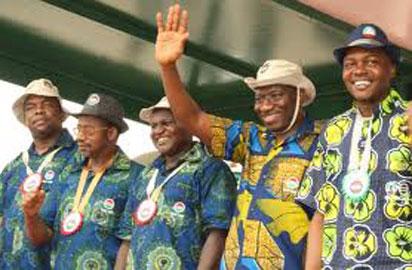
President Goodluck Jonathan (2nd right), with Labour leaders and Labour minister, Emeka Wogu (left)
This is the thirteenth and concluding edition of the serial on OWEI LAKEMFA’s latest work: “One hundred years of trade unionism in Nigeria”. The twelfth part was published yesterday.
ORIGINS of Workers: The British colonialists did not set out to create wage labour in Nigeria. Indeed nowhere in the world were deliberate steps taken to create wage labour, it was merely an inevitable by-product of a new age. As the feudal system gave way in Europe, new technology was developed which allowed for mass production of commodities. The steam engine was also discovered which helped production and mass transportation.
With the Industrial Revolutiion in the 18th century, European production lines were hungry for raw materials while finished products needed to be pushed to other parts of the world since the European markets had become saturated. Given the urgent need for raw materials and new markets, European governments and companies fanned out into the world smashing any local production system in their way and seizing territories by force of arms where the people refused to peacefully hand over their lands.
In the process of feasting on other peoples, Europeans were anxious not to eat themselves so they gathered in Berlin (1884-85) to carve up Afiica. Th colonisers in sharing other peoples lands, adopted what they termed. “The Principle of Effective Occupation.” Under this, each European country was to refrain from taking any land where another Berlin partner has shown some presence. What followed this unholy pact was a “scramble for Africa”.
European traders and even missionaries seized territories in the name of their mother countries after which they asked such countries for “lease” of the stolen land. The European countries sent armed gangs to subdue unco-operative Africans. This they christened “Gun-boat diplomacy.”
In Nigeria for instance, the British invaded and seized cities like Bonny, Calabar, Opobo and Lagos and placed their inhabitants under the gun. After the invasion and seizure of Lagos in 1861, the colonialists had to set up an administrative structure. They had to employ some of the colonised people to serve this administration.
This was the nucleus of what became the Nigerian public service. The Royal Niger Company seized the Niger Delta area and was recognised as the political authority in that area of Nigeria by the British which granted it a “Royal Charter” until Britain took possession of the Niger Delta in 1900. With these events, some local people had to be employed.
The churches with their strong ties to the colonial state, set up schools mainly as part of their evangelising mission. They also needed a crop of teachers including local ones to run the schools. To ensure the quick and cheap transportation of raw materials from the Nigerian hinterland to the seaports enroute to Britain, the colonialists began the construction of the Railway at Iddo in 1898.
It was later to be extended to Ibadan, the centre where cocoa was being collected, to the north where tin, cotton, groundnut and hides and skin could be sourced, Enugu, the coal city and Port Harcourt another major seaport. All these led to major recruitment of workers, and with it, the need to protect and defend their collective interests.
How the Nigerian Trade Unions were born: In 1900, a growing body of wage earners had been called into existence in the country following the expansion of the civil and public services due to the transfer of the “Protectorate” territories under the control of the Royal Niger Company. More workers were added from the marine, the newly developed railway, teachers and of course commercial workers.
Five years after this, an association of Civil Service Clerks in Lagos was established, followed in 1911 by a similar association in the commercial establishments. But the first recorded trade union was the Nigeria Civil Service Union (NCSU) which was inaugurated on August 19, 1912 at a meeting attended by 33 employees.
Popular support
The meeting was convened by Mr. H. Libert a Sierra Leonian who had been transferred from his country to Nigeria. A similar organisation had existed in Sierra Leone and Libert and some of the men who attended the meeting were conversant with the Sierra Leonian example.
Noted labour historian, Wogu Ananaba, wrote of this first union: Since the union was not known to have held any mass meetings during the period, it is even more difficult to determine how much popular support it commanded. Its strength lay perhaps, in the fact that its leaders (Nylander, Joseph McEwen, N .A. B. Thomas and 1. O. Gilbert) were among the most influential and highly respected members of the African Civil Service.

President Goodluck Jonathan (2nd right), with Labour leaders and Labour minister, Emeka Wogu (left)
This fact, more than anything else, would seem to have won it recognition. Its weakness lay in the fact that it was aristocratic to a fault. It did not just abhor strikes, but it lacked the courage even to make threats in furtherance of its demands.”
Later, unions like those of the railways, public works and marines sprang up. A salutary point that has to be made is that trade unions came into existence from 1912, some two decades before any law legalizing their existence. The British colonialists had feared that if unions were allowed to spring up, they would be catalysts in dismantling the colonial structure.
They were not to be disappointed. The Department of Labour Annual Reports for 1940 and 1941 revealed that in 1940 the number of trade unions in the country had risen to 14 with a membership of 4,629 workers. The following year the unions had increased to 41 with a total membership of 17,521.
In July 1941 with the World War raging and cost of living rising, unions in the public sector got together and founded the African Civil Servants Technical Workers Union (ACSTW). Its President was the popular Michael Imoudu while C. Enitan Brown was Secretary. Agitations by the new federation led to the colonial government’s inauguration of an 18-person Committee of Inquiry chaired by A. F.B. Bridges, a Senior District Officer with members including ACSTWC scribe Enitan Brown and Civil Service Union President, J. A Ojo.
Interim award to public employees
On December 5, 1941 due to increased workers pressure, before the Committee’s report could be submitted, the colonialists granted a three pence per day interim award to all public employees in Lagos. In 1941, the situation was generally deteriorating for the British in their war against Germany, for the workers in their battles against ever rising cost of living, and for the nationalists, whose ranks were decimated by internal wranglings and splits.
On the political plane, there was a felt need for unity if the British were to be kicked out of the country. So in early 1942, a body, the Nigeria Reconstruction Group (NRG) was set up primarily to research into the country’s problems and proffer solutions. Its members included the charismatic, Nnamdi Azikiwe, M. O. Balonwu, M. E. Okorodudu, a lawyer and nationalist, I. A. Onajobi and the trade unionist E. E. Esua who was General Secretary of the Nigeria Union of Teachers (NUT).
The NRG concluded that unity was paramount, and in November 1943 a youth rally was organised at the instance of the Nigeria Union of Students a body founded in 1939 on the inspiration of the Rev. I. A Ransome-Kuti, President of the NUT. The students union was led by Olubunmi Thomas, P .E.N. Malafa a Camerounian, and the noted journalist Anthony Enahoro.
Radical nationalist and historian Mokwugo Okoye wrote of that rally and its consequences “The Rally took place in the country estate of E. J. Alex Taylor at Oju Oloko, Lagos. Mr. Alex-Taylor was at the time the leader of the Nigeria Bar Association… Many youth leaders attended the rally, including Olu Alakija (son of Sir Adeyemo), H. O. Davis, Nnamdi Azikiwe, A. O. Omage and J. O. Ebo.
At the meeting, a resolution was adopted urging the formation of a National Front with the NYM (Nigeria Youth Movement) as spearhead and the students union was empowered to set the machinery to work. After a series of campaigns, the National Council of Nigeria and the Camerouns (NCNC) was formally inaugurated on 26 August 1944 with the veteran nationalist, Herbert Macaulay as president and Zik (substituting for Archdeacon Dr. J. O. Lucas who declined) as General Secretary…”
Arrowhead of anti-colonial struggle
The NCNC was to become the arrowhead of the anti-colonial struggle in the years following its formation. In the trade union movement, a similar move for unity had been set afoot. The workers felt the need to unite based on the formidable colonial power they had to contend with. The colonialists had in its General Defence Regulations of 1941 virtually made strikes in any establishment an illegal act.
The Labour Movement realised the need to fight this provision, but it was yet a fragmented group. There was therefore no central organisation to call all trade unions together. The concerned unionists including M. A. Tokunboh. Secretary of the Railway Station Staff Union and his Public Works Department Technical and General Workers Union counterpart, I. S. M. O. Shonekan sought the assistance of the noted journalist Ernest Ikoli.
Ikoli who was Editor of the Daily Express, member of the legislative council and president of the Nigeria Youth Movement (NYM). The NYM called a meeting of trade unions in October 1942 under the chairmanship of Ikoli. Apart from discussing the irmmediate danger of the Regulation, the meeting decided to establish a labour centre that would address issues of joint concern to all the unions.
Private sector workers
A committee to help implement this was set up. The African Civil Service Technica1 Workers Union (ACSTWU) assisted the Committee by convening a meeting of all union presidents and secretaries in Lagos. Finally on November 23, 1942, 23 unions met. The outcome was the formation of the Federated Trade Unions of Nigeria (FTUN) under which public and private sector workers were brought together.
The new body passed a resolution which was a signed by the Presidents and Secretaries of the unions affiliated to the FTUN. That resolution which was sent to the colonial regime expressed its belief that the Atlantic Charter applied to African Workers and that what was therefore necessary at the workplace was a “… democratic and collective approach to problem “solving. It said that trade unions in Nigeria are interested in the Regulations, measures and legislation made under the on-going war and therefore asked the colonial government to consult them on such issues.
A provisional executive with T. A. Bankole as president and M. A. Tokunboh as secretary was put in place. In March 1943, the FTUN worried by the railroading of railwaymen to doing compulsory service for the colonial armed forces, and imposition of censorship, declared in a manifesto, the right of Nigerian workers to “Full citizenship, free collective bargaining, free articulation, subject only to ordinary rules of courtesy, timely consultation on Labour and kindred matters, logical water schemes, equality of opportunities and privileges, protection against ignorance, want, disease and exploitation.”
The main achievement of the FTUN was the successful convening on Saturday July 31, 1943 at Glover Memorial Hall, Lagos, of a Conference of all trade unions in the country with men like Hon. Ernest Ikoli and H.O. Davies as guests. M.A. Tokunboh who was secretary to that historic conference said of its significance and historic nature:
“It was the first conference of a national movement held in Nigeria and in later years the example was followed not only by trade unions but also by political parties and other bodies. Two hundred delegates representing 56 trade unions from all parts of the country attended the conference which demonstrated the unity and vitality that qualified the labour movement as a factor to be reckoned with in the affairs of the country.
Workers’
interest
It was an assemblage of the new power block in Nigerian affairs and, judging from its representatives of workers interests, the conference put into motion a social consciousness that was bound to have far-reaching effect on the lives of the community.” This conference changed the name of FTUN to the Trade Union Congress of Nigeria (TUCN) T.A. Bankole was elected the President and M.A Tokunboh the Secretary General.
Wogu Ananaba wrote that eleven-point aim of the TUCN included uniting all trade unions under one umbrella, addressing workers problems countrywide, properly organising an annual congress of all trade unions. Others aims were the establishment of a workers newspaper, building of a trade union secretariat, establishment of a Nigeria Labour College and procurement of scholarships for trade unionists to study abroad. This first labour centre in the country joined the National Council of Nigeria and the Camerouns (NCNC) as an affiliate.
Disclaimer
Comments expressed here do not reflect the opinions of Vanguard newspapers or any employee thereof.