
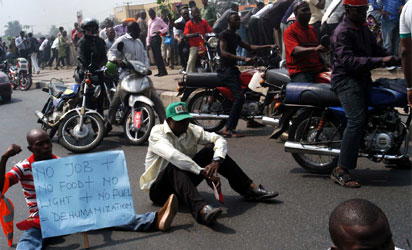
No job, no food…protest by labour leaders
This is the second edition of the serial on OWEI LAKEMFA’s latest work: “One hundred years of trade unionism in Nigeria”. The first part was published yesterday.
ON the other hand the West African Pilot and Daily Comet both Zik Newspapers highlighted Imoudu’s role and encouraged the strike.
The colonial authorities, unused to being outgunned by the “natives” were confused and further messed up the situation. Intellectual, Robin Cohen wrote: “The hard line of the strikers owned much to the attitude of the government, which successively threatened the strikers with a forfeit of wages, attempted to run a skeletal railway service with the aid of the management and Port Harcourt prison labour, took on 900 blackleg labourers, ordered the arrest of nine leaders suspected of being responsible for the derailment of a train, and finally banned the West African Pilot and the Daily Comet.”

No job, no food…protest by labour leaders
When the workers called off the strike on Saturday, August 4, it was with the colonial regime’s acceptance of four basic conditions. There would be no victimisation of any of the striking workers, the prosecution of the strike’s leaders would be dropped, the ban on the two newspapers would be lifted and an impartial inquiry to be set up to look into the workers primary demands.
The General strike gave momentum to nationalist agitations. It became a folklore told in parts of the country while Imoudu, the fearless trade unionist who propelled the strike, became a legend, he became known as the Number 1 in the trade union movement.
The main political party, the NCNC incorporated him into its executive. Imoudu had correctly read the workers mood. He had conquered fear to lead them against a rampaging colonial master that was still drunk from its conquest of Hitler and Germany. He had dared to struggle, he had dared to win.
As for the labour leaders led by TUCN president T. A. Bankole who had sped off leaving their followers behind, their days as labour leaders were numbered. To save itself, the TUCN’s General Council at its meeting of October 1945 sacrificed Bankole and his leadership.
Delegates conference
An interim president, Mr. F. C. Coker of the Postal Workers was elected to run the Congress until the delegates conference which held two months later. This December 1945 TUCN conference elected N. A. Cole of the Nigeria Nurses Association as president, and A. Adio-Moses one time leader of the Mercantile Workers, as full-time secretary.“
The inquiry set up following the general strike was headed by W. Tudor Davis. It rejected the government argument that increase in COLA allowances would lead to inflation.
It upheld the workers submissions and recommended a 50 per cent increase in allowances. In 1946, the lionized Imoudu was part of a three-person NCNC team that toured the country. The other two were its president, Herbert Heelas Macaulay and General Secretary, Nnamdi Azikiwe. Macaulay subsequently took ill during the tour and died before it could be completed.
Imoudu’s inclusion
Imoudu’s inclusion in the historic tour was proof that labour had arrived at the centre stage of anti-colonial politics.
Unions, Unity and Democratic Struggles. “All agitations for the improvement in salary and working conditions of Nigerian workers always had as its conclusion, the need for political independence.” So ran the summary of veteran Labour writer, Pastor Umoh James Umoh while characterizing the Labour Movement in the anti-colonial struggles that eventually led to the country’s independence.
The two major historical strikes at this time were the 1945 general strike led by Michael Imoudu and the Iva Valley miners’ strike of 1949 that led to a massacre of workers
After independence, unions shifted attention to the struggle for an equitable distribution of resources, social justice and a living wage. Just as labour was involved in politics, so also were successive governments the country involved in the Labour Movement.
During the All Nigerian Peoples Conference (a national conference) which held from May 19-21, 1961, a Labour Committee was set up to unify the labour centres. It was chaired by Dr. Sam. A. Aluko with his fellow economist Pius Okigbo, and nationalist businessman Alhaji Sule Oyesola Gbadamosi as members.
The conference empowered a Labour Reconciliation Committee led by the then Parliamentary Speaker, Alhaji Jalo Waziri, to reconcile the Imoudu-led Nigeria Trade Union Congress and the Trade Union Congress of Nigeria then led by Haroun Adebola.
Politicians’ interference
Labour did not object to politicians’ interference in its internal politics nor did politicians object to labour’s involvement in politics. When there were electoral crisis in 1964, Labour called a general strike to force government to respect the ballot box and its results.
Following the military coup, when General Aguiyi Ironsi met the leaders of the then our Labour centres in the country on February 14, 1966, he toldthem that: “The trade unions will now be required to play a more constructive role.”
The bulk of the trade unions supported the Federal Government during the three-year civil war from 1967-1970. But the then Head of State, General Yakubu Gowon, was uncomfortable with Labour and thought a divide-and-rule tactic was the best. He, therefore, courted the the United Labour Congress, ULC, to the exclusion of the three other centres.
In 1973, workers in the country decided to have a single labour centre. As a first step, two of them; the NTUC and the Labour Unity Front, LUF, on September 28, 1973 at the Rowe Park, Lagos, merged to form the Nigeria Trade Union Federation, NTUF. The new Federation elected Abayomi Ishola and Samuel Udoh Bassey as President and General Secretary, respectively. Apparently this did not please the Gowon administration.
He quickly issued Decree 31 of 1973 nullifying the merger by listing the old four labour Centres; the ULC, NTUC, LUF and the Nigeria Workers Council, NWC, as the only legal labour centres in the country.
On September 21, 1974 during the burial of a labour leader, Mr. J.A. Oduleye, the trade unions decided once more to merge into one indivisible labour centre.
But Gowon’s Decree 31 was a stumbling block. The only way to maneouvre was for each of the four labour centres to convene its delegates’ conference and pass resolutions for voluntary dissolution, and vote for a merger. The NTUC and LUF quickly passed such resolutions but the other two centres did not until the overthrow of Gowon on July 29,1975 removed any protection they thought they had.
Birth of the NLC
The ULC convened a conference in Kano in September 1975 at which the merger resolution was passed while the NWC followed suit with a conference in Lagos the following month. With that, the Nigeria Labour Congress, NLC, was born.
However, the new soldiers who overthrew Gowon were suspicious of the NLC whose new leader, Comrade Wahab Goodluck, was one of the radical unionists who led the two crippling 1964 general strikes against politicians. They were also uncomfortable with a legendary anti-colonial unionist like Michael Imoudu.
Thirdly, they were afraid that pro-Gowon unionists who were in the defunct ULC may use the NLC against them. Fourthly, the existence of a powerful, sole labour centre led by independent unionists ran against the conception of the new regime’s image of itself as a supra-nationalist body which had come to save the country from itself.
The regime, led by men like Generals Murtala Mohammed, Olusegun Obasanjo and Shehu Musa Yar’Adua had already decimated the armed forces, the civil service and the judiciary. Labour to them was the sole surviving force that could challenge the regime.
The December 18, 1975 date for inauguration of the NLC gave the regime little room to manoeuvre. But fortunately for it, there were anti-NLC elements in the Labour Movement who were willing to ally with the regime in its mission to smash labour centre. These elements floated two groups. The Progressive Front for the Labour movement and the Committee of Trade Unions in defence of trade union rights.
They had three major prayers
which they put in form of protest letters and with which they bombarded the regime. They wanted the military to:
i. Dissolve the new NLC because its leaders were slated by the merging four labour centres rather than through open elections.
ii. Probe the four old centres.
iii. Ban particular Labour leaders from participation in trade union activities.
All three prayers were answered. On December 4, 1975, the regime’s Labour Minister, General Henry Adefope, declared that the military would carry out “limited intervention” and ensure “guided democracy” in the trade union movement. Thirteen days later, on the eve of the NLC’s inaugural conference, police arrested about a hundred delegates to the conference in an attempt to stop it.
But the conference went on the next day as scheduled. Adefope marched into the Lagos City Hall venue of the conference to announce that the regime would probe all major labour leaders in the country.
Having arrested so many labour leaders, the regime dragged three of them including the new NLC President, Wahab Goodluck to a Lagos Magistrate Court charging them with running a banned political party, the NLC. As far as the military was concerned, the NLC was a political party and since it had banned all political parties, the NLC had no right to exist.
The magistrate remanded all three in custody until January 30, 1976. On February 12, 1976, General Murtala Mohammed signed a decree constituting a tribunal to probe Labour; it was on the eve of his assasination. In May 1976, Adefope announced that the NLC is not a legal body. With that, Nigerian workers for the first time in thirty three years had no central organisation under which to mobilise. Four months later, the regime imposed a wage freeze and workers had no national platform on which to resist it.
In February 1977, the military carried out what remains its most successful coup against Labour by banning its crème de la crème from trade union activities. Six of the eleven victims of this ‘coup’ were executive members of the defunct Nigeria Workers Council. They included its President, R. A. Ramos, General-Secretary A. U.Akpan and Treasurer P. A. Isagua.
The other three were P. A. Nwaneri, J. O. Orotunde and K. A. Adeniran. From the militant NTUC were its president and leader of the NLC Wahab Goodluck and NTUC scribe S. U. Bassey. Leaders of the militant Railway Workers, Michael Imoudu and M. J. Sule were also banned. The formal instrument of the coup was styled the Trade Unions (Disqualification of Certain Persons) Act 15.
The trade unions in the country were subsequently restructured into 42 industrial unions and a “new” Labour Centre, the NLC was allowed to operate from February 28, 1978. General Yar’ Adua the Deputy Head of state on that day told Labour that the NLC will be regarded as a partner but “… without prejudice to the overriding responsibility of the government to preserve the security and peace of the nation”.
The message was clear, as far as the military’s interest goes, while Labour would be exploited in the political process, it should not explore that process.
Disclaimer
Comments expressed here do not reflect the opinions of Vanguard newspapers or any employee thereof.