
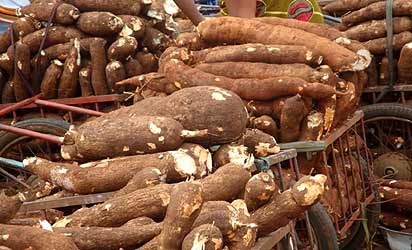
File photo: cassava tubers
By Dele Sobowale
“History Never repeats itself; man does”, wrote Barbara Tuchmann, US Historian.
Even, when some of the broad outlines of history appear to repeat themselves, on the whole nothing remains the same. Mankind has been repeating many errors made in the past since recorded history. Africans are the most backward people on earth because we hardly wrote our own history. We waited for Europeans to start writing our history for us. And, now in Nigeria, history has been removed from the school curriculum. That will guarantee that future generations will fall into the same traps as we.
The economic history of the last century reveals that from time to time certain nations or groups of countries experience spectacular economic growth and they drag the rest of the world along with them. The United States after World War I led until its economic depression became a global depression.
Then again, it pulled the free world from World War II until the mid-1950s when it slowed down. By then Communist Union of Soviet Socialist Republics, USSR, running a managed and centralized economy, especially under Josef Stalin, 1879-1953, “proved” that a planned economy could deliver GDP growth of over 10% annually.
It worked for almost a decade and the slow down came suddenly. The world should have learnt that no economy can grow at 10% perpetually. The latest miracle economies, China and India, for almost ten years mesmerized the world with over 10% annual GDP growth, sucking in large volumes of crude oil to power their expanding economies and giving comfort to those who refuse to acknowledge that oil has had its day.
Nigeria, like all oil producing countries must urgently develop other viable sources of revenue before the eclipse of oil. Rubber is one of them.
WHAT NEEDS TO BE DONE?
Prioritise Agric Effort
The first thing is to prioritise our efforts aimed at diversification of the economy; looking closely at those which provide us with comparative advantages which we can build upon. With respect to agricultural products, rubber is a prime target.
Granted we have other products; cassava, yams, maize, vegetable oil, rice, sorghum, cashew etc, which can be produced in large quantities and exported. But, a hard look at most of the other products will reveal that they are food as well as cash crops.
With a large population, increasing by 7 million mouths to feed annually, it will require all our efforts and ingenuity to produce enough of the food crops to feed our people. Rubber has the singular advantage that it is not a food crop; it is purely a cash crop.
Cultivating more rubber will have two aims, not mutually exclusive. The first is to attempt to become a tyre manufacturing nation once again; the second is to share in the global bonanza which rubber will continue to offer well into the future.
Establish a Partnership
A four-way partnership and an organisation, led by governments (Federal, States, Local) in areas where rubber can be gainfully cultivated must be established. Such an organization will focus only rubber and set realistic targets for greater output of rubber for a generation – defined as thirty years.
Members of the organization must be people who are passionate about rubber and the establishment should have permanent as well as temporary members. For instance the Ministers and Commissioners of Agriculture will remain as members as long as they hold the portfolio. Permanent members will be appointed for seven years; renewable once because the life cycle of rubber is seven years from seed to the first yield.
The assignment of the organization will be to remove all the obstacles in the way of greater output of rubber and to encourage research into increasing yield per hectare.
The other partners include private investors in rubber plantations; research institutes and the banks –ably led by the Central Bank of Nigeria. One of the major problems facing rubber producers in Nigeria is inappropriate tenure of loan facilities.
Banks never lend for more than five years to farmers; that is, if they do at all. But, as noted in the second part of this series, it takes seven years from seed to the first harvest; whereas the bank is already asking for repayment before the farmer receives a kobo of income.
The Central Bank can help in removing this obstacle by creating a special Rubber Development Fund, which will be for exclusive promotion of rubber with a tenure of eight years; that is “seven-plus-one”. The extra year is to enable the farmer and all the partners to take stock and determine how to proceed – bring more land under cultivation; invest in increasing yield on existing acres etc.
All these efforts should be supported by increased funding of research. Most rubber producing countries are in the tropical zones of the globe; invariably, they have been the least users of the developments in biotechnology which has made it possible to increase yields without adding land for other crops. This we must face squarely because no nation can continue to bring more land under cultivation for one crop forever.
Disclaimer
Comments expressed here do not reflect the opinions of Vanguard newspapers or any employee thereof.