
UDUAGHAN
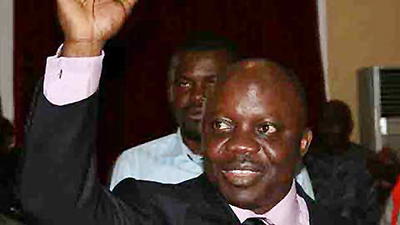
In this second instalment of the discourse, Governor Emmanuel Uduaghan explains his vision of developing Delta State without oil.
INITIALLY, it was the rich trade in commodities on the Oil Rivers; now it is the control of the rich petroleum resources of the Niger Delta.”
Obviously, the security challenge is enormous and complex, but with security and peace top on our agenda and the huge resources we have deployed to their attainment, a lot has been achieved in maintaining the peace which we now enjoy.
We have also invested heavily in human capital and infrastructural development of the State. As I have often done, I am going to reiterate some of the highpoints of our programmes which are geared towards building our vision of Delta beyond oil.
Delta State with a land area of 18,050 square kilometres, substantial portions of which are riverine, marshy and underdeveloped is challenging, but not impossible to develop. What it demands is enormous investment in money, energy and time.

UDUAGHAN
We are compelled to develop remote areas as many of our people have opted to live on their ancestral lands—which in many cases are locations of oil facilities, flow stations and pipelines. We believe they should get the best from the proceeds of the resources taken from their land. That, to me, is the fair and just thing to do.
I also sense that many people outside these areas have no understanding of life in the creeks. They are not concerned that our people living in those parts should be treated as equal and are entitled to enjoy life as others.
As an administration, we do not share such cynical attitude which, I might add, is a major source of anger and frustration for our people in the oil producing areas and other parts of rural Delta.
Our administration is sincere and determined to change the landscape of the riverine and oil producing areas. It is therefore the singular reason we are perhaps the only State that is heavily funding its agency for that purpose.
The Delta State Oil Mineral Development Commission, DESOPADEC, has since its creation been receiving 50 per cent of the 13 per cent derivation to support state government’s own programmes in developing the oil producing and impacted areas of the State.
The funding of DESOPADEC is huge and accounts for the decline of funds at the state level, but we are not deterred. We believe that from whom much is taken, much should also be given. If Nigeria were to embrace similar principle, the peoples of Niger Delta would feel justice done to them with respect to their contribution to the wealth and growth of the country. This is especially important as the terrain they live in is an extremely difficult one to develop.
In many areas we are developing, we have had to build schools, hospitals, access roads, bridges, electricity and clean water from zero.
Sustainable means of livelihood
We have had to contend with oil pollution and its environmental degradation, which has left many of our peoples without sustainable means of livelihood.
For our administration, it will be unconscionable to overlook this state of affairs. Our intervention is to rescue our people who are facing destitution, poverty and squalor. It is unacceptable not to speak out on their behalf.
We have to be their voice, otherwise they are voiceless. The whole struggle of resource control is about our people, such that when oil finishes or loses its global relevance, we would carry on with life with minimal disruption to our revenue sources.
Overall, we have not been deterred in our pursuit of developmental programmes – challenging as it is. The vision to build a Delta beyond oil, is a daunting one, but clearly conceived in anticipation of the day we will not depend on it entirely or the day oil will be one of the many other revenue streams of the State, not its only main revenue stream.
All over the world, feverish effort is being made to end oil’s dominance of the energy basket. We will be foolish not to prepare for the end of the oil era.
Supporting diversification
To prepare us for that day, this administration has been implementing systematic plans to protect the State from the shock by building infrastructure that will support diversification of the economy. Our infrastructure is both human and physical; we are in a hurry even though our vision spans a 50-year period. We believe that the thinking, planning, and implementation have to begin today.
Our plan is simple – do that which we can with an abiding concern for the future. We leave when our time is up. When we hand over, it will be a State, which others can build on because we have laid a solid foundation for its future, something that is sometimes difficult for our critics to understand.
In that regard, our objective was never to finish all the projects we began, though we are determined to ensure most are completed or at irreversible stages of development.
I am satisfied that the State is moving in the right decision. If this process continues, I foresee a future in which the State will earn value from all the investments we are making.
The journey we have embarked upon is a difficult one, but as I said in a recent presentation, I am rather pleased we had the confidence and willpower to even begin it at all. Future generations will, I am sure, look to this moment and salute our courage.”
In building a Delta that will prosper beyond oil, we reckoned it was important we had the following critical infrastructures – Oghareki power plant, Asaba International Airport, upgrade Osubi Airport to international standards, industrial clusters, (Koko Industrial Park, Warri Industrial and Business Park, and Asaba ICT Park). We thought we should harness our people’s entrepreneurial skills through our Micro Credit Scheme and nurture SMEs.
Our success with Micro Credit Scheme is spectacular. We have won three consecutive CBN awards and we have about 100,000 beneficiaries of the scheme whose stories are as enthralling as they are varied. Other States are understudying the Delta State model because of its acknowledged successes.
We have as much as possible partnered with big private investors in co-funding projects such as the multi-billion Naira OFN/Delta Farms, the N40 billion Delta Leisure Park, which on completion will make the Delta the tourist destination of choice. Some of these projects are the foundations of our hope of a better future in which other opportunities can become relevant in stimulating the prosperity of our State.
From what we have been doing, the picture of Delta State that is emerging is one that should give us great optimism and belief in the State and ourselves. For that reason, I feel as I said the other day that we should take pride in our infrastructure programme that has seen us construct 252 inter/intra city roads. I am confident that with the dualisation of major roads that include 148 km Asaba-Ughelli, 33 km Ugbenu-Koko, Effurun-Osubi-Eku, 7.2 km Ughelli Artery, PTI/Jakpa, Old Lagos/Asaba among others, we are gradually eliminating bottleneck in movement of goods and creating major network grids to link all the corners of the State.
The results of our human capital programme have been remarkable. We are making progress in addressing maternal and child mortality rate in the State. Our performance is commendable. There is a steep drop in maternal and child mortality rate in our hospitals. New health care facilities are being constructed or upgraded, but of note for me is the progress of Oghara Teaching Hospital as a centre of excellence. With current efforts, soon, Oghara Teaching Hospital would become a centre of note in Africa. I am sure with Oghara Teaching Hospital we will contribute to reversing the search for healthcare treatment outside Nigeria.
Infrastructure upgrade
We are investing heavily in infrastructure upgrade and modernisation of our public schools for our children, teaching and non-teaching staff facilities. So far about eighteen thousand classrooms have been built, renovated or upgraded. We will still do more. With collaborative efforts and keeping to standards, the physical condition of our schools can compare with any in the world, in a few years.
Through our liberal programme in education, we are giving our brightest youth with first class degrees, a head start in life. Our offer of scholarships, up to PhD level, tenable in any university of their choice, is a deliberate investment in the future.
These youths are prized assets who will look back with pride the support they received from their government. In a knowledge driven world, we are positioning our best and brightest not to be left behind. We are also sending a message to our other youth to step up and enjoy similar opportunities. We have also been consistent in payment of our bursary to augment financial investment made by parents in the training of their wards.
Ultimately, our investment in human capacity in particular in our youths will stand out as perhaps the wisest investment we have made as an administration. I hope future administrations will sustain this programme of creating generations of knowledgeable youths, committed to the future of Delta.
Making our youths knowledgeable and competitive is certainly another step in widening the options available to Delta State, when oil becomes irrelevant. Since this lecture is about the Niger Delta region and what its current crop of leaders envisions for the zone, I want to repeat the point I made last April at the 2nd South-South Economic Summit, which I hosted here in Asaba. I said then.
“I am proud of what we are doing in Delta State as well as in my sister Niger Delta States.
Disclaimer
Comments expressed here do not reflect the opinions of Vanguard newspapers or any employee thereof.