
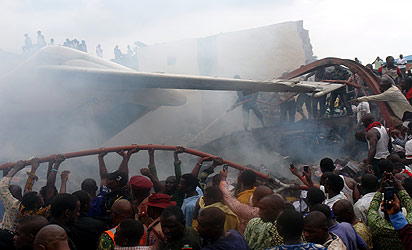
Rescue operations at the scene of the crash
Continues from yesterday
AN obstacle clear limitation plan would specify the maximum heights of objects around airport. A survey of the airports based on the pre-established plan identify buildings, communications masts and other objects that may come up due to urban development and natural phenomenona.
20.Government should streamline all existing legislations on aeronautical Search and Rescue (SAR) such that NAMA will act as coordinating agency for alert purposes, while the NAF oversee the operational lead agency. Despite existing legislation and establishment acts, there is seeming blurred delineation of responsibilities amongst the organisations chain of the National Search and Rescue system. This leads to delay in responding to air accidents.

Rescue operations at the scene of the crash
The Task Force notes that for effective response to any air disaster, there should be a lead which must have the capacity and disposition to undertake Search and Rescue. Hence, it is the considered opinion of the Task Force that NAMA continues to provide alert and coordinating force respectively; the NAF should serve as the lead agency in aeronautical search and rescue operations.
21 An enabling legislation should be enacted to empower NEMA to have Memoranda of Understanding (MoUs) with necessary organisations for equipment requisitioning in SAR; and to have insurance cover for persons involved in SAR. The lack of MoU and insurance cover is said to discourage organisations and individuals from releasing their equipment during search and rescue. Thus, an enabling legislation would demostrate government commitment to all the organisations and individuals who may be involved in SAR.
22 NCAA should direct all aircraft operators in Nigeria; including the military, paramilitary and government agencies, to install the 406 MHz Emergency Locator Transmitter, (ETL) Beacon before January 1, 2007. This would reduce the false alarm associated with the old type of ELT, the 121.5 MHz. It is also more accurate for locating the point of crash, and has some other facilities which are not available in the 121.5MHz.
23. NCAA should ensure mandatory compliance of all agencies and airlines with all industry safety requirements. NCAA should ensure that all agencies and airlines produce safety and security manuals and that their Safety Management Systems are adequate in terms of:
a) Accident Prevention Programmes
b) Collection/analysis/communication of safety information;
c) Technical training; and
d) Emergency Response Procedures
This is an in-house safety and security regulatory system which would help focus the operations of the agencies and airline to extant practices and standards. It would entrench safety culture in the aviation industry.
24. NCAA should ensure that Quality Assurance Department of Airlines are headed by professionals of senior management level who can undertake air, ground, and quality control functions effectively and, report directly to the Chief Executive Officer (CEO).
Uniform standards
This is to ensure that safety management system is handled at a level that the rule can be effectively enforced. Also, without quality control being handled at such a level, uniform standards may not be achieved throughout the industry.
25.NCAA should ensure stringent airworthiness certification procedures for ageing aircraft. They should also re-orienate airworthiness inspectors on the necessary steps and checks on ageing aircraft, and ensure that the most experienced staff are assigned to inspect ageing aircraft.
The usage of older generation aircraft by most nation’s airlines is a very topical issue. As a matter of fact, the average age of aircraft in Nigeria is about 22 years. The Task Force is of the view that the age of aircraft per se needs not be an issue.
It is also not peculiar to Nigeria. What is necessary is for NCAA to ensure that the aircraft undergo recommended maintenance as and when due. This can best be achieved through rigorous, correct and regular inspection by experienced airworthiness assessors.
26. Government should ratify and implement outstanding international aviation conventions. This would enable the local aviation industry take full advantage of the opportunities derivable from such treaties. For example, the Cape Town Convention on financing and leasing of aircraft, rolling stock and space equipment could assist local airlines gain access to newer generation aircraft on terms, hitherto, unavailable. This will not only assist the operators but will also permit greater participation and growth of the sector, as aircraft acquisition will be enhanced.
27. The Ministry of Aviation should uphold its policy responsibility and allow the agencies to discharge their duties accordingly. The Ministry of Aviation im
poses banks, insurance companies, contracts and other financial burdens on the agencies; and they have lost huge sums of money as a result. FAAN’s N400 million is trapped in Lead Bank; while NAMA’s N400 million and US$ 14,1778 are trapped in Hallmark Bank. Both banks were recommended by the the ministry.
28. Government should cancel all contracts which are yet to be awarded, but which FAAN claimed has received Ministerial Tenders Board approval.
* Clearing of bush and grassing of area along runway 36R end of NMIA. Contract amount is N34 million and is to be awarded to JON FEMA Nig Ltd.
* Clearing of bush and grassing of area along runway 36R end of NMIA. Contract amount is N49.5 million and is to be awarded to Quidsworth Ventures Ltd.
* Clearing of bush and grassing of area along runway 18R end of NMIA. Contract amount is N45 million and is to be awarded to Tripple Ventures.
* Appointment of consultants to review the financial records of FAAN. Contract amount is N90 million and is to be awarded to Williams Deloitte Consulting.
* Supply of Apron bus for Virgin Nigeria Airlines. Contract amount is N35.9 million and is to be awarded to Contrac Cobus Industries.
*Supply of com bus 2400 for NMIA. Contract amount is N35.9 million and is to be awarded to AES Contract Industries Ltd.
29. FAAN should carry out a review of its current procurement process and align same with the Government Due Process Guidelines.
The outcome of this review should be documented using process maps and flow charts as well as details of the amended procurement procedures. The development of the procedure manual and process maps will streamline procurements decisions and ensure that materials purchased meet the requirements of FAAN in terms of use and pricing. FAAN should also develop a comprehensive checklist of items to be included in contractors’ files before any payments are made. Evidence of contract approval by the appropriate Authority should be a required item on the checklist. The Internal Audit should be empowered to carry out intermittent review of contract files to confirm compliance with this requirement.
30. Government should approve the revised sharing formula in respect of the five per cent charge on ticket sales and cargo charges as follows:
(i) Nigerian Civil Aviation Authority (NCAA) – 45 per cent
(ii) Nigeria Airspace Management Agency (NAMA) – 30 per cent
(iii) Nigerian Meteorological Agency (NIMET) – 10per cent
(iv) Nigerian College of Aviation Technology – 15 per cent.
The reduction of NCAA’s revenue from 60% to 45% is informed by the realisation that NCAA has other sources of funding as listed in Section 12 (a-g) of the Bill. The level of decay and obsolescence of infrastructure and equipment used by NAMA and NIMET and the near collapse of NCAT necessitates re-ordering of the priorities within the aviation sector. Moreover, NCAA has less capital intensive responsibility unlike the other agencies which have critical functions of procuring, maintaining and sustaining capital intensive equipment.
31. Government should approve that all airports be insured in line with ICAO standards. The four major International Airports should have minimum liability cover of USD 500 million. Other airports should have minimum insurance cover of USD 50 million.
The Nigerian aviation industry is not currently adequately protected against regular perils to key aviation infrastructure, airports facilities including other third parties at the airport. There is also no industry regulations or prescriptions on minimum insurance requirements. The regulatory lacuna has led to the absence of standards to be followed in protecting aviation assets and stakeholders against perils. This is at variance with international standards.
32. Government should approve the establishment of a Computer Reservation System (CRS), and the Bills and Settlement Plan (BSP) for the domestic airlines.
These are key success factors in the implementation of the Nigeria Airline Support Fund. The CRS and BSP would ensure that all deductions on Ticket Sales and Cargo Charges are made at source and appropriately channeled.
33. Government should enforce the registration of foreign airlines operating in Nigeria to enable them pay appropriate taxes to Government in line with extant regulations. Currently, only Air India and Virgin Atlantic are registered to operate in Nigeria.
The Task Force was made to understand that most foreign airlines are not registered with Corporate Affairs Commission (CAC), and thus evade the payment of taxes and other commissions to Government. It would be necessary for the NCAA and CAC to work closely to effect this recommendation.
34. Government should appoint a reputable tax consultant to conduct a tax compliance audit of all foreign airlines operating in Nigeria as well as verify claims that the airlines owe the Federal Government over USD 500 million in unpaid cumulative taxes since the inception of their operations.
During the interactive session, the Task Force was made aware that an estimated USD 500 million is being owed the Federal Government in unpaid taxes by the foreign airlines.
35. Government should approve the use of the Nigerian Airforce (NAF) hangars by interested private airlines pending the fruition of the National Hangar project. The NCAA should provide oversight.
The private airlines have been accused of not conducting their inspections and maintenance in a hangar, in contravention of standard practices. Conducting maintenance in the open could lead to several safety hazards including the exposure of maintenance personnel and sensitive aircraft systems to environmental hazards. The NAF has standard hangars at Ikeja, Makurdi and Kainji which are grossly under utilised.
36. All aircraft should be insured against accidents or damage to aircraft, passenger liability and third party liability from aviation perils.
Air carriers and aircraft operators should ensure that insurance cover exists for each and every flight. This is regardless of whether the aircraft is at their disposal through ownership or any form of lease agreement, or through joint or franchise operations, code-sharing or any other agreement of the same nature.
Minimuminsurance coverage
Minimum insurance coverage shall depend on the number of passengers on board and Maximum Take off Weight (MTOW) of aircraft. However, minimum liability cover per passenger shall be USD100,000.00. Insured passengers shall not be required to establish evidence of life worth in the event of an accident. Also, minimum cover for aircraft crew shall not be less than insured limit for passengers.
It is necessary for NCAA to require air carriers to provide evidence that they respect at all times the minimum insurance requirements. All air carriers and aircraft operators must deposit evidence of compliance with minimum insurance requirements with NCAA and must carry on-board each flight the evidence. Failure to provide evidence of compliance on demand would be enough ground to refuse aircraft from flying in Nigeria’s space.
37.NCAA should establish procedures for monitoring the application of the minimum insurance requirements.
NCAA does not have a machinery to effectively monitor the compliance of local airlines to international insurance and minimum requirements prescribed in the Civil Aviation Policy. The machinery should therefore be developed, and should be transparent and non-discriminatory. It should, however, not impede the free movement of goods, persons, services and capital.
Disclaimer
Comments expressed here do not reflect the opinions of Vanguard newspapers or any employee thereof.