
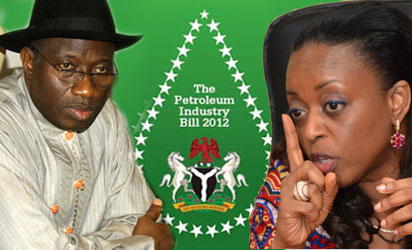
President Jonathan and Petroleum Minister, Diezani
By Dele Sobowale
“Money! Money! How much sorrow it causes the world”. Leo Tolstoy, in VANGUARD BOOK OF QUOTATIONS p 163).
From Small Beginnings Start Great Conflicts
The looming and imminent battle over the Petroleum Industry Bill, PIB, is at the end of the day a fight about money. It is about how the oil wealth will be shared from now on. For that reason, it is going to be brutal, and anyone without a tough skin should avoid it. We are in this predicament because we had for too long neglected diversification of our economy; a step which would have reduced our dependence on oil.
If about 20% of Nigeria’s GDP or 35% of government revenue was contributed by oil, the PIB would have been only of interest to financial experts, constitutional lawyers and economists. But, it is now everybody’s affair because we have not advanced as a nation since the 1970s when General Gowon (rtd) proclaimed that “Money is not our problem but how to spend it”. Well, General Gowon has lived long enough to experience money becoming our problem and we are now poised to fight over lots of it. Dr Arthur Burns, the US Chairman of the Federal Reserve Bank, under President Nixon, once said that, “If you allow an untenable economic situation to go on for too long, suddenly there are no good options left”. We allowed a mono-product economy to exist for too long and we have no option but to fight over oil money.
The new PIB, like the old is already generating its own controversy; even before the National Assembly starts debating it. The old bill suffered a defeat, which people I will call Nigerian Economic Guerilla Fighters, NEGF, went to war to prevent the bill sent by the Executive, to the sixth NASS, from being passed because it represented a rape of Nigerian interests. The Presidency, the Ministry of Petroleum Resources, and the International Oil Companies, IOCs, had conspired to enact a bill which would have sold the Nigerian down the river.
The President and the Minster promised the international community that the bill would be passed last year. Despite spending tones of money to promote the bill, it was defeated by the NEGF. The new bill is already undergoing a rigorous check by the same group which has reassembled for battle. The Presidency, the Ministry and the IOCs have also lined up their media fighters. One of them had a full length article in one of the national dailies urging the NASS to pass urgently a bill they have not even read; and the “majority” of Nigerians to rise up in support of the bill that they have not seen.
The battle is on; and like all conflicts, it will produce its share of villains, heroes and heroines; traitors and mercenaries. The truth is nobody can predict when and how it will end. Certainly, it will not end this year. The document is a long and tedious one and less than a score Nigerians, other than those who partook in preparing it will read the entire piece. In a way, that would mean that most of the arguments advanced will be emotional; but, that is fine. The few who will read will lead the fight on both sides.
Stakeholders and Combatants
PIB is a global issue; the stakeholders include every person in the world who uses petroleum products because Nigeria is one of the largest producers. In addition, the IOCs are all quoted on the international stock exchanges and their shares are held by millions of people round the globe. So, directly or indirectly, we are all in this conflict. Specifically, the global investment community is watching with keen interest.
The outcome of this battle will ultimately determine the fate of billions of dollars in investment; both here in Nigeria and elsewhere in the world. Nigerian investors are also regarded as part of the global pool of investors and they too are waiting.
Everybody in Nigeria is a stakeholder; at least it is our commonwealth that they are proposing to auction to the preferred bidder (note that there is a distinct difference between a “preferred bidder” and the “highest bidder”; selection of the former is usually fraught with corruption). Federal, State, Local governments are involved; and every Nigerian alive, in one way or another, depends on oil proceeds. But, that does not mean everybody is united.

President Jonathan and Petroleum Minister, Diezani
Quite the contrary!
The IOCs are sharply focused. Their mission is to grab as much of the cake that is about to be auctioned as possible, ordinary Nigerians are not. That places the citizenry at a disadvantage. But, that does not mean the battle has been lost. Last year’s conspiracy against the people failed because a few patriotic Nigerians wanted a fair deal for the people. This new version of the PIB is already generating controversy before the NASS touches it.
One group of Nigerians we can quickly write off is the staff, present and past, of the IOCs. The Nigerians among them are caught in a loyalty dilemma; as Nigerians they owe the country loyalty. But, as staff of the IOCs they also owe loyalty to their employers whose interests and that of Nigeria are not the same on this issue.
We pity them.
But, in a conflict, human sentiments are the first to be sacrificed. We also have it on the authority of Wikkileaks that some of their former directors had been spies for the IOCs. We don’t expect their espionage to stop – using Nigerian traitors. But, against the vast sums of money (that evil word again) at their disposal, and the fact that the Executive branch and the Ministry of Petroleum favour them, we have a coalition of Nigerian interests and groups ready to ensure that no matter how long and hard, Nigeria will get a fair deal or there will be no PIB.
The First Salvos
The President, who is already having a frosty relationship with the National Assembly, sent the PIB to the legislators on the day they were to start their annual vacation; and it was immediately denounced as an insensitive ploy. Two members pointed out that the bill was promised for May 2012, and it came in July. They locked it up in their offices and proceeded on vacation anyway. There it will stay for approximately six weeks and it might not be the first bill to be considered when they resume. That is a bad start for a controversial bill which needs all the friends it can get – at any price.
But, civil society groups have already got copies of the bill and oil producing communities, who had been the most vocal adversaries of the IOCs are again leading the attack. Section 166 of the bill is the main focus of attention. It is not the intention in this article to treat piecemeal various parts of the bill. Mention has only been made of this development to buttress the point that, unlike the former PIB, which was a closely guarded secret between the Presidency, the Ministry of Petroleum and the NASS, a lot of people are awake now. This new bill will not be handled in secret; it will be openly argued in every city, town, village and gathering of Nigerians until a fair deal emerges.
A Not Too Modest Proposal
In a matter such as this, touching on the fundamentals of our statehood, it is expected that every public official can be trusted to be totally committed to the national interest defined in this case as ensuring that Nigeria obtains as much money as legitimately possible under the PIB. Neither the President, nor any of the Ministers should be suspected of having conflict of interest. That is not the case with the Minister of Petroleum, who, as former Director of Shell, cannot disregard her years in the company; anymore than I can deny VANGUARD.
The fight over this bill will frequently place Nigeria and Shell at opposite sides of the issue. Nigerians should not have to guess which side Mrs. Alison-Madueke is on; and the way to avoid any doubt is for her to be moved from that Ministry – to another one if the President values her services so much. As long as she stays there she will bear the most merciless attack by opponents of several parts of the PIB.
This proposal might appear to make her the first victim of the war on PIB; but better be considered a victim than something worse.
In this case, two people can decide. The President can move her; or she can ask to be re-assigned or resign. Either way, she must leave the Ministry for a breath of fresh air.
Disclaimer
Comments expressed here do not reflect the opinions of Vanguard newspapers or any employee thereof.