
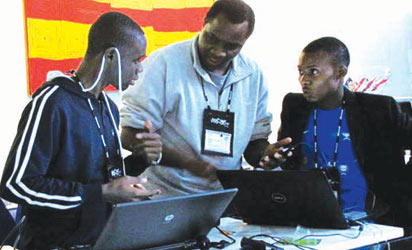
IMAGINE CUP: From left, Okoya Timileyin; Shina Oyetosho, Developer & *Platform Evangelism Lead, Microsoft Anglophone West Africa and Oludayo Alli getting ready for their presentation on Saturday at the just concluded Microsoft Imagine Cup software competition in Sydney, Australia. Photo: Emeka Aginam.
By Emeka Aginam, Sydney, Australia
THIS year’s edition of the Microsoft Imagine Cup Competition — the football World Cup equivalent in software design — saw no fewer than 350,000 budding software experts from 75 countries worldwide gathering at the convention centre in Sydney, Australia to compete in different categories like software design, game design, IT challenge, Windows Azure challenge, Kinnect fun Labs challenge, Windows Azure challenge and Windows phone challenge, with health care solutions dominating entries.
Such health solutions, according to Vanguard Hi-Tech findings will include diagnosis of diseases via mobile applications and proactive accessibility of medical information. However, software design category had the largest proportion of presentations addressing health issues. Of 106 entries on parade, 72 solutions were in the software design category.
For a healthier future
With no fewer than 106 teams participating, available data from Microsoft showed that 65% of all projects addressed healthcare related issues, emphasising that efforts are on course to realise health targets in the Millennium Development Goals of the United Nations, (MDGs) in developing countries.
Further, health products showcased by participants including Nigeria’s representatives from Obafemi Awolowo University, Ile-Ife, Osun State, Nigeria are already close to the market for deployment. In addition, about forty per cent of all healthcare-related finalist projects used Windows phone, providing healthcare tools and resources for people in remote areas across the globe.

IMAGINE CUP: From left, Okoya Timileyin; Shina Oyetosho, Developer & *Platform Evangelism Lead, Microsoft Anglophone West Africa and Oludayo Alli getting ready for their presentation on Saturday at the just concluded Microsoft Imagine Cup software competition in Sydney, Australia. Photo: Emeka Aginam.
For the physically challenged
Also, 23 per cent of projects were designed to improve lives of individuals with disabilities such as visual and hearing impairments and diseases that limit human physical mobility. Accordingly, of the 24 projects designed to increase accessibility for the disabled, such as those suffering from blindness or paralysis, Microsoft data disclosed that two-thirds — 66% utilize Kinect for Xbox 360 technology.
Window Azure employed
However, nearly half of all finalists’ projects (45%) employed Windows Azure, taking advantage of the cloud to help solve the world’s toughest problems from tackling pollutions levels in the environment to diagnosing diseases, with strong support from Nokia in relation to digital tools for the competing students.
Health solutions on parade
Among health solutions that excited the judges are Swift Emergency Response (SwiftER) developed by Team Nigeria from Obafemi Awolowo University, Ile Ife to improve the response of medical, security, fire and other services to emergency situations.
Although the team did not make it to the second round, their solution will be helpful to people who find themselves in critical emergency situations; especially countries with no unified helpline/emergency hotlines. It is believed that their solution if deployed by the Nigerian government including those in the private sector will definitely address health challenges in emergency situations.
For Team Vivid from Egypt, their solution was also on health; a mobile application that physicians can use to access patient’s e-medical records and a cloud-based storage system that is not expensive. Another finalist team, BoddyMusic from Argentina created a classroom application for Kinect for Xbox 360 to allow people with disabilities to learn about music and even play various instruments using body movements.
Team CatchCake from Serbia also created a programme to assist blind and visually impaired people in their travels by using radar to alert them of objects in their way. Similarly, Team Symbiosis from Greece created software to provide augmented reality therapy for Alzheimer’s patients.
For one thing, speaker after speaker during the event including the judges and the mentors while applauding the creative works of the students strongly believed that the world will be a better place with the products showcased especially on health related issues which dominated the competition.
Amazing entries
Speaking with Vanguard Hi-Tech in an interview on Monday at the Sydney convention centre, Walid Abu-Hadba, corporate vice president of Microsoft’s Developer and Platform Evangelism group with optimism said that health solutions presented by the students were amazing. According to him, Imagine cup was an avenue to really prepare the students ahead of the global work force.
“I expect these solutions to be in the market soon. They are really good. The quality of participation has been really good. There is no industry in the world that gives the kind of opportunity software gives. Every student who wants to build his future ought to participate. You can own your company through software incubation
For the software design captain, Rob Miles who was excited by the students’ work, he said that Imagine cup was the beginning of the student’s job market.
“ I have been involved in the Imagine Cup since the very first world final in Barcelona in 2003. I’ve seen first-hand the great things that students have achieved in the competition and the way that taking part can change their lives. From my early days as a mentor I now take part in the judging, which means I get to see all the amazing things that students come up with.
“And I love that. The Imagine Cup provides a fantastic place for you to develop programming, management and presentational skills. If you want to show how well you can develop and present an imaginative idea you should head for the Imagine cup software design challenge” he explained.
Great performances
For the mentors, it is preparatory ground for the students to be their own bosses and become what they want to be. According to Shabbir Khan from Pakistan who was among the mentors at the event, the solutions showcased by the students were fantastic.
While believing in the talents of the youth in the world, he was optimistic that they have the energy to solve difficult societal problems including health care and education. He further said that all the younger people is little bit of funding and some guidance in business to deploy their solutions to help needy people in their societies.
Imagine Cup grants
To extend the impact of Imagine Cup, last year Microsoft launched the Imagine Cup Grants programme, a three-year, $3 million investment by Microsoft to help students turn their ideas into reality. The first grant recipients were announced in January, including team Lifelens (United States), which developed a Windows Phone application that can detect the presence of malaria through a blood sample.
Disclaimer
Comments expressed here do not reflect the opinions of Vanguard newspapers or any employee thereof.