
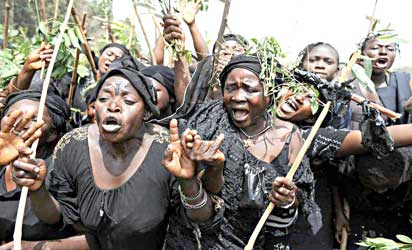
*Protesting women
WHEREAS the Universal Declaration of Human Rights, which was adopted by the United Nations, UN, General Assembly on December 10,1948, was expected to preserve the sanctity of human life. The reverse is the case in Nigeria, where life has become short and worthless. CHARLES KUMOLU reports
FOR travellers on Enugu/Onitsha Expressway and Nkpor Old Road, Limca Roundabout stands out among others in Onitsha, given that it is located in front of the residence of Nigeria’s first President, Dr. Nnamdi Azikiwe. Being sited close to the home of the great Azikiwe makes it an irresistible tourist attraction, with many visiting or having to pause to stare at it.
But the historical and tourist signifance of the place was lost to Mrs. Vero Nwoye following her ordeal in the hands of kidnappers at that Junction on April 26, 2012. Mrs. Nwoye and her daughter, Chisom, a Senior Secondary, SS11, student of Mercy Girls Secondary School, Umuoji, left her pharmacy shop located at 6, Obosi Street, Nkpor and were driving home in her Mercedes Benz 190 with number plate BR 439 LSD, when suspected kidnappers blocked their car at the junction and pulled her out of her car. She was dragged into theirs.
Kidnappings resurge in the East
Realising that Chisom,16, who was sitting beside her might live to tell the story, one of the hoodlums turned back and shot her on the chest and she died on the spot.
Similarly, Port Harcourt Street in Ogui New Layout within Enugu Metropolis, was on March 28, thrown into confusion following the murder of a printer right inside his shop. The printer, known as Ifeanyi, had sent out wedding invitations for his wedding scheduled for Easter Monday before he was assasinated.
The assailants reportedly forced their way into his shop and pulled out their pump action rifles out of the long suits they wore. One of the killers shot at Ifeanyi twice, while the second person shot him once and he fell down immediately bleeding profusely from the head, which was shattered by the bullets.
Also, the sleepy village of Ezi Ewa Enohia in Ebonyi State had its share of bizarre killing in May, when a 26-year-old man, Clement Chime, was arrested by the police for allegedly chopping off the head of a 65-year-old woman, Mrs. Grace Nwachi. Chime, a 200-level student of a Polytechnic, told detectives that he was ordered by members of his cult group to kill someone, as he had not done so since he joined the group.
The deceased was said to have gone to the farm that fateful day, to harvest cassava and instructed her two grandchildren to join her later. In addition, a 16-year-old girl was, in March, raped to death in a cassava farm at Odume area of Obosi, Idemili North Local Government Area of Anambra State. The girl, it was gathered, was said to have earlier been sexually abused by a neighbour .

*Protesting women
Ritualists on the prowl in the West: In what seemed like a trend, a wealthy Ibadan-based goldsmith, Yakubu Azeez, aka Ojutalayo, 46, was assassinated in his bedroom in March. The deceased was in his bedroom as his wife, Morufat, had travelled to Dubai for a business trip.
His six children and mother were sleeping in another building within the compound when the assailants arrived. The assassins had gained entry into the compound by scaling the fence of the building and accessing Yakubu’s bedroom by breaking the ceiling. He was then shot at close range in the chest and left in the pool of his blood.
Pool of his blood
The yelling of ‘Mama mi o’ (My mother) woke other members of the family, but it was too late. His brother, Ishola, who rushed out of his room on hearing the screaming was ordered by the gunmen to go back to his room. They went to his mother’s room and dragged the old woman to come and behold his son’s lifeless body.
On the heels of Azeez’s murder, was the brutal killing of a 42-year-old Mrs. Sekinat Emiola, who was killed in Ibadan by two men identified as Femi and Asimiyu in April.
Asimiyu, it was gathered, was having an affair with the deceased. After being intimate with her, he allegedly killed Emiola by chopping off her head and hands, and used a container to collect her blood. Asimiyu was said to have cut the head and the hands of his victim, put them inside a sack, while he hired Femi to assist him in burying Emiola in a shallow grave at Oke Aremo cemetary, Yemetu, Ibadan.
As it was in Ibadan, so it was in Lagos, as news of the gruesome murder of innocent citizens seems to have become a daily occurrence. For instance, in January this year, Mr. Niyi Ehindero, was allegedly shot dead by soldiers attached to Operation MESA Unit on Bada Street in Mushin area of Lagos.
Eyewitnesses said the soldiers shot Ehindero at close range in his car when they went to the area to disperse hoodlums who were engaged in a fierce battle.
Another instance where life was debased recently, was the alleged throwing of a three-week-old baby into the Lagos Lagoon by a Navy rating. The suspect identified as Joseph fathered a baby by Glory Yusuf, a lady he was dating.
Trailing the infant saga
Displeased with the birth, the naval rating stormed Miss Yusuf’s apartment with some friends and colleagues, beat up the lady and her aged mother, before forcefully taking possession of the baby. The baby was later thrown into the Lagos Lagoon from the Liverpool Street area in Apapa.
Trailing the infant saga, was the killing of a 35-year-old bureau de change operator, Ali Sani in May, who was attacked and fatally wounded by a Lebanese national in a hotel in the Apapa area of Lagos. Sani was lured into the hotel by the Lebanese, Bilal Fahs, 23, and his colleagues in crime, on the pretext of changing a large sum of foreign currency for them. Rather than exchange currency, they turned round to attack him with dangerous weapons.
Sani, who bled profusely from the gaping wounds inflicted on him by his attackers, could not live after he was rushed to three hospitals by his colleagues for treatment.
Reign of terrorists in the North: While the killings in some parts of the country may have happened unnoticed, VanguardFeatures,VF, can reveal that not a few are in the dark about the ongoing wanton waste of human lives in Northern Nigeria. Apart from activities of the Boko Haram sect, which have reduced the value of life in the region to nothing, VF findings indicated that the North stands out as the most dangerous place to reside in Nigeria, as nearly 1,000 Nigerians have been sent to their untimely graves since the beginning of 2012.
From the relatively calm state of Sokoto, to the volatile cities of Jos, Maidugri, Kano,Yobe, among others, life is short, nasty and brutish-apologies to Thomas Hobbes.
Protecting the citizens
Lately, the killings in Jos have captured global attention, given that many wondering how such terror could reign unchallenged in the face of a government that swore in the 1999 Constitution to protect its citizens. Accordingly, since January this year, the cities of Jos, Kaduna and Kano, have been engulfed by ethno-religious killings. Jos, particularly, has remained a theatre of gruesome killing of Christians by suspected Fulani herdsmen.
Life now three for one naira: Recently, a federal lawmaker, Senator Gyang Dantong and a member of Plateau State House of Assembly, Gyang Fulani, met their untimely death. The duo were murdered when gunmen invaded Maseh village in Riyom Local Government Area as they were conducting mass burial for 63 victims, who were killed by Fulani herdsmen in Karkuruk, Barkin Ladi.
With the situation attaining a helpless state, many are asking if perpetrators of these crimes were ignorant of the United Nations, UN, position on the sanctity of human life.
Specifically, Articles 3 and 1 of the UN Universal Declaration of Human Rights, notes that: “Everyone has the right to life, liberty and security of person. All human beings are born free and equal in dignity and rights. They are endowed with reason and conscience and should act towards one another in a spirit of brotherhood”.
It is for this reason that Executive Director of Joint Action for Defence of Rights of Persons, JADRP, Ngo Komonibo, told VF that: “What is happening in Nigeria is ethno-religious cleansing; we may not know the extent now until it consumes everyone. Life no longer has worth in Nigeria. Life can be sold and bought under the situation we find ourselves. Each time I open the papers, I am always confronted with stories about lives being snuffed out of citizens. The situation is very dangerous because as I am talking to you I do not feel safe because I don’t know who might come after me now.
“I knew early about the sanctity of life. I have always known that it is only the government that has the power over life apart from God who owns life, but the situation now in Nigeria is different. Life is now three for one naira. This trend must stop, else we end up like Somalia”.
Komonibo’s position was also supported by a 2012 Human Rights Watch Report on Nigeria, which maintained that: “Boko Haram’s attacks show a complete and utter disregard for human life. The Nigerian authorities need to call a halt to this campaign of terror and bring to justice those responsible for planning and carrying out these reprehensible crimes”.
It also observed that: “The January 20, 2012 attacks in the Northern city of Kano left at least 185 police and residents dead and resulted in the highest death toll in a single day since Boko Haram began its violent campaign in July 2009. More than 935 people have been killed in about 164 suspected attacks by the group during this period.
Human rights violations
As in previous years, the indisciplined Nigeria Police Force was implicated in frequent human rights violations, including extra-judicial killings, torture, arbitrary arrests, and extortion-related abuses”.
What is the government doing?
Besides, further checks discovered the existence of an uneasy feeling across the land and beyond, on the manner the government is handling the issue. The verdict in this regard, remains: Government is not doing enough.
“Do we have a government? it is a shame that people are being killed across the country without suspects being prosecuted by the law. The North is finished now and no longer safe, while across other regions people are being killed by armed robbers and kidnappers. With this volatility increasing, it is as good as asking if we have no government,” Regional Head, Committee for Good Governance and Accountability, Mr. Aduwo Shabayan, told VF.
As far as the Human Rights activist is concerned: “The sanctity of human lives has been thrown to the dogs in Nigeria; we are now living in a banana republic. Let’s assume that the people perpetrating the killings are ignorant of the legal guarantees of lives, the government, whose duty it is to protect these lives is deaf and handicapped.”
Asked what could be responsible for this loss of respect for human lives, he said: “I can only speak at as a civil society person because from what we have seen over the years, we are reaping the fruits of bad leadership. Past and present leaders failed to plan for the overwhelming good of the citizens. That is why someone would wake up and chop off another person’s head. And nothing would happen.”
Social problem
But Dr. Obinna Ekweozor, a Sociology lecturer, disagrees with Shabayan as he told VF thus: “The whole thing is a social problem, which is a basic occurrence in every human society. In social relations, conflicts arise. But the dimension the conflict has assumed is worrisome and needs to be arrested before the nation is consumed.”
Ekweozor, further pointed out that: “Whether it is death in the hands of kidnappers, ritualists or bombers, the obvious truth is that some thing is fundamentally wrong with the welfare of the citizenry, hence he is no longer comfortable.
“That is why anger and aggression are transferred to innocent persons in the form of killings. Those at the top ladder of the society should address this inequality because life has lost its value in this society”.
Ekweozor’s stand on the worth of life, also has the support of the Catholic Bishop of Sokoto Diocese, Bishop Hassan Kukah. Kukah at the National Summit on the Freedom of Information Act in Abuja, said that life is becoming cheap in Nigeria, adding that the citizens were running out of ideas and time.
He said though President Goodluck Jonathan might not be responsible for the problem but the key is with him. “Nigeria is running out of time, those who are pushing us are determined to have war. Many of us who have been voices of restraint no longer know what to say,” he added.
Disclaimer
Comments expressed here do not reflect the opinions of Vanguard newspapers or any employee thereof.