
By Franklin Alli
In recent times, the major concern of stakeholders in the manufacturing sector has been how to accelerate development in the sector and raise its contribution to the Gross Domestic Product, GDP. However, several problems bedeviling the sector have kept it from rising beyond its present state.
While sectors like Agriculture contribute 39.5 per cent, telecom 5.6 per cent, crude oil and natural gas 13.6 per cent, manufacturing sector contributes a mere 4.5 per cent to gross domestic product. This is despite federal government’s intervention funds through the Central Bank of Nigeria and the Bank of Industry.
In the past eight years alone, more than N800 billion was made available to operators in the sector for them to re-tool their machines and increase productivity. The impact of these intervention monies have not manifested as the sector ‘s contribution to the GDP has been hovering between 4.5 to 4.8 per cent per annum over the last ten years.
Recently, the Federal Government through the Minister of Trade and Investment, Dr. Olusegun Aganga, charged the Organised Private Sector, OPS, to ensure that the manufacturing sector contributes 10 per cent to GDP in the next three years, precisely by 2015.
Aganga said he believes the figure was attainable through concerted efforts by the private sector. He asserted that since other economies have achieved success in that respect, the success story can also be replicated in Nigeria. He told the business leaders: “The key to economic transformation is in your hands to drive the economy of this country if you really want to. Our overall aspiration is to increase manufacturing contribution to GDP to 10 percent from 4 per cent.”
He drew inferences from Kenya that increased its manufacturing contribution to GDP to 6 per cent, Malaysia 26 percent; Indonesia also jerked its manufacturing GDP, from 17 to 27 per cent and Cameroun from 25 to 34 per cent. “These countries have done it, why can’t we? It’s in your hands. You have the power to drive the economy, to create demand. It’s my job to create enabling environment. We just have to get the courage and the will to do it,” he stated.
Aganga assured that government was doing all in its power to ensure that it addressed all lingering problems impeding progress in the sector. He noted that 500 megawatts of power supply would be channeled to industries in Lagos and Ogun State, adding that the government was also addressing lack of access to credit among other challenges.
In a swift reaction, Chief Kola Jamodu, President of Manufacturers Association of Nigeria (MAN), said the private sector can achieve the target and even surpass it if only government would implement the recommendations in a blueprint the association just finished working on termed, “Strategies For Accelerated Development of Manufacturing in Nigeria: The Way forward.”
Jamodu noted that since his exit as the then Minister of Industry, succeeding administrations have introduced policies that are inimical to development of the sector. For instance, he noted that duty on machineries was zero per cent, but “today, it is five per cent.”

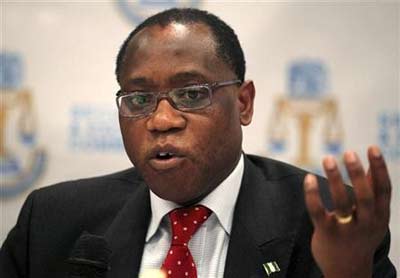
Minister of Trade & Investment, Olusegun Aganga
According to him, the manufacturing sector’s contribution to GDP could actually improve significantly to between 15 and 18 per cent in the next five years, if recommendations in the Blue print are considered and implemented.
He explained “The document is based on an integrated approach that addresses the important role of manufacturing, particularly SMEs in the generation of substantial employment.
“This document reviews the status of the manufacturing sector in Nigeria and identifies the extent of the burden that manufacturers have carried over the years. It sets out an action plan that would accelerate the development of the manufacturing sector in the context of vision 20:2020, provides a framework and formulates a vision for the sector in the short medium to long term.
“The document also provides general sector-specific action plans and addresses critical questions relating to the manufacturing sector as well as proposes a bold set of reforms which if embraced, are capable of unleashing the full potentials of manufacturing in the economy.”
He noted that there is an urgent need for the restructuring of government spending in favour of capital expenditure in view of huge infrastructural deficit confronting the nation, as part of recommendations contained in the blueprint. “To facilitate free flow of goods and persons, government should rehabilitate the existing road network, construction of new ones should be given priority and the railway system should be completely overhauled and privatised.
“The federal government should put in place a revolving intervention fund to meet the long-term funding needs of the manufacturing sector which Deposit Money Banks are unwilling to provide.” Other recommendations made by the association include push for patronage of Made-in-Nigeria products, channeling more efforts to tackle security challenges, and pursuing of power sector road map with greater vigour.”
The question is can the Organised Private Sector (OPS) can deliver on the federal government’s target of 10 percent manufacturing contribution to the country’s gross domestic product over the next three years?
Commenting, President of Lagos Chamber of Commerce and Industry, Mr. Goodie Ibru, said for the target to be met, there is need for government to tackle the problem of high exchange rate because the Nigerian economy is very sensitive to developments in the Foreign Exchange market. This, he said, is so because of the structure of the economy which is still heavily dependent on imports.
“This in itself is a major weakness of the manufacturing sector and our economy. In the first half of this year, the economy has witnessed 5 per cent depreciation in the exchange rate of the naira against the dollar. The rate was N157 to the dollar in January and currently ranges from N162-N165 to the dollar, in the interbank and parallel market.
The trend is yet to abate and has negative implications for business performance in terms of: higher production and operating cost as the cost of raw materials and other imported inputs increase and inflationary pressures induced by higher production cost.”
Dr. Ademola Ajayi, President of NACCIMA, affirmed that the target can be made a reality through the joint efforts of Governments and the private sector operators. He pointed out that infrastructural development is key to boost the performance of the real sector.
“However, we are still worried that not much has been achieved; as less than 30 percent of the nation’s roughly 200,000 kilometers of road network coverage, are in good condition while 60 percent of Federal and State roads are in poor condition, resulting in an increase of about 60 percent of the cost of production in Nigeria due to delays and losses incurred from breakdowns, accidents, wear and tear.
“In particular, most federal roads, especially in the South West, South East and South-South of the country are in very bad and deplorable state. This has continued to hamper economic activities as most of the industrial/commercial nerve centres in the country experience heavy traffic, thereby constituting undesirable delays to motorists and other road users. The rail and mass transit schemes are also yet to receive the desired attention and growth needed to transform the transportation sector.
To address this problem, Government should continue to give priority attention to ensuring the provision of adequate and reliable infrastructure for road, rail, air and waterways transportation, including effective road transport system management in order to achieve supply chain efficiencies.
“For effectiveness, Government should continue to explore the Public-Private Partnership (PPP) arrangement, in line with Build, Operate and Transfer (B.O.T) options/models nationwide for the following: Rail (Interstate, East-West to link Calabar with Lagos, and Lagos with Kano and Calabar with Maiduguri); Metro lines within cities to facilitate intra-city movement; Roads – Coastal Road from Lagos to Calabar, Lagos – Kano road and Calabar – Maiduguri road; Rural Road to support agricultural produce and evacuation to markets; Water Ways – Develop inland water ways and deep 17 to 20 metres ports to permit construction of local oil rigs., etc.
“We believe this will improve the operating environment for manufacturing to thrive, as well as positively transform the economy and reduce the already high cost of doing business in the country. Finally, there is need for government to work on the power supply situation in the country.
“We have observed that despite the on-going Electricity Power Sector Reform and with huge allocation of funds to the power sector, the generation of power is presently far below 4,000 MW despite Government’s intention to increase power generation to 10,000 MW.
“The unabated incessant epileptic power outage in most parts of the country, especially in industrial zones has led to low capacity utilisation of manufacturers as well as continue to reduce productivity of the real sector operators who now depend mainly on private provision of alternative sources of electricity through generators, thereby contributing to the high cost of doing business,” he concluded.
Disclaimer
Comments expressed here do not reflect the opinions of Vanguard newspapers or any employee thereof.