
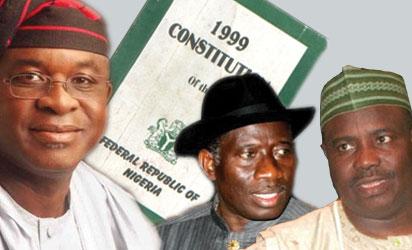
Senate President, David Mark; President Jonathan and House of Reps Speaker, Tambuwal
By Ochereome Nnanna
I have searched in vain for the ideological underpinnings of the constitution amendment which the National Assembly has embarked upon.
All we heard from our Senate when they held their recent retreat in Asaba, Delta State, was that they wanted to amend the Constitution to, among other things, “devolve powers”, create the long-agreed extra state for the South East Zone, “strengthen” democracy at the local government level and so on.
Exactly how far they are prepared to go and what grand national objectives we are pursuing are matters that have not been defined. This is very important to guide the nation and give the citizens the basis on which to debate the issues.
One would have expected, for instance, for the ruling Peoples Democratic Party, PDP, to have a vision of a restructured Nigeria based on which the President Goodluck Jonathan regime will articulate the ongoing Constitution amendments.
If the party had such a vision, it would not be necessary for President Jonathan to empanel the Justice Alfa Belgore Committee to harmonise past constitutional efforts since the National Political Reforms Conference, NPRC, of 2006, a much larger and representative body empanelled by his predecessor, Olusegun Obasanjo, had done a more comprehensive job.
As far as I am concerned, there are three basic imperatives for Constitution amendment staring this nation in the face. These are (a) the need to remove all distortions in the system which have made it difficult for the country to make progress since the military assumed control of our body politic in 1966; (b) to drastically cut down the cost of governance and free up resources for development and (c) to redress alienations, enhance equity and give all Nigerians a sense of belonging for collective nation-building.
In other words, this round of constitution amendment should be tailored for Nigeria to part ways with self-inflicted problems that wasted the first 50 years of our independence and set a new tone for 50 years to recover lost time, more so as Nigeria will be celebrating her centenary anniversary in 2014. We must not enter the second centenary still mired in our ignominious past.
Decentralisation of political and economic power (which some have expressed in terms of “true federalism” and “resource control”) is the way forward.
We have experimented with true federalism and resource control (1963 Republican Constitution) and the centralised system of federalism brought upon us by the military adventurers. We saw the speed of development in the First Republic and the keen competition among the defunct regions which made Nigeria one of the most promising emerging Third World countries.
We have also seen the total backwardness, wastefulness, corruption, indolence, consumption mentality, increasing poverty levels, free fall in living standards, an overflowing harvest of conflicts, violence, rising criminality, collapse of national values and heightening ineffectiveness of government at all levels since we centralised power and control. The difference is clear.
When a woman marries two husbands, as the elders say, she will know who treated her better than the other. Going back to the system that worked better will not be an experiment in uncertainty. It only requires courage and willpower to do it. So, how do we decentralise power? Certainly, it cannot be by merely adjusting the revenue sharing formula and giving more money to states and local governments.
It will not solve the problem of poor governance and corruption, and it will not address violent agitations in the Niger Delta. We won’t achieve it by merely creating an additional state in the South East or giving all the six geopolitical zones seven states each. It will give a sense of belonging to cheated Nigerians, but the runaway cost of governance will be intensified.
What we need, in my view, is to abrogate the states and local councils as currently constituted. We should transform the six geopolitical zones into the second tier of government. Each region should control its own resources and pay taxes to the Federal Government.
Revenue from oil resources beyond the continental shelf will go directly into the Federation Account as national commonwealth for redistribution to the regions on equitable basis.
Each region should have its own constitution which will, however, be subordinate to the Constitution of the Federal Republic of Nigeria. Each region will have the power to decide how to carve out administrative units, such as provinces and community or local governments (as the case may be) and administer them without the Federal Government meddling except where the unity and sovereignty of the Federal Republic of Nigeria are threatened.
The Federal Government must hands off education, health, roads and so on, or at least limit their roles to policy regulation and maintenance of national standards. In any case, the Federal Government has proved unable to handle these matters.
Let the regions be the theatres of effective governance, while the Federal Government maintains common services such as foreign affairs, defence, the Federal Capital Territory, the Customs and international trade, national unity and protection of the rights of all Nigerians.
The Federal Government will become a more effective father figure, while the regions and lower levels of government will operate the engine room of growth and development. If we do this, we will be putting power back in the hands of the people, and the people will retake full control of their destinies.
That is what they are doing in America where we copied our constitution from, and that is why America is great.
It worked before in Nigeria, and it will work again.
Disclaimer
Comments expressed here do not reflect the opinions of Vanguard newspapers or any employee thereof.