
AROUND this period seven years ago, Nigerians were in a joyful mood because former President Olusegun Obasanjo had successfully liquidated Nigeria’s estimated $30b external debt.
This feat represented a watershed in the nation’s march towards economic recovery and growth as Obasanjo warned that “to prevent re-occurence,we must remain vigilant at community, local, state and federal levels of authority. No amount is too small or too big to be protected from being looted or wasted”. But while the nation is still relishing this freedom from indebtedness, Nigeria is again back to the debtors’ club. CHARLES KUMOLU reports.
ALARMED Senators: The venue was the upper chamber of the National Assembly, NASS. And the day’s sitting was specifically among other things, for the inauguration of the Senate Committee on Local and Foreign Debts. From this committee that had barely spent 24 hours as a group came a bombshell. Raising the alarm was the Chairman of the Committee, Senator Ehigie Uzamere, who said Nigeria’s debt profile had risen to US$39.72 billion (about N6.02 trillion) with external debt put at US$5.398 billion while domestic debt was N5.21 trillion.
He said the debt profile was “more than the Federal Government’s yearly budget as its external component translates to 2.76 percent of Gross Domestic Product, GDP, and its domestic component translates to 17.53 percent of the GDP. “The amount is unsettling and calls for concern. Do we have the capacity to repay this money considering our yearly revenue profile?
Future value

What is the future value of the total debt in 10 years time? Needless to say that proper DSA reveals a country’s susceptibility to debt distress; the committee will align its energy with the executive to review the country’s debt policy and therefore, redefine its debt strategy,” he had submitted.
Uzamere urged the Federal Government to focus on borrowing for projects with self-repaying capacity and job generation rather than borrowing to finance gaps in budgets that are largely recurrent. He stressed the need for government to embrace Public Private Partnership, PPP, through adequate legal framework for Nigeria’s external debt.
This concern that was raised in November 2011, practically set the tone for the wave of mixed feelings trailing the country’s current debt status. For instance, barely three months after the Senate brought the issue to the fore, the House of Representatives on March 26, urged President Goodluck Jonathan to, within 60 days, submit to the NASS Nigeria’s debt ceiling in line with the provisions of the Fiscal Responsibility Act, 2007.
The lower chamber of the National Assembly said pegging the limit to which government could borrow had become necessary given the fact that Nigeria’s total debt portfolio had risen to an all-time high of N13 trillion. The resolve to demand the submission of a debt ceiling came through a motion sponsored by the Minority Leader of the House, Femi Gbajabiamila (ACN/Lagos), and endorsed by a cross section of the lawmakers.
In the lead debate, Gbajabiamila noted that since the Act came into effect about five years ago, the President had not complied with the provisions of Section 42, a situation which, he said, had led to arbitrary borrowing by both the federal and state governments.
“The overall intention of the Fiscal Responsibility Act 2007 is to enable us live within our means and only engage in prudent and responsible borrowing where necessary. The non-implementation of Section 42 of the Fiscal Responsibility Act 2007 is capable of encouraging imprudence and recklessness in government borrowings and improper utilisation of borrowed funds to the detriment of our economic growth.
It is a provision designed to instil fiscal discipline and restrain government from arbitrary borrowing and frivolous expenditure. If we do not put a stop to the culture of borrowing by placing a ceiling to what government can borrow, we stand the risk of accumulating debts for our children and future generations,” Gbajabiamila said.
Debt as at March 31, 2012
Relatedly, an indication that the country’s debt, appears to be on an all time rise, was confirmed by Vanguard Features, VF, checks on the official website of the Debt Management Office. The figures as gathered showed that the debt stood at $38.37bn (N5.97tn), while the external debt stood at $5.91bn ,N919.44bn, as at March 31, 2012. The external debt owed to financial institutions accounted for 83.28 per cent(see box for more details).
Accordingly, debt owed to the International Bank for Reconstruction and Development is $6.31m, while the International Development Association is owed $4.29bn. The African Development Bank is owed $43.55m, while the African Development Fund is owed $387.23m. The International Fund for Agricultural Development, also a member of the World Bank group, is owed $70.25m.
Also, non-Paris Club debt accounts for 8.26 percent of Nigeria’s external debt. The European Development Fund is $110.08m and the Islamic Development Fund, stands at $14.56m. Bilateral loans stand at $433.84m, while commercial loans stand $54.63m. The $500m, the country borrowed from the International Capital Market in 2011, accounts for the remaining 8.26 per cent of the external debt.
Details of the domestic debts, on the other hand, showed that FGN bonds accounted for N3.67tn or 61.44 per cent of the money borrowed by the Federal Government from internal sources. Treasury Bills also amounted to N1.95tn or 32.63 per cent, while bonds account for N353.73m or 5.93 per cent.(see box for more details).
Obasanjo’s intervention
Given that this is coming barely six years after Obasanjo secured a debt relief of $30 billion from the Paris Club, VF findings have shown that there are worries in both government and private sectors that the country is heading back to the debtors club.


Jonathan launches energy saving bulbs
Why Nigeria would always borrow: Those, who are scared about the situation are quick to lament that the country is about blowing the gains achieved by former president Obasanjo through the 2005/2006 debt buy back deal. “The debt profile would rise when we are importing and not a producing economy; all the things that we import, we can produce them here in Nigeria, but government does not consider making that possibility a priority.
The truth of the matter is that the environment of this country must be made conducive for the economy to grow so as to discourage reckless borrowing by the government,” Executive Director of Social and Economic Rights and Accountability Project ,SERAP, Mr. Adetokunbo Mummuni told this reporter.
Obasanjo, it would be recalled, inherited over $30 billion external debt from his predecessors. With the situation constituting a hiccup to his then proposed socio-economic policies, Obsanjo embarked on the process of liquidating the debts. Consequently, with the assistance of Ngozi Okonjo-Iweala in 2005, Nigeria paid the sum of $12 billion to buy back $18 billion Paris Club debt. This prepared the ground for the country to completely pay off its debt by April 2006 and made her the first African country to fully do so. This exit from debt trap was celebrated both nationally and internationally.
Following this feat, an elated President Obasanjo told the nation in a national broadcast on June 30, 2006 that, “there is nothing like freedom from debt and the image that the debt relief and exit from Paris Club debt give to Nigeria’’, stressing that ‘’ the debt relief has brought benefits to Nigerians and that it first represents a direct saving on debt-service repayment, interest, surcharges and other fees.
It also improves the country’s worthiness in the global community and builds credible financial confidence for transactions. More investment would start to flow into Nigeria knowing we are no more classified as a bad and doubtful debt country. The debt relief is expected to create jobs and new wealth with new investments, which would translate into improved standard of living.”
But the prevailing hue and cry over the latest fate of the nation’s debt status has revealed that the country’s economic future would be doomed if the debt profile continues to grow at this rate. Speaking on the matter, an Economist and a Member of Manufacturers Association of Nigeria, MAN, Chief Modestus Ogbonnaya said: “Those in the position of authority should realise that monumental debt profile is a signal to the financial international community that Nigeria is an investor’s nightmare.
Though most economies require public debt as one of the instruments of public expenditure, that does not mean that we should encourage increasing our debt profile without good reasons. It leads to a decline in the country’s external assets and the productive capacity of the national economy. It is evident that the mounting debt is a national yoke and a burden to generations of Nigerians yet unborn”.
Permission to borrow
He however added that: “I am not saying it is wrong to borrow. Yes, an economy can borrow for the purpose of economic growth. We are all aware of the way and manner the US congress handled the issue of borrowing recently in the United States and it eventually gave President Obama the permission to borrow within a specified limit; so borrowing to grow the economy is not wrong.” But the a former presidential candidate of Conference of Nigeria Political Parties, CNPP, Dr. Olopade Agoro argues differently as he sees everything wrong in borrowing.
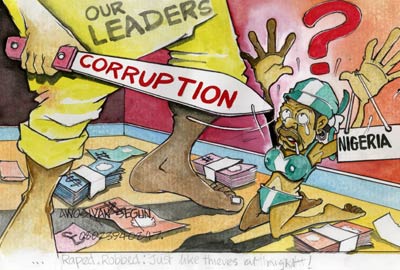
Nigeria now a bankrupt nation: For Agoro, if an economy is performing at its peak, there would not be any need to seek financial aid from multilateral financial institutions. “Nigeria is now a bankrupt nation, all these people in and outside government have been sabotaging the economy through bunkering and corruption.
Why would they not go borrowing. Nobody has been able to tell us what Nigeria is worth now. The money saved in excess crude by Obasanjo, which was $62 billion when he was leaving office has deflated to nothing. That is why they are playing on the intelligence of Nigerians that they want to create a Sovereign Wealth Fund with N1 billion.
How do you replace $62 billion with $1 billion? Nigeria’s foreign reserve as at the time Obasanjo was leaving office was over N400billion, but it was depleted to about N200 billion,’’ he noted.
In addition, Agoro said: ‘’It is sad that the country is now a debtor nation and it is borrowing money recklessly. Dr Ngozi Okonjo-Iweala is fooling the nation when the country is in the international financial market to borrow money. The money accuruable from crude oil sales has consistently been mismanaged by those in authorities”.
Still expressing sadness about the matter, Agoro added that ‘’going back to the foreign nations to borrow, amounts to mortgaging the future of our children. Nobody can even say how much we are owing local contractors. As at last month, it was hovering between one hundred and fifty billion naira. Unfortunately for the nation, we are suffering capital flight. Rather than investing in Nigeria, people are going outside the shores of Nigeria to invest.
Most investors in Nigeria are Indians and Chinese. No American or British is ready to seriously invest in Nigeria. We don’t know how much we are earning and saving. What is needed is for President Goodluck Jonathan to open up and speak to the nation about the rising debt profile; this should be taken as a matter of urgency because Obasanjo addressed the nation when he cleared the debt he inherited.
“The truth is that government has not been able to come forward with what is happening to the economy. Even the Central Bank Governor is deemed not to have been forthcoming in this regard. Why do they always borrow when we generate funds from sale of petroleum products”.
The concerns raised by Agoro, especially the question on why past and present governments at all levels, usually seek financial aid, was also amplified by Mumuni.
“The question to ask is: What are we borrowing for? They should tell us what they are using the money they are borrowing from international organsiations for. Why would they borrow and there is nothing on ground to justify the borrowing. It is not that a country cannot borrow but for whose interest are they doing after?’’ he queried.
Not done with his damning verdict on the state of Nigeria’s economy, the SERAC boss said, “we have abundant petroleum resources yet we are still exporting fuel, the country also has abundance of coal deposits, but electricity generation is a problem to us. This is a country that has professionals in every field, yet those who are in government do not provide the enabling environment for them to realise their dreams, and the situation has led to brain-drain.
There is no country in the world where you will not find Nigerian professionals. They are contributing meaningfully to the economic development of these countries. The reason why we will always find ourselves borrowing is because of those that rule this country.
They steal so much money from the state. They mismanage so much; some of them get these loans and convert them to personal and questionable uses.”
Least indebted countries: Regardless of this growing outrage, the Federal Government had come out to defend Nigeria’s debt status, noting that the country was also doing well in terms of its debt to Gross Domestic Product, GDP, ratio, now at 17 per cent. It said that Nigeria presently has $5.6 billion external debt, but warned that the country should not go beyond the 25-30 per cent sealing it had set for itself.
“Our domestic debt is about 15 per cent of the GDP. We need to watch it so that we do not overdo things and have a borrowing that is above what we can sustain. We need to bring down the over N5 trillion we have in domestic debt so that what we use in the budget to pay our debt do not escalate. Our foreign borrowing is about two per cent. The bulk of the external debt is concessionary,’’Minister of Finance, Dr. Okonjo-Iweala stated recently.
Also defending the Federal Government, was the National Publicity Secretary of Peoples Democratic Party, PDP, Chief Olisa Metuh, who said Nigeria is still one of the least indebted countries among comparative growing economies with a debt/GDP ratio of 17.45% as at 2011compared with countries such as Indonesia at 24.5%, South Africa at 35.6 per cent and Ghana at 38.7 per cent.
‘’It is common practice even in the most advanced economies in the world to borrow funds to supplement the income they generate for development projects. That Nigeria is found worthy of such credit facilities shows the improved credit rating of the country that was non-existent only a few years ago,’’ Metuh said in his defense, which has been generally described expected of a PDP member.
Meanwhile, attempts were made by VF to know at what point Nigeria started borrowing with reckless abandon. Accordingly, inquiries showed that the country’s debts date back to the early 1980s, and had ballooned to more than $35bn due to penalties and late fees during the 1990s.
A report by the DBO titled: NIGERIA’S DEBT RELIEF DEALWITH THE PARIS CLUB revealed that: ‘’Nigeria’s first loan from the Paris Club of Creditor Nations was a US$13.1 million loan taken from the Italian government in 1964 for the building of the Niger Dam. From thattime till the end of the decade, Nigeria’s borrowing from foreign lenders was generally insignificant.
‘’However the oil boom of 1971-1981 introduced the era of big borrowing in Nigeria. Loans were acquired by various tiers of government as Nigeria embarked on major development and reconstruction projects in the wake of the civil war. The borrowing continued well into the civilian era, as the Federal Government embarked on the guaranteeing of many unviable loans taken by private banks, state governments and parastatals’’.
Continuing, the report said: ‘’In 1982, when oil prices crashed, Nigeria was unable to pay off the loans it borrowed. Interest payments spiked, penalties rose, the crisis had begun. This pattern continued well into the military regimes of 1985-1993 and 1993-1998, when Nigeria stopped paying its debts to the Paris Club altogether, after the Paris Club refused to substantially reduce Nigeria’s debt.
Disclaimer
Comments expressed here do not reflect the opinions of Vanguard newspapers or any employee thereof.