
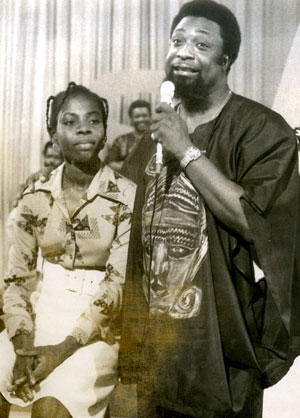
Ndidi Osaka with Arts Alade
For over three decades, ace broadcaster, Ndidi Osaka of the I Beg Una fame bestode the broadcast industry like a colossus. Her entry into the broadcasting world was by no means coincidental but rather an opportunity that helped to explore her inherent potential.
Despite her 35 years stint in the glorious profession, Ndidi still carries humility as a breastplate. This unassuming dispositon provided a leeway for her steady growth in the industry For most radio listeners, Ndidi Osaka is indeed a jewel to behold. A lady who prides herself as the only Nigerian Japanese.
As a woman of many parts, Ndidi brought her artistic skills in drama and dancing to bear on her programme, production and presentation.


Ndidi Osaka
This was demonstrated in her unique style in the presentation of I Beg Una which she anchored for almost two decades. This woman of many parts who passed through the tutelage of renowned broadcasters has also produced many famous radio programmes addressing the social nuisances in our society.
Her impeccable scorecard would be difficult to surpass in the near future. This explains the immediate reason behind the elaborate send forth party organised by the management of the FRCN to celebrate her thiirty-five years stint in broadcasting. In an emotional laden voice, this grandmother of four ruminates with nostalgia her travails in the media world to Charles Adingupu.
Journey into broadcasting
I didn’t get into broadcasting by accident. From childhood, I’ve been into drama, dancing and entertainment groups in primary and secondary school days. However, upon completion of my secondary education, I found my way to Lagos armed with my School Leaving Certificate result. At that time, it wasn’t easy gaining admission into the university. More so, the number of tertiary institutions in Nigeria were grossly inadequate. Well, on arrival in Lagos, I put up with my Aunty somewhere in Surulere. It was my quest for a job that brought me to Radio Nigeria.
I was initially employed as a Library Assistant until one year after. Though as a Library Assistant, I enjoyed recording. The then Controller of Programmes, Ishola Folasho who doubled as a Sports Commentator after listening to me in the progamme“Join the Band Wagon,” felt that I was wasting as Library Assistant. I was the only female presenter among them. He redeployed me to Production and my appointment was regularised in 1978. It is right to say I was discovered by Ishola Folasho and others. Now as a Producer, you must have a creative mind. This time, I’ve to employ those dramatic and entertainment skills acquired in my early school days. I have produced a lot of programmes.
Gains and pains
There was never a dull moment in broadcasting. I’ve this tendency of making people happy. This kept me going on the job.
There were so many producers I was looking up to then. At the end of every programme, I took time to listen to my superiors’ criticisms. There was what we called post-mortem in Federal Radio Corporation (FRCN) where programmes were properly appraised. You will be told where you got it wrong and right. All these were mainly to task your abilities. Besides, I challenged myself that I must get to the apex of this profession. I became inspired by people around me. The programme,“Join the Bandwagon, exposed Ndidi Osemenam which were my real names then. In less then six months, Ndidi became an household name. I played a special role alongside John Chukwu. I was Mama Caro in the programme.I was the only female presenter among them. That singular role brought me joy because our listeners then convinced me with their reactions that I was touching lives.
Also, as a junior producer, I produced other programmes. Though, I cannot easily recall all of them because I did some in Radio Nigeria One (RN 1) before I was transferred to Radio Nigeria Two (RN 2), Martins Street. However, some of the programmes were yours for the asking, ‘Never Say Die, a one hour light entertainment programme aired every Sunday which I produced for years. I produced Masculine Line for a very long time. Some of the presenters who worked with me then were Ihrai Enakhimim, Ohio Alegbe. Femo Sowolu, Ohio and Ehrai presented the programme for a very long time, while Sowolu presented it for only one year.
Jones Usen who is currently working with one of the private stations in Lagos was a staff then also presented the programme. Others I produced include “Just a Chart, Woman to Woman” at a stage.
Martins Street Special presented by Godwin Asuquo. That programme earned series of awards and recognition. Other presenters of Martins Street Special were Paul Obi, Mani Onumonu. Later, I started other programmes as Sunshine Choice and eventually in 1995/96 I started the production and presentation of I Beg Una, a pidgin English specialised programme. These were some of the progammes I can remember.
Why I beg Una
I’ve this urge of addressing the near collapse of morality, and the social decadence that pervades our society. Sometimes it’s irritating when you open the window, you see a man or woman obeying nature’s call. Sometimes by the road side, you see Lagosians passing urine indiscriminately. No sense of decency in our conduct. But beyond all these is man,s inhumanity to man. The people in government must be held accountable for their actions. When the people complained, the government also have an opportunity to respond. At that time, power failure was rampart. At that time, they were called National Electric Power Authority (NEPA). The Water Corporation was not working and they were distributing bills.
The market places were filthy and the general security of Nigerians were daily threatened. So, I felt there was need for a programme of that magnitude. I thought how to reach people at the grassroot as well as the government. So, I sought the medium language to use.
The radio was available to me, and pidgin English which virtually every Nigerian understands. I considered pidgin English as the best and shortest way to communicate to Nigerians. In broadcasting, there is what we call, planning consent. So, between 1994/95, I made a suggestion for us to introduce a phone-in-programme.

Ndidi Osaka with Arts Alade
Though the popular GSM was yet to be introduced in Nigeria then, the only option then was to use the phone. However, it’s important to note here that phone in programme was introduced in Nigeria by the late Ikenna Ndaguba who was the General Manager of Metro FM at that time. Our station was Radio Nigeria (RN 2) at Martins Street. It all started the very year the Under-17 Eaglets won the Coca-Cola World Cup. We spoke to them through the telephone while on air.
The I Beg Una was planned in such a way that it will not generate controversy. The practice was for people to call us and relay to us via the telephone their needs or problems, in their immediate environment.
Everybody was involved. Although whenever we received calls from people making complaints, we proceed to investigate them before we go on air. I recalled that after the programme was approved, in the maiden edition, we received not less than thirty phone calls in a thirty minutes programme.
By the second week, we increased the airtime to one hour. It was like we started a programme people have been waiting for. The response was overwhelming.People started coming to the station to lodge their complaints. My landlord did this and that. I’ve settled many cases through the programme. At a time, lawyers from the court had to come on air to defend themselves. In similar way, government officials, local government chairmen have been invited to raise defence over accusation against their administration.
I celebrated the programme when it was just one year old.
The programme was volatile, my colleagues and superiors were afraid. They asked if I can sustain it. Tension became pronounced over the programme during the late General Sani Abacha’s regime. People were phoning to criticise the government. People thought the programme would be scrapped. My defence then was that I never generated issues discussed on the programme people were calling to ventilate their ideas, even secondary students called to complain of withheld WASC result and so on. The programme kept the authorities on their toes.
Who takes over from you?
If I drop dead tomorrow, the programme must continue. But somewhere along the line, each time I want to proceed on my annual vacation, I could not because nobody to handle the programme. However, two years after we relocated to Ikoyi, it was decided that somebody should join me in the programme. That was how Fred Onyeka Nwauluene came on board. Well, for sometime, I will still participate in the programme. I think my withdrawal will be gradual.
Which other programmes brought you fame?
Join the Band Wagon, Never Say Die, Sunshine Choice, Martins Street Special is another programme I produced for a long time. Our focus then was to highlight the happenings around Balogun Market and environs in a magazine form. Also, I produced Woman to Woman, which later gave way for Eve.
Joyous Moments
I can’t quantify my glorious moments. Those of us at Martins Street, Radio Nigeria two (RN 2) now Metro, we called it the Sun Shine Station were like one united big family. Honestly, the stubborn ones were sent to Martins Street. But when we got there, we turned everything around. There was never a dull moment. You will miss Radio Two if you were not there in Martins Street. We do virtually everything together.
There was a place we converged to eat, a popular buka known as Mama Yinka. From management level, there was no disparity between senior and junior officers but the respect was there. Particularly those of us in programme department. We did not compromise standards or discipline but were friendly all the same.. You cannot celebrate your birthday alone. It was indeed one big family. The likes of Jacob Johnson Akinyemi of Rhythm FM, Late Ladi Lawal, Frank Oshodi, Godwin Asuquo, Phil Ushie, Alaoma Nwaogbe, Benson Idonije, late Tony Ibegbuna, we called Uncle Tee, Tony I, Ten Ton Tony. Patrick Oke was a presenter of the programme Pop Round the World and Femi Jarret who produced time buy collection.
My immediate boss then was Princess Banke Ademola. She was a real programmer. You can see that Martins Street was a place producers and presenters looked forward to be. We contribute money to eat together. We also have a coffee club. Memories of Martins Street are indeed worthy to beholds. It’s obvious that most of the directors in private broadcast stations in Nigeria are all product of Metro FM at Martins Street.
Assessment of the Broadcasting Industry
The world is now a global village following the introduction of computers and other electronic gadgets as IPAD, IPOD and others. We cannot rule out things changing. We’ve to move forward. In our days, we were very thorough and at the same time confronted a lot of challenges. We also had a lot of content at that time. You dare not go on air with just any rubbish. My grouse with the new media is their content. Everything in today’s broadcasting is all about music. Again, are we doing the right thing? What kind of music are we playing? There are a lot of obscene music being played on air and nobody seems to be interested in putting these abnormalities to check. It’s like some of the stations don’t monitor their presenters.
How can you go on air unprepared? When you listen to some stations it’s only when the presenters get on air that he starts thinking of what to say. But one thing about FRCN, presenters must be prepared before they go on air and the supervisors are there to guide them. Any attempt to say things contrary to the script attracts penalty. Although, digression is alright because it allows for creativity and enables presenters to talk on current issues..
However, content is an important key. Whatever goes on air is packaged. Regrettably, what we listen on air these days particularly with the new broadcasting stations is outrageous. How can a presenter tell his listeners “I will shoot you?” It’s what we called NTBB, meaning, not to be broadcast. Sometimes when I hear presenters using abusive language, I feel sad. In FRCN, you can’t go free. Such language should not be heard on air.
Also, listeners believe that whatever a presenter says is final and correct. Unfortunately, some children listen to the presenter in order to form their opinions over issues. So why must you feed them with thrash? Therefore, managers of broadcast stations must endeavour to vet the content of their products and the presenters. The earlier we start doing that, the better for us. Some people are bastardising the industry and it is not the best.
Disclaimer
Comments expressed here do not reflect the opinions of Vanguard newspapers or any employee thereof.