
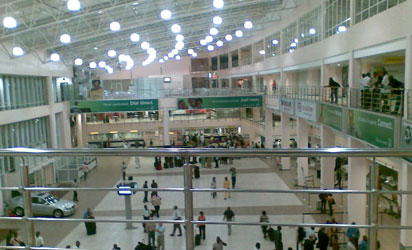
Murtala Muhammad Airport 2: Just celebrated five years of concession.
FOLLOWING the agelong infrastructural decay in Nigeria, occasioned by leadership failure, efforts were made towards revamping the various national infrastructure across the country.
This became a reality with the signing of Infrastructure Concession Regulatory Act of 1995. But, since the nation embraced this Private Public Sector Partnership, most concession agreements have been marred by controversies at the expense of efficient service delivery. CHARLES KUMOLU writes

Murtala Muhammad Airport 2: Just celebrated five years of concession.
WHEN President Olusegun Obasanjo, signed the Infrastructure Concession Regulatory Act in November 2005, expectations were high that the intractable problem of infrastructural decay, would be a thing of the past.
Accordingly, the Act among other things, provided for the participation of private sector in financing the construction, development, operation or maintenance of infrastructure or development projects of the Federal Government through concession or contractual arrangements.
“Any contractor to whom concession has been granted under this act shall make payment to the federal government of such sums at such intervals, from the proceeds realised from the implementation of the concession as may be provided in the concession-contract or agreement,’‘ part 1 section 4 of the Act observed.
Relatedly, Vangaurd Features,VF, findings showed that the ICRC Act covers virtually every sector which includes; power plants, highways, seaports, airports, canals, dams, water supply, telecoms, railways, land reclamation, inter sate transport systems, industrial estates or township development, housing.
Others are tourism development, waste management, ICT and database infrastructure, education, health, drainage, dredging, trade fair complexes, etc.
Also, it was gathered that concession could be achieved through Build, Operate and Transfer (BOT)Build, Operate and Own (BOO) Build, Transfer and Operate (BTO),Build, Own, Operate and Transfer (BOOT), Design, Build, Finance, Transfer (DBFT) and Design, Build, Finance, Manage (DBFM).
What this implies is that from the period the policy became law, Public Private Partnership (PPP) became the order of the day in the management of physical infrastructure in the country.
While the development was expected to have transformed the sectors, that had been concessioned since 2005, VF can authoritatively reveal that reverse has been the case.
Specifically, there is hardly any infrastructure that had been concessioned since 2005, that had not gone through different forms of controversy.
Growing controversies
Consider this: Lately, reports about controversies surrounding the concessioning of infrastructure such like the Lagos/Ibadan express Way,Federal Airports Authority of Nigeria (FAAN) and its concessionaire, MAEVIS Limited, Lekki/Epe Express Way, The Nigeria Maritime Administration and Safety Agency, NIMASA, have continued to dominate public discourse, following fears that the drive for service efficiency would be at the receiving end because of crisis.
Though, investigations, indicated that some level of success had been recorded on some sectors that had been transferred to the private sector, the current crisis being experienced with the concessioning of the Lagos/Ibadan Express Way, has remained a source of concern to those, who had thought that concessioning would end the woes of travellers on this road.
The road which was constructed in 1978, it would be recalled was concessioned to Bi-Courtney Highway Services Limited in 2009.
Specifically, the firm was given the mandate to manage the road under a design, build, operate and transfer arrangement with the federal government for 25 years. Though it was reported that the contract was not signed until last May 2011.
Given that the agreement is yet to start have positive effect on the road, checks showed that the question on the lips of many Nigerians is; What manner of concession is going on in Nigeria?
For instance, two human rights activists, Messrs Olawale Fapounda and Richard Akinnola, recently asked a Federal High Court sitting in Lagos to revoke the concession agreement between the Federal Government and Bicourtney over allegation of non performance and “incessant destruction of lives and property along the Lagos-Ibadan expressway.”
Order of mandatory injunction
The plaintiffs, who listed Legal Resources Consortium as the third plaintiff, are asking for an order of mandatory injunction compelling the Federal Government to immediately repair and maintain the Lagos-Ibadan expressway “sequel to their obligations, legal and statutory duties so as to stem or curb the incessant traffic gridlock and destruction of lives and property on the expressway.”
Joined as defendants in the suit are the Federal Government of Nigeria, the Minister of Works, his counterpart in the Ministry of Justice, Federal Road Maintenance Agency, FERMA, and Bicourtney Highway Services Limited.
The plaintiffs are praying the court to declare that “the failure and or refusal of the 5th Defendant (Bicourtney Ltd) in executing the contract four years after its award amounts to abandonment and ought to be struck down and revoked.”
Incessant accidents and loss of lives
Also they urged the court to declare that “the incessant accidents and destruction of lives and property are a direct consequence of the negligence and willful refusal of the 5th Defendant in executing the concession agreement four years after its award.”
In addition, they are praying the court to declare that the government has “abandoned, shirked, abdicated their legal and statutory obligations to repair and maintain the Lagos- Ibadan expressway, thereby occasioning traffic gridlock and destruction of lives and property.”
In their suit, the plaintiffs want the court to determine whether the Bicourtney Limited as a concessionaire to whom the Federal Government had given approval in September 2009 for the rehabilitation of the Lagos-Ibadan expressway has failed in executing the contract four years after the contract was awarded to it.
Also, they want the court to determine whether the Federal Government, having approved the concession of the rehabilitation of the Lagos-Ibadan expressway to the company through the Executive Council of the Federation can revoke the contract awarded to the 5th defendant (Bicourtney) for non performance.
It averred that the concession agreement, having not followed due process nor complied with the guidelines of the concession agreement, should be struck down and revoked by the court sequel to its inherent powers.
Besides, the recent face-off between the Federal Airports Authority of Nigeria (FAAN) and its concessionaire, MAEVIS Limited, was another matter that brought the manner of concession in Nigeria on the front burner again.
Barely five years into the 10-year pact with the firm, FAAN, terminated the contract, adding that it was done to improve its services and revenue profile.
FAAN’s General Manager, Public Affairs, Mr. Akin Olukunle, said in a statement that in terminating the agreement, the agency did not only heed the directive of the Aviation Ministry to do so but also the advice of the Senate which, after a public hearing in 2010 asked that the agreement be dispensed with.
While this move was applauded by aviation experts, investigations revealed the action ultimately scared investors away from the country.
It was further gathered that
the continuous controversies trailing most concessioning exercise in the country, might derail the gains envisaged in the ICRC act.
Speaking on the matter, President General of Association of Authorised Customs Agents,AACA, Chief Mike Akunaecheobi, observed that PPP is what is obtainable for service delivery all over the world at the moment, but warned that the basic principles of concessioning are being neglected in Nigeria.
“When you concession there are expectations that it would boost economic development, and it has been experienced worldwide, government no longer gets involve in the day to day running of social infrastructure like airports and seaports. If you want your economy to grow, open it up and allow people to participate it would create competition and efficiency. It is for this reasons that we concerned professionals visited President Obasanjo in 2006 to commend him for taking the bold move to open up the ports,’‘he stated.
Still making a case for concessioning, Akunecheobi observed that, “The time has come for us to put in place a sector specific policy that would guarantee the success of Public Private Partnership. It should be done with a sense of seriousness and focus. It is very sad to read every time that there is crisis about one concession or the order. The policy is good, the truth is that the Federal government should stop playing politics with everything, the Lagos/Ibadan is being frustrated by politics. I am not making a case for Bicourtney, but we all know how unserious Nigerians are.”
While the ACCA Head’s position, seems to have answered the question of why concessioning, but a former Chairman of Nigeria Society of Enterprenures ,NSE, Mr. Debum Nwalibe, argued that if the Federal government has been responsive to its duties, there may not be need to involve private hands in the management of all national infrastructure.
Speaking specifically on what he described as “deliberate neglect of national infrastructures,”Nwalibe said, “Obasanjo did well for this country by bringing about a process that would address the past neglect of social infrastructure. It is good to inject competent hands into the management of these assets. but what I am saying here is that had the institutions of government been functioning appropriately, would there have been any need to invite private hands?”
In addition, he said, “former president Obasanjo have said at different fora that he left about 30 planes at the Nigerian Airways, when he handed over to Shagari in 1979. But during his second time as President, he met no functional aircraft in 1999, what does that say about neglect. If they had been properly maintained and handled, Obasanjo would not have considered the privatisation of Nigeria Airways as an urgent matter. So what we are saying is that controversies trailing PPI should not have come up, because there are instances where some facilities had been successfully concessioned.”
Infrastructure
Regardless of this, it was discovered that there are also those, who do not accept concession as a roadmap to addressing infrastructure problems.
President General of Congress of Commerce and Industries, Mr. Pete Agbonivore belongs to this group.
To him, “all the noise is
loud and deafening because of failure by those who were delegated with authorities. Social infrastructure survived before the dawn of privatisation, so why can’t it survive now. Why must government take its hands off the management of utilities. Concession or whatever it is called breeds monopoly.”
Beyond these conflicting voices, findings indicated that instances where concession was deviod of hitches in Nigeria.
This was contained in a 2011 newspaper(not Vanguard) report, which observed that “ there a few examples of successful PPP projects include the 12.15 megawatts IPP at the Akute/Adiyan Waterworks with Oando Plc, conceived to ensure constant, reliable, affordable power for Lagos. The project has enabled the water corporation to save about 40 percent cost which could have been expended on diesel to run power generating plants, and also boosted the volume of water supply to Lagosians.”
It further said, “The 9.7 megawatts Island IPP jointly executed with Island Power Limited (a part of Negris Group) is another example. This Build, Own and Operate (BOO) project is designed to provide uninterrupted power supply for the judicial and health facilities, as well as 20 streets on the Lagos Island Central Business District. There is also the BRT mass transit scheme which is generally acknowledged by Lagosians as a long way in easing the transportation difficulty of the residents in the ‘traffic infested’ commercial city.”
Disclaimer
Comments expressed here do not reflect the opinions of Vanguard newspapers or any employee thereof.