
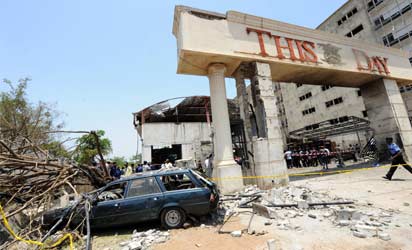
The bombed This Day office, Abuja
By Uduma Kalu
…As Sahara Reporters bags media award
ON World Press Freedom Day in Nigeria, there was no press statement from the various media groups in the country. There were no rallies, conferences or visitations by the journalists or media groups. When the press releases came, they were late.
On global press freedom index, Nigeria last January moved from the 146th position it was in 2010 to 126th. In 2008, it was 131st and 135th the previous year.
Under the theme, New Voices: Media Freedom Helping to Transform Societies”, the event was also marked at the African Union, AU, Headquarters organised by the United Nations Educational, Scientific and Cultural Organisation (UNESCO) in collaboration with the African Union Commission, some Associations of Journalists based in Ethiopia and the Ministry of Information of the Federal Democratic Republic of Ethiopia amongst other partner organisations.
In Nigeria, mum was almost the word. Yet, never in the history of Nigeria has the media come under such terror attack as it is today. Earlier, it used to be assassins tracking and killing journalists, or letter bombs sent to a reporter in his house as the case of Dele Giwa in 1986; or media houses shut down, copies of their newspapers and magazines seized by the police or the secret operatives. Some were hounded into jail or hell, or simply beaten up . That was then.
In Nigeria, Media Rights Agenda (MRA) uploaded its message only on May 3. The You Tube videos were about significance of the World Press Freedom Day, Freedom of Information; Media Freedom in Nigeria; Safety of Journalists; and the need for citizens to see attacks on journalists and media houses as attack on their rights to be informed and to rise and fight for media Freedom.
Today, attack on the media has become more murderous. Reporters are attacked and killed with impunity. Magistrates beat up and jail journalists at will, and terrorists bomb and threaten media houses at will. On World Press Freedom Day, in Nigeria, the various press groups expected to champion the rights of journalists simply forgot it. The Minister of Information did not say a word about it. Yet, it is an axiom that a free country needs a free press.

The bombed This Day office, Abuja
Yet, in the United States yesterday, the Omidyar Network of Redwood City, California, honoured Nigerians among other African media houses with award of nearly $5 million in funding to four media-related groups involved in investigative and citizen journalism in the developing world. The four groups are: African Media Initiative (Kenya); the Sahara Reporters project (Nigeria); Media Development Loan Fund (U.S.), and the Committee to Protect Journalists (Africa programs).
May 3 was proclaimed World Press Freedom Day by the UN General Assembly in 1993 following a Recommendation adopted at the 26th session of UNESCO’s General Conference in 1991. It serves as an occasion to inform citizens of violations of press freedom – a reminder that in dozens of countries around the world, publications are censored, fined, suspended and closed down, while journalists, editors and publishers are harassed, attacked, detained and even murdered.
It is a date to encourage and develop initiatives in favour of press freedom, and to assess the state of press freedom worldwide. It serves as a reminder to governments of the need to respect their commitment to press freedom and is also a day of reflection among media professionals about issues of press freedom and professional ethics. Just as importantly, World Press Freedom Day is a day of support for media which are targets for the restraint, or abolition, of press freedom.
It is also a day of remembrance for those journalists who lost their lives in the exercise of their profession. Even though Nigeria, after almost a decade, now has the Freedom of Information Act, last month, April 4, judiciary correspondents attached to the Ikeja division of the state High Court were arrested and beaten up mercilessly on the orders of a magistrate for allegedly flouting her directive not to report proceedings in her court.
Though the above story was reported, the varuious press houses and groups did nothing, apart from muted press releases. Perhaps, seeing that the powers of the press is being demystified by the various inactions by the media and its groups on affairs that concern it, a new dimension into press repression has been born.
On Thursday 26, April 2012, This Day workers were shocked when a suicide bomber, at approximately 11:07 am drove a bomb laden vehicle into the head offices of their Abuja office in Jabi, Abuja. The suicide bomber drove through the front gate of the building and crashed his vehicle, killing a number of people, and destroying most of the building, inlcuding the press hall.
The Islamic sect last Monday released the video of the attacks and vowed to attack more media houses further. The group said that it attacked This Day newspaper’s offices in Abuja and Kaduna to send a strong message to the media that it would no longer condone reports misrepresenting it in the press, or blaming it for acts it knows nothing about.
This week, the sect named more media houses and staff as targets of their attack. In an 18minutes video, the group threatened to attack more media houses, naming Voice of America (Hausa), Radio France (Hausa), Daily Trust, among others. The group also gave reasons why they bombed Thisday office in Abuja and other media houses last Thursday.
The terrorists can give any reason for killing people as its killings spree shows. In January, they killed the young, brave Channels Television vibrant reporter, Enenche Akogwu whom they shot dead in Kano when he approached bystanders for an eyewitness account at the scene of a bomb blast that was masterminded by the group.
His death came immediately after the murder of Nansok Sallah, 46, a news editor of government-owned radio station, Highland FM in Jos. In October 2011, the sect also killed 41-year old Zakariya Isa, who was reporter and cameraman of Nigeria Television Authority, (NTA) in Maiduguri.
He was shot at close range in front of his house at Bulunkutu area of the city. Two journalists, Nathan Dabak 36, and Bwede, 39, both working for The Light Bearer were attacked and killed in recent times by Islamic mob in Jos while they were on their professional duty. Many other journalists have been threatened, assaulted and brutalised even as they have no insurance policies.
However, Article 19 of the 1948 Universal Declaration on Human Rights states that everyone “has the right to freedom of opinion and expression; this right includes freedom to hold opinions without interference and to seek, receive and impart information and ideas through any media and regardless of frontiers”. Bombing, killigs, reprssion of any form is not part of that.
Disclaimer
Comments expressed here do not reflect the opinions of Vanguard newspapers or any employee thereof.